Never in a lifetime had I imagined that I would live to see proof of how simple everyday life impacts the environment around us. The COVID-19 lockdown woke me up as to the magnitude of this influence. I first read about the carbon footprint of wine in Jancis Robinson's 2006 article, Down with Bodybuilder Bottles. Up to then, I had never made the connection. Unfortunately, yes, viticulture does contribute to climate change and vice versa; climate change is affecting viticulture. Growing grapes, producing, storing, packaging, transporting and serving wine are stages in a chain that generate waste and release greenhouse gases.
In this article I will be referring to some of the things that can be done to minimise the damage as these are practised by four of the wineries in Greece that are working towards reducing their carbon footprint. They are not doing everything right, but they do care about the environment and passing on life to their children.
Domaine Karanikas
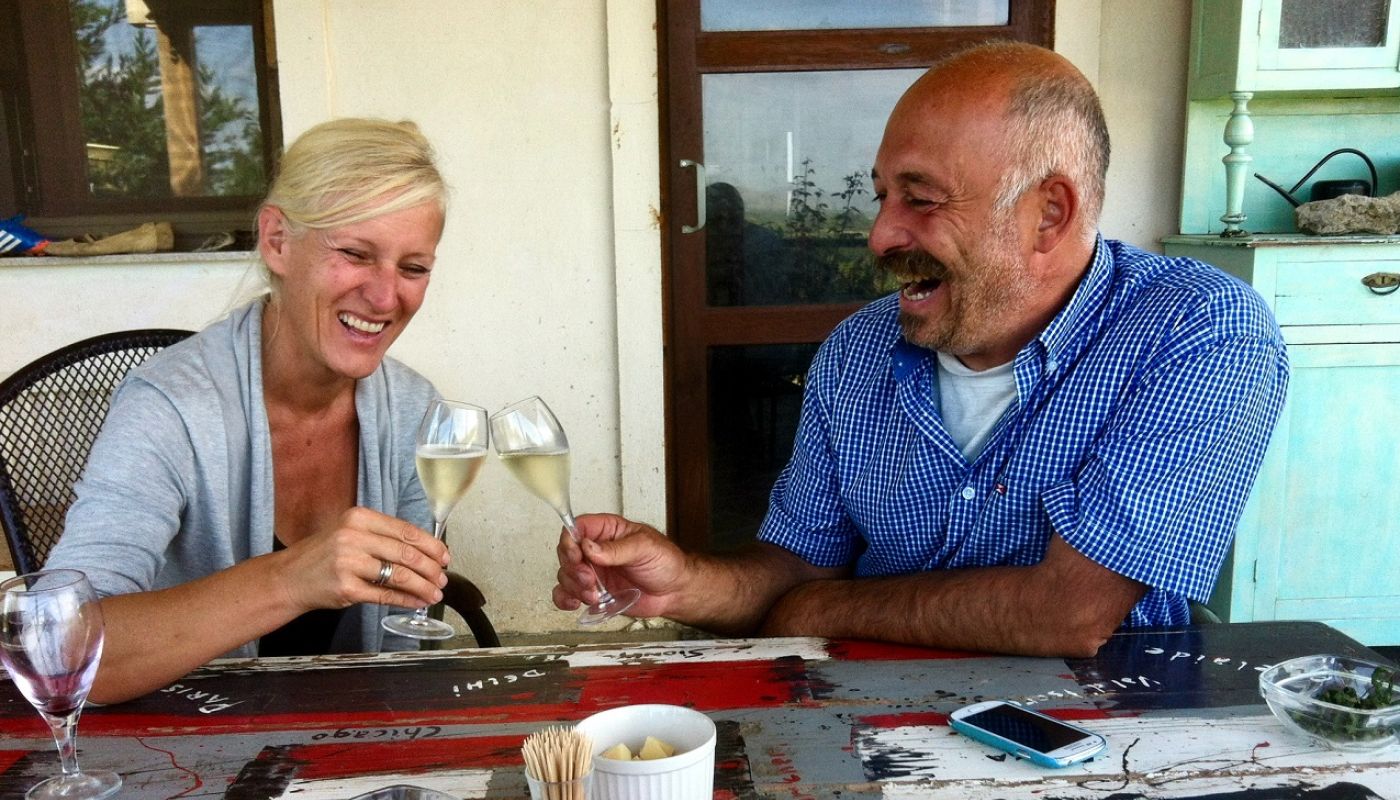
I first visited Domaine Karanikas in Amyndeo about five years ago with a group of seven really tall fellows and I playfully dubbed myself Snow White and The Seven Giants. The winery is situated at 650 m altitude, surrounded by four lakes which temper the continental climate. Laurens Hartman-Karanika and his wife Annette van Kampen (pictured above), welcomed us and escorted us into their living-room cum office, strewn with toys, with the desk doubling as tasting area. Like being in a friend's home.
At that time Laurens wasn't as disheartened as he is nowadays with Greek bureaucracy. He often says, ‘I spend more time sorting out paperwork and running from one office to another, than I spend tending my vines and wines’. In fact, he is a bit of a multi-purpose tool, as he is oenologist, manager, sales person, office boy and handyman all in one.
The winery, attached to the house, is built in three stories, 70% of which is underground, so that everything works with natural flow. These people managed to decrease their energy consumption by 75%, from 150 kw/hl of wine in 2014 to 40 kw/hl of wine in 2019, whereas their production is now 90% sparkling wine. They use solar energy, recycle their water to be used for watering, if and when necessary, ‘we use half the water needed by a family of four’.
Biodynamic practices, in viticulture and winemaking, they use copper and sulfites as little as possible, and prefer to use kaolin and dried horsetail to decrease pressure from fungal diseases. They have also started to experiment with essential oils (oregano and orange). They use two small tractors 2–3 times a year to spray, plant cover crops which they just cut and leave on the ground so as not to disrupt soil life, and whatever is pruned together with grapes, skins and lees is made into compost to use as fertiliser. They are now in the process of acquiring two work horses for the vineyard.
In the winery the vats don't need to be cooled (cool climate region), no fining and filtering and only bicarbonate of soda and citric acid is used for cleaning. The green glass bottles are 600 gr, but this is necessary for them to be able to withstand 6 atm of pressure. Their cartons are made of recycled uncoated cardboard. The bottles, cork, wire cages and labels are shipped from Italy and they export 60% of their wine. They recycle all recyclable materials and try to support their community by using workers from around the area and help with education and travel to other wineries. ‘The Dutch had to force away the sea, so they learned to work together and depend on each other. We think of our people as colleagues and not as employees. We always support regional festivals with our wine and sponsor events.’
Certified organic since 2009 for their viticultural practices and in 2017 for their wine. They are hoping to receive Biodynamic certification by Biodyvin in France and are currently involved in a research project with the University of Kozani to create energy capsules from the CO2 released during the first fermentation.
Domaine Economou

Yiannis Economou is not the easiest person to find and not one who enjoys PR and the layman. Astute and humorous if you hit it off well with him, he enjoys a good talk and sharing his knowledge. Studies in viticulture were followed by those of winemaking; worked in Italy, Bordeaux, Freiburg. He is dedicated to making wine. ‘This, here, is a way of life. I'm out in the vineyard every day. I take pleasure in that. And, I have my perks (chuckling). I get to do my gym workout and sun-tanning for free.’ I tell him that I am writing about environmentally minded producers and he answers, ‘look, I just do what we should all be doing’.
He owns 18 ha of land (10 ha in actual use at a time) at 600–700m altitude in Sitia, Crete, and from these he produces around 20,00 bottles. ‘My vines have much uncultivated land around them, they're all dry farmed bush vines (otherwise the wind and the sun would destroy the grapes) and I'm trying to hold on to the self-rooted bush vines’. He explains that although phylloxera does exist in the area, due to the fact that the climate is very dry and the roots are really deep, the aphid doesn't seem to survive well. ‘It never rains in the summer, so my only worry is oidium for which I will use sulfur once or twice in a season. I turn in the wild growth with one of those small tillers. I make my own compost by blending residue from the winemaking process (stalks, skins, lees, tartrate crystals), pomace wood and slaked lime and this I use to fertilise. I don't do anything about hares and birds because I figure they need to eat something too’. This is what I call equal opportunities!
His winery is the old stone family home that dates back to 1600, with walls that are about 50–60 cm thick and a tile roof. ‘I don't use much electricity, because up here you need a blanket at night even in the summer. I harvest in September, so my grapes are cool, I use small vats, so mostly I just open the windows to let in the cool breezes’. He tells me that he uses less than 1/2 litre of water for every litre of wine he makes. He washes only with water (no detergents) and this water he reuses for his garden. He collects rainwater and has a well. The wine is made with indigenous yeasts, no fining, no filtering. Winemaking, to him, is about philosophy, authenticity, observation, time and respect of what has gone before. He releases his wines when he decides they are ready to be drunk.
I tell him that from what I remember his bottles are quite light and he responds, ‘hey, I sell wine. I don't sell bottles. They weigh 450 gr because most of my wine is exported and I would feel a little unsafe shipping bottles that are lighter than that’. He uses green glass, natural cork as his closure and his labels are paper with glue. He uses twelve bottle cardboard boxes (to save on boxes).
His winery is not open to guests; so no pamphlets, glasses, and tasting area.
Organically certified for viticulture since 1997 by TUV Austria and HACCP.
Tetramythos Winery

Situated in Ano Diakopto, on the Helmos mountain of the Peloponnese, near one of the most beautiful gorges in Greece that still has a funicular railway running its length. They own 14ha of land and source grapes from another 20ha contracted producers. I talk to Panagiotis Papagiannopoulos the oenologist/part owner. I called him twice to ask my questions, the first time he was toiling away in the winery, the second time he was baby-sitting his three kids(!). Usually we meet at wine fairs and I am taken by his style. A cross between back country and rock chic.
‘We are in a place that has a unique climate, as all the vines are on slopes at 650–1,050 m altitude with a northern aspect, which means we don't have humidity to worry about and which helps organic farming. We have old dry-farmed bush vines and we have our trellised 14yr old vines that may need a tiny amount of water in the summer, which we get from a spring with natural flow’.
All the work in the old vineyards is done manually, they cut and turn in natural growth, use only some sulfur for oidium, and fertilise with goat manure and organic compost with earthworms.
All of their wines are ambient yeast fermentations with spontaneous malolactic conversion, unfiltered and unfined. They clean the winery with water or steam only, and this water is collected to be used for fire protection (there was a very big fire in the area in 2007 that destroyed much farming and forest land). The lees are given to a nearby vinegar producer. The grapes are harvested and received in the early morning and only 7% will be cooled for the maceration process; their vats only need cooling from July to beginning October.
Their bottles are 425 gr, they use DIAM cork, and everything used for bottling is bought within Greece (the labels come by bus). 85% of their produce is exported, but they make sure to use trucks that have a full load. They try to support their area, so anything wooden is bought from the saw mill of the neighbourhood, are trying to convince other farmers to convert to organic farming, and provide construction materials from their soil, straw and glass. Cork is given to schools.
Certified organic since 1996.
Sant'Or Winery

Situated in Santameri at 600 m, about 30 km from Patras; a little 3 ha gem that makes about 20,000 bottles, 90% of which are exported. Panagiotis Dimitropoulos makes you fall in love with his love for his vineyard and his wines. His eyes shine like those of a lover when he talks about the vines. As we walk through the vineyard he is constantly bending over the plants, straightening something here, cutting a leaf there, almost caressing them. ‘I talk to them every day and I say thank you my lovely little vines, I will do the best I can for you. I want to help improve the immunity of the plants and the vines will return my care by giving me whatever they want’.
He allows natural vegetation, which he just cuts and leaves on the ground, he uses a tiny bit of sulfur, but mainly horsetail and nettle, together with all the biodynamic ‘potions’. He has classical music playing everywhere, in the field for the vines and in the winery for the wines. He favours biodiversity and also has olive trees, plum trees, cherry trees, lotus trees, together with a vegetable garden.
His winery is not a fancy building and is made with local materials. He takes advantage of geothermal energy, makes sure to do most of his work in the cooler hours or days (apart from consulting the biodynamic calendar), and is in the process of installing solar panels. All of his wines are made with ambient yeast and are not fined and filtered. The water he washes with, he stores and later uses for watering plants. The skins and lees are used to make biodynamic compost, he recycles all recyclable materials. His bottles are 500 gr and all bottling accessories are bought within Greece. ‘I hire people from around here to help in the vineyard and they always say I work harder than they. As my father used to say, you always pay your people first, even if there is nothing left for you’.
He finally managed to get biodynamic certification (Demeter) last year, although he has practised this for a number of years, because he was the first to do so. Before that the vineyard was certified organic since 1998. His wines are also vegan certified.
















