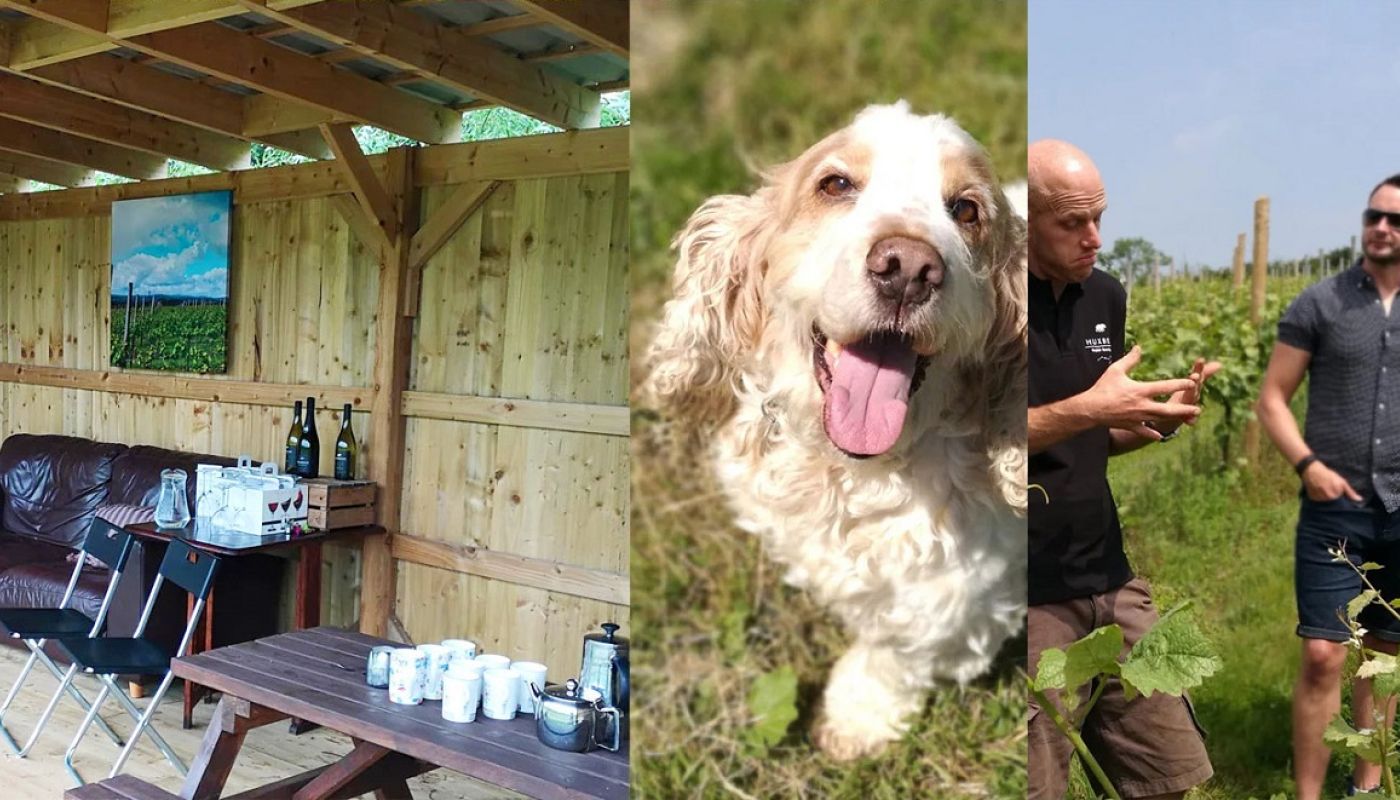
Gathered with a group of friends, we sheltered from the quintessential British rain that appears like clockwork every time one plans something outdoors in August. The open fronted cabin providing our retreat was new and smelt deliciously of cut pine, which blended harmoniously with the unmistakable smell of petrichor (from the wet earth) and wet dog (from a three-legged spaniel). Lucy, our host, thrust a much appreciated cup of tea at each of us and explained how lovely the view was on a less revolting day, although this vineyard seemed pulchritudinous regardless of the weather – what I could see of it, at any rate.
Thus was my introduction to Huxbear Vineyard.
Nestled in the bucolic heart of Devon, Huxbear is a small(ish), completely off-grid, winery and vineyard making still white, pink and sparkling wines. Having been around a little over a decade it is now beginning to blossom (literally and figuratively) and I was struck with just how much care and love goes into every aspect of it – sustainability is key (obviously) and penetrates virtually every process. From the moment we arrived it felt a bit like home.
Rather like Toby (their dog), there are three main footprints to sustainability: environmental, social and economic. The Huxbear pair are extremely hot on the environmental aspect, as you shall see below, and their main social drive is the idea of a community, supporting local sports clubs and, admirably, offering discounts to NHS and key workers. Their picking staff are largely comprised of locals and there is a big party at the end of harvest where all workers and neighbours are invited. Whilst from the PR sponsored mouths of a larger company it may sound like nothing more than lip service to say ‘it is important that people feel good about the business and ultimately themselves’, from an enterprise of this size and set up it seems truly authentic.
Ben (Lucy’s husband, viticulturist and winemaker) studied at Plumpton and wrote his dissertation on site selection, explaining that they had searched extensively to find somewhere that would both provide high quality fruit and allow them to operate in the manner they wanted. As mentioned, the entire operation is off-grid with energy coming from solar power and a large lithium battery (along with wind and some hydro power they have created). Having a limited supply forces their hand to be parsimonious with energy in the winery: managing temperatures with juice additions, pump overs etc. When spraying, all the water comes from their roof or bore hole. Fastidiously never using insecticides, they much prefer introducing natural predators, either physically (to control spider mites) or by dedicating plenty of space to wild flowers to improve biodiversity.
Ben likes to show the cover crops who is boss, partly by pointing at a photo of Bruce Springsteen, but mainly by applying a once a year splash of (oft maligned but totally safe) glyphosate, and then doing nothing more than strimming. Everything else is managed in a minimal intervention way (low sulphur additions, vegan and various other attributes that people in Shoreditch care about). Living on site and having the winery right next to the vineyards does help make carbon emissions virtually zero on a day-to-day basis and Ben strongly believes they are a net carbon negative company, although has yet to have this truly ‘tested’.
It is at this point that the purists will no doubt be asking why I have not mentioned anything about organic credentials, or whether or not they follow in the footsteps of the Austrian theosopher, racist and all-round madman, Steiner. No, is the short answer. Whilst they are experimenting with organic practices in part of vineyard, Ben is ‘unprepared to toss enough copper on the vines to be eligible for organic certification’. Dog owners are very welcome at Huxbear. Dogma, not so much.
This author was far too well brought up (see Jancis writing competition 2018) to ever ask about how financially sustainable they are, but the proposition is strong. The branding is excellent (the label has a picture of the plough as the constellation sits over the winery), the bottles and labels look smart and it is all incredibly well priced. They have cemented themselves in the local community and economy and, from the outside at least, everything seems as stable as a tripedal pooch.
Whilst this all sounds spiffing for a small operation, something can only really count as sustainable if it can be scalable. I put this to Ben and he seems confident. Renewable energy is absolutely doable (for a big player one can look at Lanchester/Greencroft sites). CO2 can be reduced easily by more local human labour and water footprints can be starkly reduced (as per Taylor Fladgate’s success in this area). Whether or not more people should work this way, Ben put it eloquently by saying ‘Should they do it? Of course they f***ing should!’ He followed this up with ‘for God’s sake don’t quote that, will you?’ I would hate to edit his words out of context.
One of the most misunderstood phrases ever has to come from the early evolutionary theorists, adopted by Darwin – ‘survival of the fittest’. People seem to think it means that the physically fittest will survive, when ‘fittest’ in this context means most adapted or adaptable to its surroundings. Huxbear is a great example of something fitting and yet also nimble enough to adapt. Not being bound by pseudoscientific mantras, archaic appellation laws or meaningless buzz words like ‘natural’ or ‘clean’, they manage their enterprise in a truly sustainable way, being able to take interventions where necessary, but mainly by letting plants and the ecosystem do its thing.
As a final note, the only thing not really touched upon is whether or not the wines are any good, for surely bad wine is not a sustainable business? The answer is yes. Yes, they are superb. They are classically English bright fruit, lean, crisp and subtle – enough to entertain the classicists and the hipster brigade, as well as a group of sodden visitors who were being forced to listen to an MW student excitedly enquire about rootstocks. The wines we took away with us managed to sustain us well into the early hours, too.
















