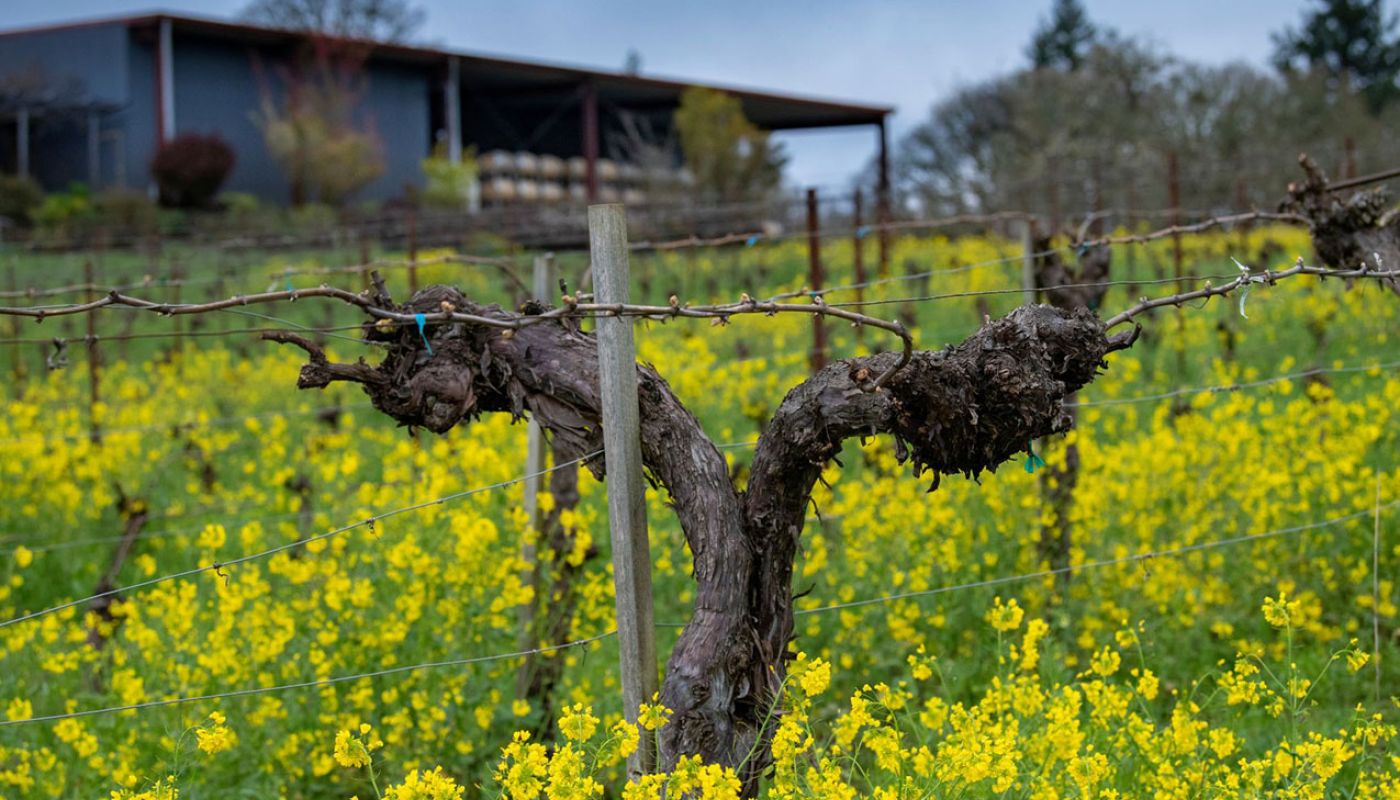
For most vineyards in the world, the discovery of the vineyard root-louse phylloxera in own-rooted Vitis vinifera vines is a death sentence. Yet the Bethel Heights Vineyard in Oregon’s Willamette Valley, which has had phylloxera since 1990, has been given a stay of execution.
The series of events that led to the first vines being planted in the Bethel Heights vineyard nearly 45 years ago could easily be described as a perfect storm. Cultural, economic and agricultural turning points came together in 1977 to lead Pat Dudley and Marilyn Webb along with their husbands Ted and Terry Casteel to abandon their academic life in pursuit of their love of wine. Together with Pat’s sister Barbara Dudley, they bought 75 promising-looking acres in the Eola-Amity Hills northwest of Salem, Oregon.
“There was a cultural moment in the late 60’s and early 70’s when it seemed that you could do anything that you wanted to do, it was this great feeling of liberation, of freedom from restraint,” said Bethel Heights Co-Owner, President and General Manager Pat Dudley. “We sold our house in Detroit, packed up our station wagon with our babies: our two children, our two cats and our avocado tree. We moved in with Terry and Marilyn in Seattle, then we started to talk about what we were going to do next. We had sort of decided it was going to be a vineyard, the question was where?”
With no knowledge of viticulture or enology and a little money in their pockets from the sale of their house, Pat Dudley and Ted Casteel decided to enroll in a crash course in viticulture at the University of California, Davis. This course no longer exists today but was a precursor to many of the university’s current wine education programs.
“There was a moment in time again when we went down to Davis. It was 1977 and we enrolled in this course that had just been developed by UC Davis specifically for people like us,” said Pat Dudley. “There were airplane pilots, and engineers, and chemists, educated people who wanted to leave it all behind. We weren’t the only ones. There was something in the air.”
It was during this class that Pat Dudley and Ted Casteel first heard of people, like Willamette pioneer Dick Erath, having early success growing wine grapes in Oregon. Not long after, the couple saw an advertisement in a trade magazine for the property of their dreams, an abandoned walnut grove in Willamette.
“This never sounds like it could really have happened, it was a fairytale, but there was a little ad that said ‘50 acres, suitable for vineyard, available in Oregon’s Willamette Valley,’” said Pat Dudley. “So, Terry and Marilyn drove down from Seattle, and we drove up from Davis, and there was no need to look any further. It was so beautiful; we were sold on the spot.”
The property was serene, perched upon a hillside with a geological quilt comprised of benches and slopes and a clear stream running through a deep ravine dividing the site in half. Ranging 480’ to 620’ (146 to 189 meters) in elevation, the site had little protection from the wind. They later found this created greater phenolic potential for their wines, meaning more potential for color and structure, as well as longer acid retention.
The previous owner had planted 14 acres of Pinot Noir and Chardonnay cuttings from the Erath Vineyard in 1977. The Casteel and Dudley families moved to the property and cleared and planted 36 additional acres in 1979. In 1981 they began home winemaking in Terry Casteel’s basement. Just three years later they produced their first commercial vintage under the Bethel Heights label with 3,000 cases, establishing one of the first major wineries of the Eola-Amity Hills.
These plantings occurred before the discovery of phylloxera in Oregon and so the families simply stuck unrooted Vitis vinifera cuttings in the ground and let them take root and thrive. Over forty years later these same plantings are now what make up the Bethel Heights 32.3 acres of own-rooted Legacy Blocks: the West Block (Pinot Noir), Flat Block (Pinot Noir), Southeast Block (Pinot Noir), South Block (Pinot Noir) and Highwire Block (Chardonnay).

In the mid-90’s the team at Bethel Heights discovered the first signs of phylloxera in their vineyards. Unlike their neighbors however, they didn’t rush to pull out the vines.
“Phylloxera spreads very, very slowly and we were not surrounded by a lot of other vineyards at the time. We didn’t see any reason to proactively pull-out vines that were still producing wonderful wines,” said Pat Dudley.
Now, going on thirty years later, many of these old vines are still thriving and producing elegant and complex wines. In 2018, Co-owner and Director Mimi Casteel led a project to assess the vitality of the Legacy Blocks and found that 80% are still sound, producing vines. Phylloxera has spread ploddingly through the Bethel Heights property, in part because of how the vines were originally sourced.
“We bought clean plant material,” said Co-Owner, Director and Winemaker Ben Casteel. “My family purchased unrooted cuttings from Dick Erath because they cost a lot less. Since phylloxera can only survive on the roots of grapevines, we did not inadvertently bring phylloxera into our vineyard on rooted plants in the beginning. Our family attributes this cost-cutting decision as one of the main reasons our vineyard remained phylloxera-free for so long.”
Phylloxera is incapable of moving on its own and typically only spreads through water flow or human intervention. Knowing this, Bethel Heights has not tilled the Legacy Blocks since 2006. The Bethel Heights team also began taking preventative measures to increase soil health and protect the old vines. These include eliminating herbicides and pesticides, implementing permanent cover crop, compost tea sprays and compost around the vines, and using the natural systems in place to ensure the vines have access to every possible nutrient they need in the soil. The Bethel Heights Vineyard is LIVE certified and Salmon Safe, and the team is currently in the process of pursuing organic certification.
“We really felt that if we worked hard to bolster and support the immune system of the old, own-rooted grapevines that we could help them live longer,” said Pat Dudley. “Just like with people, if they exercise every day and eat healthy food and don’t expose themselves unnecessarily to threats, they can live for quite a long time, even with some ailments. They can still do great things.”
To avoid taking out entire blocks, Bethel Heights has developed a plan to replace vines one at a time as they die from the phylloxera. This method of planting a baby grafted vine in the place of a single older ungrafted vine that dies is more frequently used in the Old World than the New and ensures that the legacy of a site continues uninterrupted.
“What makes the Flat Block unique is not just that it’s planted on this particular flat space, but it’s the whole community of associated organisms that have created the Flat Block that the baby vines are getting to grow into,” said Pat Dudley. “They get to learn the language of their neighborhood and associate with those Old Vines and organisms that have created the essence of the Flat Block. So, by the time they are adults they will have learned the language and the culture of the place, and they won’t have to start from scratch.”
This plan was first implemented in 2018 and the Bethel Heights team seems optimistic about its progress. They had intended to begin the process of replanting sooner, but through their sustainable farming practices, the vines have thrived for much longer than anticipated.
“When I started working here in 2005, we drew out a five-year plan to strategically move through our property and replace things,” said Ben Casteel. “We had earmarked 2010 as when we would be done replanting and then fifteen years went by, and we have hardly done anything. I am hopeful that it continues that way.”
Today the second generation – Ben, Mimi, Jessie and Jon Casteel – run the winery alongside their parents. The winery now produces 13,000 cases annually from their Legacy Blocks, the newer plantings in the Bethel Heights Vineyard and their more recently purchased Justice Vineyard, also in the Eola-Amity Hills. While the second generation has an emotional tie to the Legacy Block old vines that their parents planted all those years ago, they also recognize that the vines are integral to the business and to making high-quality wines.
“I share my parents’ and my aunt and uncle’s philosophy that we make wines of place and not wines of personality. Old vines are better at speaking to where they are, as opposed to how they are made,” said Ben Casteel. “Younger vines are more consistent. Older vines have more variation, but I like the variation. I like when we see overripe and underripe fruit in the same block because it protects us from pushing too far in one direction or the other. It really shows the place.”
Each of the Legacy Blocks has its own block-designate bottling. By replanting one vine at a time, Bethel Heights will never lose the integrity of their Legacy Blocks. The young vines will grow old alongside their elders. The land will not be tilled as the young vines mature. They will learn the root systems, become friends with the microorganisms and take on the essence of the place.
“We will have some vines that are very young, some vines that are ten years old and some vines that are fifty years old,” said Ben Casteel. “Our vineyard’s date-planted will be 1977 to present.”
The story of the vineyard blocks at Bethel Heights consists of a series of moments, of perfect timing and a little bit of luck. Through hard work and careful, mindful viticulture, the legacy of Bethel Heights Vineyard will outlive the phylloxera.
The photographs were provided by Monique Geisen.
















