The 56-year-old Pinot Noir vines at David Hill are far from the oldest in the United States. They may be among the most mysterious, however, for exactly what they are and where they came from remain unclear. Yet unpacking their history is key to understanding Oregon’s reputation as a premier Pinot Noir producer today. Not only do the David Hill old-vine Pinot Noir grapes lend to a unique flavor profile with notes of black tea, spices, dark fruit, savory herbs, and meat; cuttings from these old vines grow today in the vineyards of many of Oregon’s notable producers, such as Adelsheim, Penner-Ash, WillaKenzie, Wahle Vineyards, Hyland Estates, and Trisaetum.
The story begins when Charles “Chuck” Coury, a U.C. Davis graduate student, returned to California in 1964 from Alsace, France, with a suitcase full of contraband vine cuttings. Coury’s vines then made their way to Oregon, where he planted them on a hillside near Forest Grove, west of Portland, and renamed the estate from David Hill to Charles Coury Vineyards. In 1977, Coury abandoned his Oregon project and returned to California.
In 1992, a chance visit to the estate by a lumberman set the scene for David Hill’s revival. Portland businessman Milan Stoyanov, who was out wine tasting, was entranced by the vineyards in the autumnal light. He bought the property and returned it to its earlier name, David Hill. In the years since, Coury’s vines have been carefully preserved through David Hill’s commitment to organic viticulture, while their fruit is gingerly coaxed to its fullest expression through minimal intervention winemaking.
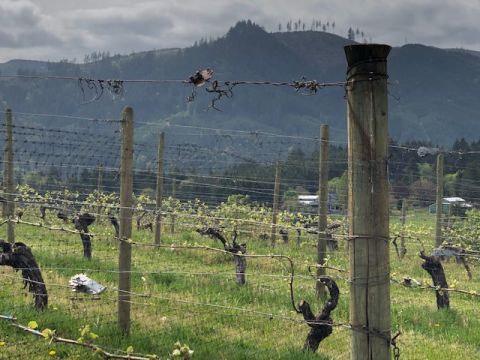
David Hill’s Pinot Noir vines stand today like humped-back soldiers in formation. The vines root down through wind-blown volcanic silt, known as Laurelwood soil, into 15-million-year-old bedrock composed of volcanic rock and basalt. They are self-rooted Vitis vinifera vines, which means they are not grafted onto American rootstock. While other self-rooted Oregon vineyards succumbed to phylloxera in the 1990s, the vines at David Hill escaped this fate – partly due to the plant louse’s dislike of Laurelwood soil, but primarily because the property existed as a self-contained island, where no outside crews or machinery entered.

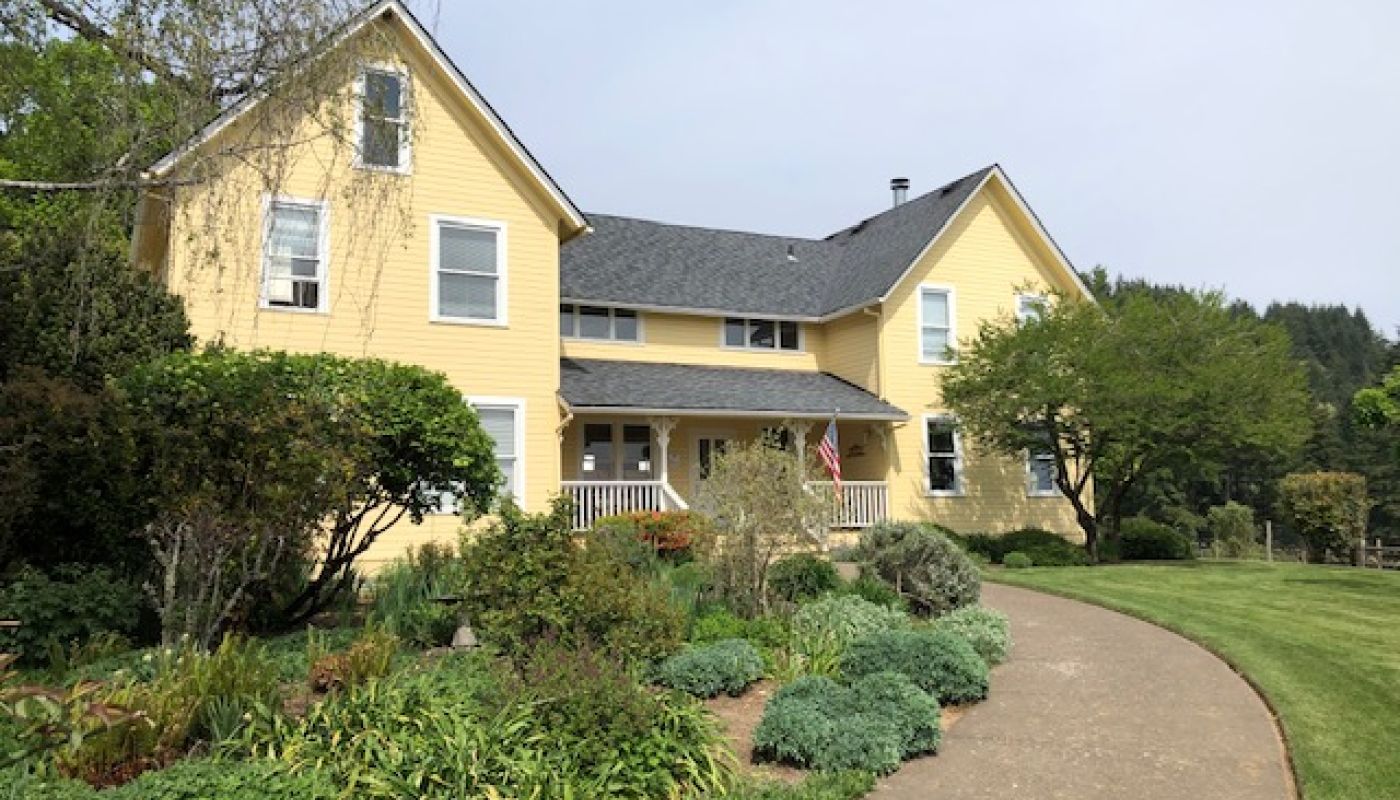
The vineyard’s location is spectacular. Driving west from Portland across miles of flat countryside, one questions what Charles Coury was thinking when he drove this way for a vineyard. However, once you reach Forest Grove, you turn up into the hillside and grasp his logic. You arrive to a restored 1883 yellow farmhouse and 150 acres of south-facing vineyards with a commanding view of Oregon’s Coast Range. One of the northern most vineyards in the Willamette Valley AVA, David Hill is nestled in the Tualatin Hills – established as its own AVA in 2020.
Early Years

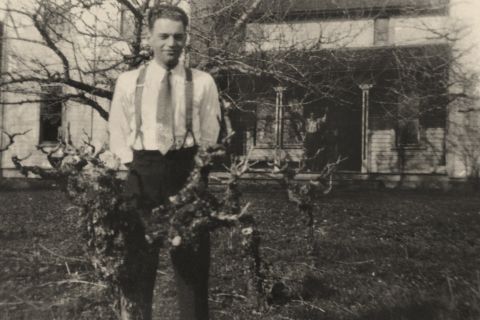
Coury was not the first one to spot David Hill’s grape-growing potential. In 1883, Frederick Rueter, a German immigrant, built a farmhouse at then called “Wine Hill” and planted a vineyard with Alsatian varietals. With his wines winning medals at the 1904 World Fairs in Chicago and St. Louis, Rueter understandably thought the Willamette Valley could become North America’s next Rhineland.
Rueter’s vision would have to wait. In 1913, Oregon began carrying out Prohibition earlier than most, and Rueter’s vineyards were replaced with potatoes and fruit trees. Fifty years would pass before vines would once again cover these hills.
Post-Prohibition Pinot
Like California, Oregon awoke slowly from its post-Prohibition slumber. Apart from the Tualatin and Honeywood Wineries, which sprung up in 1933, little viticulture or winemaking occurred until the 1960s. Around the time Robert Mondavi was planning to build his Napa winery, a handful of U.C. Davis graduates – David Lett, Dick Erath, and Charles Coury – ventured north to experiment with cool-climate viticulture in the Willamette Valley.

Coury’s formative years combined an interest in climate and grapes. After earning a degree in meteorology from U.C.L.A., he spent time in Japan as a naval officer, where he discovered fine French wine in the officers’ club. He enrolled at U.C. Davis in 1961 to earn a master’s degree in horticulture and traveled to France to study the grape-climate connection. He returned home convinced that Pinot Noir was perfectly suited to Oregon’s cool climate because it would reach its peak ripeness at the season’s end, maximizing a period of slow ripening.
Coury returned with much more than a vision; he also smuggled a suitcase of Gallic vines into the country. Known as Coury’s “suitcase cuttings,” the vines barely survived the trip, but they would soon find a home many miles from their birthplace.
In 1965, Coury traveled to Oregon with his wife, Shirley, to find land for a vineyard and heard about a bank-sale property near Forest Grove. He bought David Hill for $25,000 and renamed it Charles Coury Vineyards. Coury’s son Charley later recalled the property’s dire condition, “When my mother first brought my Aunt Betts to see the house, it was in pretty bad shape. My aunt cried, and my mother was ecstatic. Everyone thinks my dad was the driving force, but it was my mother who was the real adventurer.”
Coury planted a variety of Alsatian white varietals, including Riesling, Gewürztraminer, Pinot Blanc, Sylvaner, as well as Sémillon, which still thrive on the property. He also operated a nursery, the cuttings from which provide the base material for many older vines in the Willamette Valley today. Golden Cluster Winery, for example, uses Coury clone material to make its old-vine Sémillon and Gewürztraminer.
The Mysterious Coury Clones
The Pinot Noir vines that Coury planted, however, have attracted the greatest deal of attention – not just because they were some of the first such planted in the Willamette Valley after Prohibition, but because Coury refused to divulge where the cuttings originated. One theory is that the plants came from his research vineyard in Bergheim, an Alsatian grand cru village. Unfortunately, that vineyard later burned and with it any chance of tracing the clones to there. Whether Coury planted the vines at his home in Carneros when he returned and possibly integrated other plants from various Sonoma vineyards is also unknown. When prominent ampelographer José Vouillamoz performed DNA testing on the Coury vines, he could not detect any markers and concluded they simply stemmed from the “Pinot” family.
To be sure, there was more than one Coury clone, and together – under Coury’s use of vertical shoot positioning and dry farming – they produced a field blend like no other. According to Chad Stock, David Hill’s current winemaker, five distinct Pinot Noir genetic clones exist in the vineyard, and they vary from row to row. In The Boys Up North, David Adelsheim recalled the unusual flavor of Coury’s wine at the time: “Chuck poured his wine, and we wondered what he had brought. It was darker than anyone else’s. He never revealed the clone he used. I still have not tasted another Pinot Noir like it.”
After a failed business partnership with New York investors, Coury went bankrupt and returned to California in 1977. “I went to Oregon to grow grapes and make wine, but I left with my tail between my legs like a beaten puppy,” he admitted. Not one to wallow in defeat, he went on to establish one of the country’s first craft breweries. In a 2020 interview, David Adelsheim praised Coury for having fostered an Oregon-first mindset that led to the state’s present-day success that Coury, because of having left Oregon, never got to enjoy.
Were it not for Coury’s partner, David Teppola, the mysterious Coury clones might have died off at this point. Teppola farmed the vines and eventually bought the property in 1986 to establish the Laurel Ridge Winery with his wife Susan, who served as boss crew during the inaugural harvest while nine months pregnant. The vines survived but their vitality was sapped from conventional farming.
Pinot Revival
When Milan Stoyanov bought David Hill in 1992, the farmhouse was derelict, and the vineyard was in poor shape. “We bought it with our heart, not as an investment...I looked at the vineyards and thought I’d really like to be responsible for improving them,” he recalled. During this time, Stoyanov leased the property to the Teppolas until they moved their Laurel Ridge Winery to the Yamhill-Carlton AVA in 2001. By then, Milan and his wife, Jean, were determined to uphold the legacy of the old vines and decided to make David Hill a family wine-making business. They restored the farmhouse (see top picture) and produced their first vintage with the David Hill label in 2000.
Stoyanov’s decision in 2013 to hire Mike Kuenz – known for his passion for and experience working with old vines – was a major turning point in the vineyard’s history. Acting as managing partner/owner and vineyard manager, Kuenz put a plan in place to improve the vineyard’s low yields. He conducted soil and virus testing, adopted organic viticulture, and set a goal to be LIVE (Low Input Viticulture & Enology)-certified. “I wanted to make sure we had competency above ground and below ground, not only with viticulture, but we also worked with a consulting agronomist,” Kuenz said. “It looked like a moonscape,” winemaker Chad Stock added, “but the vines were squeaky clean. They just needed to be farmed well.”
In 2018, Kuenz expanded David Hill’s commitment to old vines by purchasing The Wirtz Vineyard. Located two miles from David Hill, the vineyard’s 14 acres are planted with heirloom clonal vines from Coury’s nursery. In 2019, David Hill gained the LIVE, SalmonSafe, and Certified-B corp certifications, and in 2021, they instituted no-till farming.
While Coury’s Pinot Noir vines have received the most attention, Kuenz is equally determined to champion Coury’s vision of cool-climate aromatic whites. “It’s about allowing the vineyard to speak through a bunch of different types of wines,” he said.
According to Bree Stock MW, Oregon Wine Board’s education director, David Hill will serve as a “living museum” of old vines. She explains that it is unique for its combination of Pinot Noir clones: the mysterious Coury clones, the Wädenswil clone (imported by David Lett), and the Pommard clone (brought by Dick Erath and Charles Coury). Fifteen additional acres at David Hill are set to be planted with self-rooted Coury vines, using tighter spacing, improved farming techniques, and better agricultural machinery. “We see no issue with these vines producing for decades to come,” Chad Stock remarked.
According to Chad, “The most significant thing about the BlackJack Estate Pinot Noir (produced from the Coury clones) is its diversified material in a small footprint, with all the chaos that ensues. Some grapes ripen faster than others, while others have more acid.” Such chaos, he explains, creates complexity in the glass but demands simplicity in the cellar. Stock uses native yeast fermentation with a long, cold élévage in neutral oak, no filtration, and minimal sulfur. “If you handle the fruit with simplicity,” Chad maintains, “that complexity will show.”
In the end, where the Coury clones came from is undoubtedly less important than where they’re headed—a future that looks very promising in Mike Kuenz’s and Chad Stock’s hands.
Resources
- Karen Magner interview with Chad Stock, David Hill’s winemaker, and Bree Stock MW, Director of Education, Oregon Wine Board, 30 April 2021
- https://digitalcommons.linfield.edu/owha_miglavs_interviews/14/ (Milan Stoyanov interview)
- https://oregonwinehistoryarchive.org/interviews/mike-kuenz/ (Mike Kuenz interview)
- https://oregonwinehistoryarchive.org/interviews/charley-coury/ (Charley Coury, son of Charles Coury, interview)
- https://oregonwinehistoryarchive.org/interviews/susan-teppola/ (Susan Teppola interview)
- William “Rusty” Gaffney, “Oregon Pinot Noir: Who Planted First?, https://digitalcommons.linfield.edu/cgi/viewcontent.cgi?article=1005&context=owha_gaffney
- William “Rusty” Gaffney, “Solving the Mystery of the Coury Clone,” https://digitalcommons.linfield.edu/cgi/viewcontent.cgi?article=1010&context=owha_gaffney
- “David Hill celebrates 50,” https://www.oregonwinepress.com/article?articleTitle=david-hill-turns-50--1440697330--2178--
- “Charles J Coury (1931-2004), Charles Coury Winery, Vineyards & Nursery,” http://www.oregonwinehistory.com/Notables/Coury.html
- “Reuter's Farm (Reuter’s Hill Winery),” http://www.oregonwinehistory.com/HistoricalWineries/ReutersFarm.html
- “David R Teppola (1942-2006) Laurel Ridge Winery,” http://www.oregonwinehistory.com/Notables/Teppola.html
- “Susan Teppola,” Susan Teppola | Laurel Ridge (laurelridgewinery.com)
- Paul Pintarich, The Boys Up North: Dick Erath and the Early Oregon Winemakers, Wyatt Book, 1991.