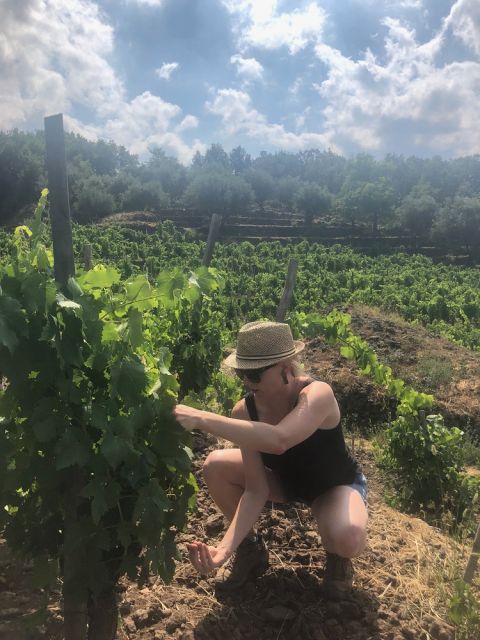
'I first encountered the Rampante vineyard held by Passopisciaro in May of 2014. I was traveling around Sicily with my mother and brother, and I’d been dying to visit Etna as a part of our road trip, to see what all the fuss over these volcanic wines was about. As we drove up the state road from the town of Passopisciaro to the winery of the same name, swiftly climbing 200 meters as we passed lavic boulders covered in blooming pink and yellow broom, and then up a potted concrete drive to the rust-colored gate, my stomach did a bit of a flip. There was something special about Passopisciaro, and walking through the vineyards that day with Vincenzo Lo Mauro, who was interviewed for this piece, proved to be the first of many times. I proceeded to work as a brand ambassador for Andrea Franchetti’s Passopisciaro on Mt. Etna and Tenuta di Trinoro in Tuscany for several years, from 2014-2020, starting the harvest after my first visit in 2014 (I quit my office job at Sotheby’s on a cryptic invitation from Andrea, a decision which I have never regretted). To date, I have visited Mt. Etna fifteen times.' See our WWC21 guide for more old-vine competition entries.
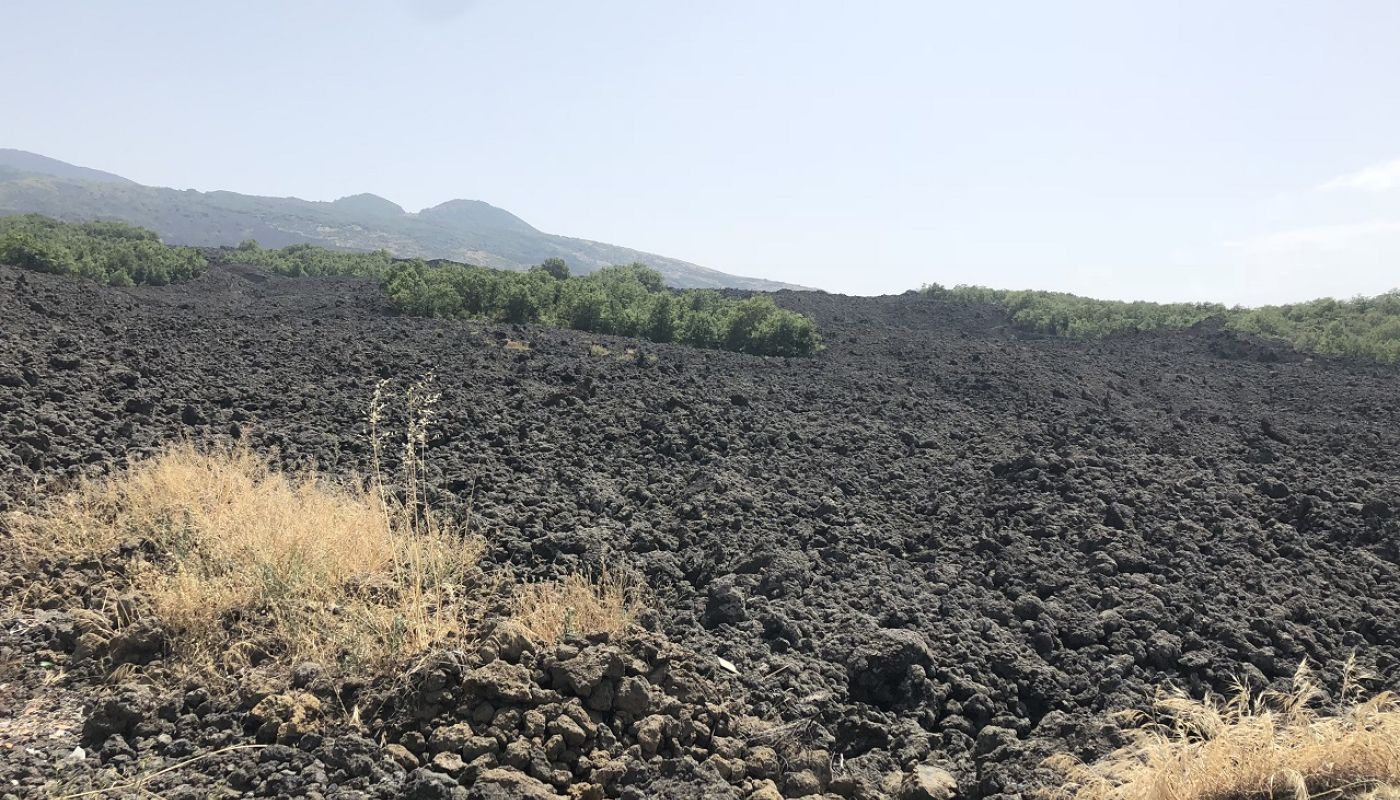
Etna is a fascinating place, at once feral and majestic, old and new. Large swaths of blackened, rocky earth scar its surface, reminders of the devastation that can come from an eruption. It is the highest active volcano in Europe, its magmatic activity the result of the meeting of the African and Eurasian tectonic plates far beneath the glimmering seas that surround the island of Sicily. The last eruption to reach Catania and the sea was in 1669, but she’s still quite active (yes, the locals refer to her in the feminine). Craters can form at any elevation, so when they burst like little pustules, rivers of lava can easily reach the small buildings and towns that ring its lower third. Driving along the Etna wine route from the town of Passopisciaro to neighboring Randazzo, one passes through the flow from 1981, still as starkly rugged as the day it first enveloped 200 hectares of land.
Passopisciaro’s Contrada Rampante is tucked into the mountainside at 3,300 feet above sea level, facing the Peloritani mountain range, due north, which serves as a rain shadow for any incoming effects from the Tyrrhenian sea. Steeply rising terraces climb deep into the cut of the 1.4-hectare site, which looks as though a speeding river tore down the side of the mountain; the locals call this farming on “terra rubata” or stolen land, earth they made plantable by taking it from the woods, from Etna herself.
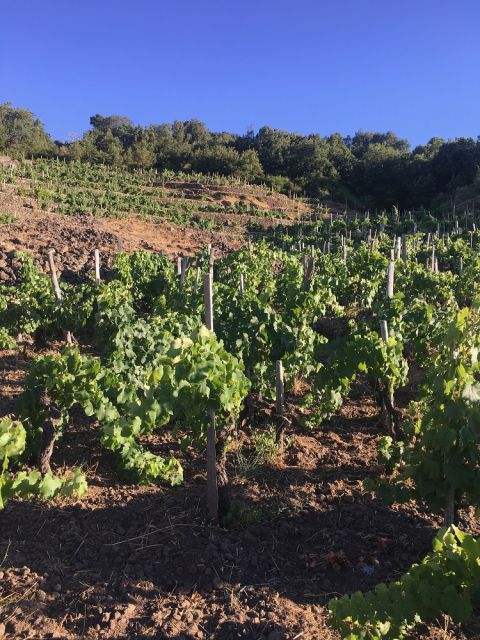
When Andrea Franchetti arrived on Mt. Etna, this vineyard in Contrada Rampante was the first he purchased from an older, local gentleman named Vincenzo di Carlo. This was back in 2000, prior to the explosion that the region has seen in terms of growth and notoriety. It technically straddles two contrade (local boundaries between zones that have been appropriated as names of crus), Rampante and Barbabecchi, and neighboring vineyards carry both names. When one understands the modernization of Etna as quite recent, this isn’t hard to understand. The two-lane paved road that connects the towns of Linguaglossa and Randazzo at that altitude – called the Quota Mille, or Thousand Meter Road – was a tiny dirt road until the 1970s. The vineyards predated the development. Di Carlo, in his seventies at the time of purchase, had spent his life in this vineyard that his forebears had planted, which put the vines at, best guess, over a hundred years old. The planting itself supports this: traditional head-trained alberello vines (local terminology refers to them as little trees) pruned short, planted roughly 1.1 meters apart in ashy soils. These little trees of the indigenous nerello mascalese, a natural crossing of sangiovese and mondanico bianco, produce large bunches of thin-skinned, tannic red grapes that are the dominant variety in the traditional Etna Rosso blend.

Passopisciaro’s estate director Vincenzo Lo Mauro paints the picture of the beginnings of Passopisciaro, which is celebrating its 20th vintage this harvest, as a sea change for the way things had always been done on Mt. Etna. He was introduced to Franchetti in July of 2001 and a month later found himself in Rampante with secateurs in hand. He remembers the juxtaposition of glee and terror that resulted from that meeting, when Franchetti invited the two Vincenzos to walk the site with him. For decades, Di Carlo had lovingly tended each vine to produce the maximum amount of fruit it could, and here, this man dropped bunch after bunch of beautiful fruit. “He went to pieces after just an hour, Lo Mauro recalls, a piece of his heart and life and work dropped with every bunch, and he went down to the town of Solicchiata [200 meters below] and told everyone he passed that he’d sold his vineyard to a madman.”
Instead of crazy, however, Franchetti proved to be revolutionary. No one on Etna Nord had ever thought of green harvesting nerello mascalese before, but the resulting concentration of the fruit was a revelation, with the first vintage of Passopisciaro Rosso, now called Passorosso, speaking to the potential of the region in a way that few wines before had. Lo Mauro recalls the seismic shift at the start of the millennium: “Andrea and Frank [Cornelissen] brought una tramontana di novità, a wind of change, with them with many of their practices, shocking the elders of the region with their cultural baggage.” Today, Passopisciaro still leaves only five bunches on the vines selected for its single-vineyard Contrade wines (the most ethereal of which is produced from Contrada Rampante), few more for its Passorosso, signaling the house’s commitment to this work for producing benchmark wines of outstanding quality for a still-young region.
Young, yet old. Vines have been planted here since the time Greek and Phoenician traders arrived on its shores. But the most recent boom, predating today, was during the onset of phylloxera further north. The old farm and cellars that house Passopisciaro speak to this time. According to Lo Mauro, who helped to oversee the renovation of the dilapidated building over the course of several years, it was built around 1860 and would have been massive for the times, with a footprint of 1,200 square meters (in contrast, most homes were only twenty-five meters square). It was built, as was much of the viticultural infrastructure of the times, in response to an amazing demand for bulk wine that grew as vineyards in other wine-producing regions were being devastated by the American louse.
As for much of Sicily’s history, land laid in the hands of few, and there was much famine and need in the region. Building the infrastructure required for these vineyards put many people to work, hand-building terraces, moving land. For many years, lots of income was generated, as the great palazzi littering the mountain’s face can attest, and some of that trickled down. The industry, however, was totally unprepared for those historic regions to replant and rebound so quickly and soundly, and the Etna wine region collapsed at the turn of the century when their grapes were no longer needed to backfill vintages elsewhere. “Demand died on the mountain,” he notes, with the gentry moving down to the more profitable plains to plant orchards instead of vines. The poor remained where they were, and the landowners sold off parcels of the newly worthless land to their workers, who could at least eke out some sustenance and sell vino sfuso locally.
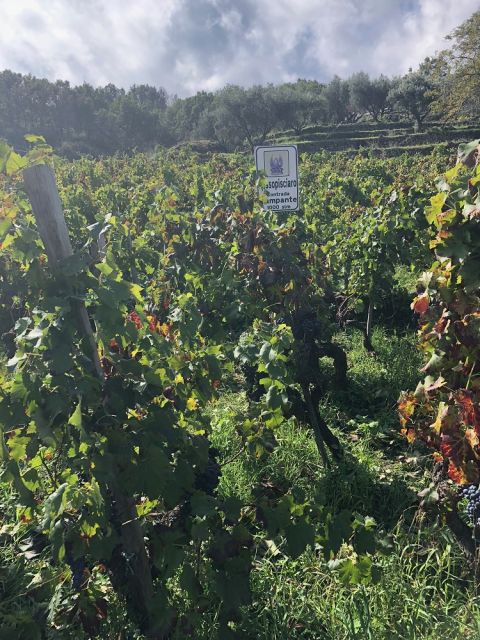
Given that Etna is a mountain, it doesn’t have the plains to develop like other parts of Sicily, where farming was impacted by the rise of industrialized agriculture in the twentieth century. One simply can’t not terrace to farm the slopes, and thus the terrain itself greatly impacted the region’s lack of further development, as there was little outside investment for decades. The labor required, combined with the poverty of the region and lack of market, meant that the farmers had no means or incentive to rip out their vines and change their farming practices. In this case, one could argue that farming preserved heritage.
“This is the land, it is what it is, it can’t give more,” Lo Mauro muses in one breath, while in the next acknowledging the potential it has realized over the last twenty years: “It was a daily discovery, this was making real wine,” working with innovations like stainless steel tanks and temperature control, so different from how he’d always seen it done. And like a true Italian, he sees the art in all they do: “like Michelangelo, it was all there in the plants, we just had to draw it out."
The photos are provided by Sarah Bray.
















