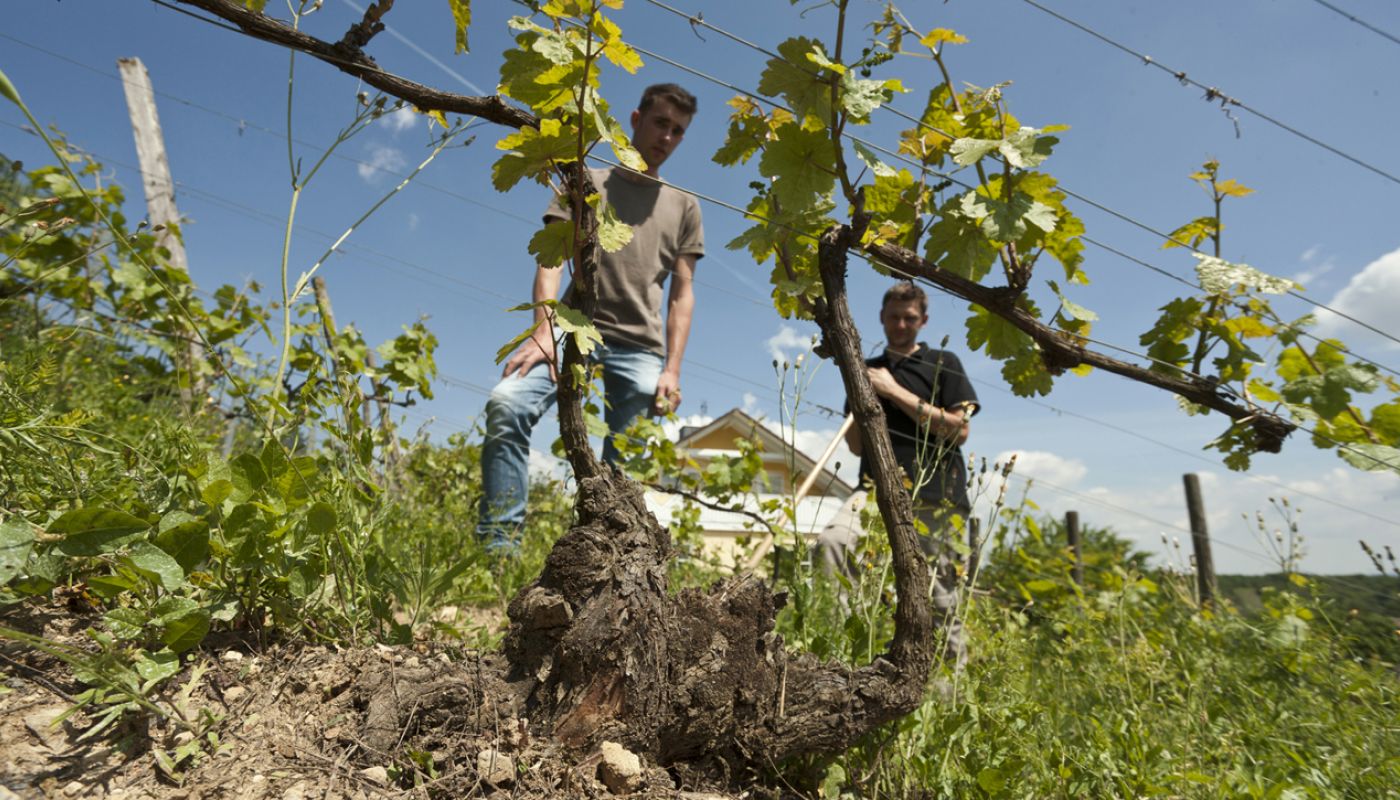
Pure coincidence. A crossing of fate over a couple of ambercloudy Distelhäuser-wheat beers; a voluntary fire brigade training session on a sweaty-hot evening in August 2010 having just finished.
Eugen leaned over to Ulrich with an irritated tone: “Good that I took action! I am so annoyed, so sick and tired of it. When my father Urban, at 86 years of age, couldn`t take care of it anymore, we cut the vineyard down hard underneath the grass level. 3 years ago, just to get rid of it – and now the vines come up every spring again upon the meadow! It is so frustrating: We have to clear it again every single year!”
“Eugen, please, I certainly know every vineyard of Sulzfeld, but I have no idea what you are you talking of. Which vineyard do you mean?”, Ulrich asked back.
“Look, it is not even a vineyard, it was just the small patch Urban took care of for his personal use behind his small house over the years. You cannot see it from the street passing by our houses, you have to go over our terrace to get to it... It is in the middle of a residential area now, land awaiting construction and the only thing we all want is peace and quiet and a nice and green meadow until it will be used for other purposes…”
Eugen took another sip of his yeasty-fruity smelling beer. Then he said: “But after tomorrow it will all be over! I was an excavator driver for a living with a construction company, I know what to do! I ordered an excavator for tomorrow – all the root stumps will be grubbed out and gone forever!
“Wait, wait, wait…”, said Ulrich, spinning possibilities around in his head, reflecting, “… the vines are coming up every spring you say … so it has to be an old vineyard, built up in the old Frankish way … when our strongly continental winters were really hard, freezing cold, way below zero … and the vineheads had to be buried under at winter times just to ensure that the vines will not freeze to death…” He paused for a while, thinking.
Then suddenly he turned to his firebrigade friend, asking: “Eugen, please tell me, do you know how old this vineyard is? And who planted it?”
“Hmmm…”, Eugen answered, “… let me think – it would have been my great-great-grandfather at that time … must have been 1870 or 1871… at least that is what we know…”
“What? Eugen, can I have a look at it tomorrow morning, before you clear it, please? Maybe we have a precious jewel of vine growing here. If it makes sense, I would like to grow it up again…”, Ulrich asked tentatively and Eugen immediately replied:
“Are you crazy man? The vineyard has an alley width of just 60 centimetres! You have to do everything manually, no machinery possible! Hoeing by hand and all the rest for almost no yield! Are you crazy?”
“Wait, I will come over to your place tomorrow and then let us see...”, said Ulrich.
The next morning the firebrigade friends Ulrich and Eugen met again in fresher and cooler air, just outside the fully-preserved walls of the picturesque medieval town Sulzfeld in Franken – the only catholic enclave on the right bank of the river Main, being fought for in the famous Cyriacus battle of knights in 1266 and since then (religionwise) belonging to the (Prince-)Bishop of Würzburg. They stepped up from the street and walked over the terrace behind Urban Schenkel’s house to the vinepatch, being located on the lower slightly loess-covered end of the south-east facing Sonnenberg – a hill with dark soil based on Keuper clay on top of it, then colour-changing over just a few metres downhill into lighter colours, influenced by the yellow and then white Muschelkalk limestone rich in fossil shells.
As Ulrich Luckert from the VDP vinery Zehnthof Luckert investigated the upsprouted vines closely on the ground, he suddenly got goosebumps: “This is the oldest self-rooted, single-grape variety vineyard in Franken from 1870/1871! The deeply serrated leaves indicate Yellow Silvaner – in 19 rows on an area of roughly a third of an acre!” And it truly was – Thank God! --Yellow Silvaner, the origin clone of Green Silvaner, the latter being the less complex in taste but more yield stable clone widely planted after 1960. What an unbelievable heritage and joy!
“Eugen, do you know the name of the vineyard? How was it called by your grand-grand-great-father?”, Ulrich asked, imaging in mind already a possible imprint on a bottle label.
“‘Creutz’. The name of the whole hill site was ‘Creutz’, standing in the prolongation of the walls of the cemetery outside the town, named after the baroque Holy-Cross-Chapel of 1775 located on the cemetery grounds”, said Eugen, and then: “They practically cleared the whole site from vines in the 1950s or 1960s, as it was declared as a site for construction just outside of the old Sulzfeld. Imagine, there was no place left to build houses within the medieval town-walls … Urban as well built a small house there. But as he liked to work with the vines – counterbalancing his profession as a locksmith – he wanted to keep some vines for his daily ‘Haus-Schoppen’ in the evening…”
And Ulrich enthusiastically asked: “Let me grow Creutz, let me raise the vineyard up again! Please?”
Seeing the fire in his eyes, Eugen was taken by the passion and he agreed.
A lease contract was made later that year after the experts of the state-owned Veitshöchheim viticulture institution proved Ulrich's intuition: They showed that out of the 700 vines, there were only 10 vines of Blue Silvaner, 10 vines of Yellow Muskateller and 2 Elbling vines. The vast majority really was Yellow Silvaner! (It is an enigma still until today, why the vineyard was not planted in the “Old Frankish Mixed Set” as it was usual at that time to secure yield no matter which weather will occur the upcoming years.)
The organically certified-working Luckert family then developed two vinerods with 50 centimetres distance out of each vinehead from underneath the surface and erected a wire trellis system. The vineyard is hoed once manually in spring and the grass is cut 2-3 times during the year. The yields are as low as between 20 to 25 hl/ha and after a short maceration on the grapeskins, the pressing and natural settling of the turbidities, the grape juice is fermented with ambient yeasts in a 400-litre wooden barrel made out of the nearby Spessart oak, automatically undergoing malolactic fermentation. Then the resulting wine is preserved in the historic original cellar of the 1558 built Zehnthof, at the time being the “10% tax collection site in wine” of the Prince-Bishop of Würzburg. The wine stays on the full lees in the barrel for 7 months until it just gets a minimal dose of sulphur before being put in about 600 very rare-to-get bottles. Since 2012 this wine has been produced, being judged as the “Best Silvaner in Germany” many times over the last 9 years.
The result for the 2019 vintage is an understated vibrating wine full of concentration with a well-balanced complexity: elegant herbs in the nose, the chalkiness of the limestone, hints of liquorice, wild fennel, white flowers and white tea, notions of quince and white peachskin, then a touch of white pepper, foaming butter, suddenly a clue of mint. At the same time fresh, juicy, salty, grippy and creamy on the palate with an endless length echoing its complex nature. An old, wise, vivid gentleman of a wine, not loud, but distinct, incorporating and amalgamating the experiences of a long and rich life. Someone to listen to for a very long time without feeling the passing of the hours. Just being touched in a friendly, maybe caring way with a depth of emotion way below the surface.
And if by pure coincidence a future crossing of fate occurs to a wine-enthusiast, being offered the opportunity to enjoy some drops of Creutz, it is only just to recommend to not to let that chance pass – and admire the inner glowing mature complexity of Creutz, wine from the resurrected Silvaner vinepatch with 150 years of age…
Acknowledgements
For his gaining of a deeper understanding of the Silvaner grape variety in Franken/Germany, the author would like to thank Nicolas Frauer, chief winemaker of the Juliusspital in Würzburg for having him as an intern as well as the Tasting Club Würzburg for the friendly possibility to participate as a guest. He thanks furthermore the “Silvaner High Priest” Hermann Mengler for giving him the hint concerning the Creutz vineyard and explaining him the quality evolution of the Silvaner vinification methods in Franken over the last 20 years as well as – with highest professionality and openness – why Silvaner will probably offer more complexity in the times of climate change than Riesling in the future. The certainly biggest “Thank you!” from the author goes to his name-cousin Ulrich Luckert, who opened cellar, vineyards and bottles of the VDP Zehnthof Luckert winery at Sulzfeld with utmost friendliness, in-depth knowledge and enthusiasm for the Silvaner grape variety in Franken, the high terroir-expressing grape variety to be explored next by many wine-lovers seeking for a German alternative to Riesling.
















