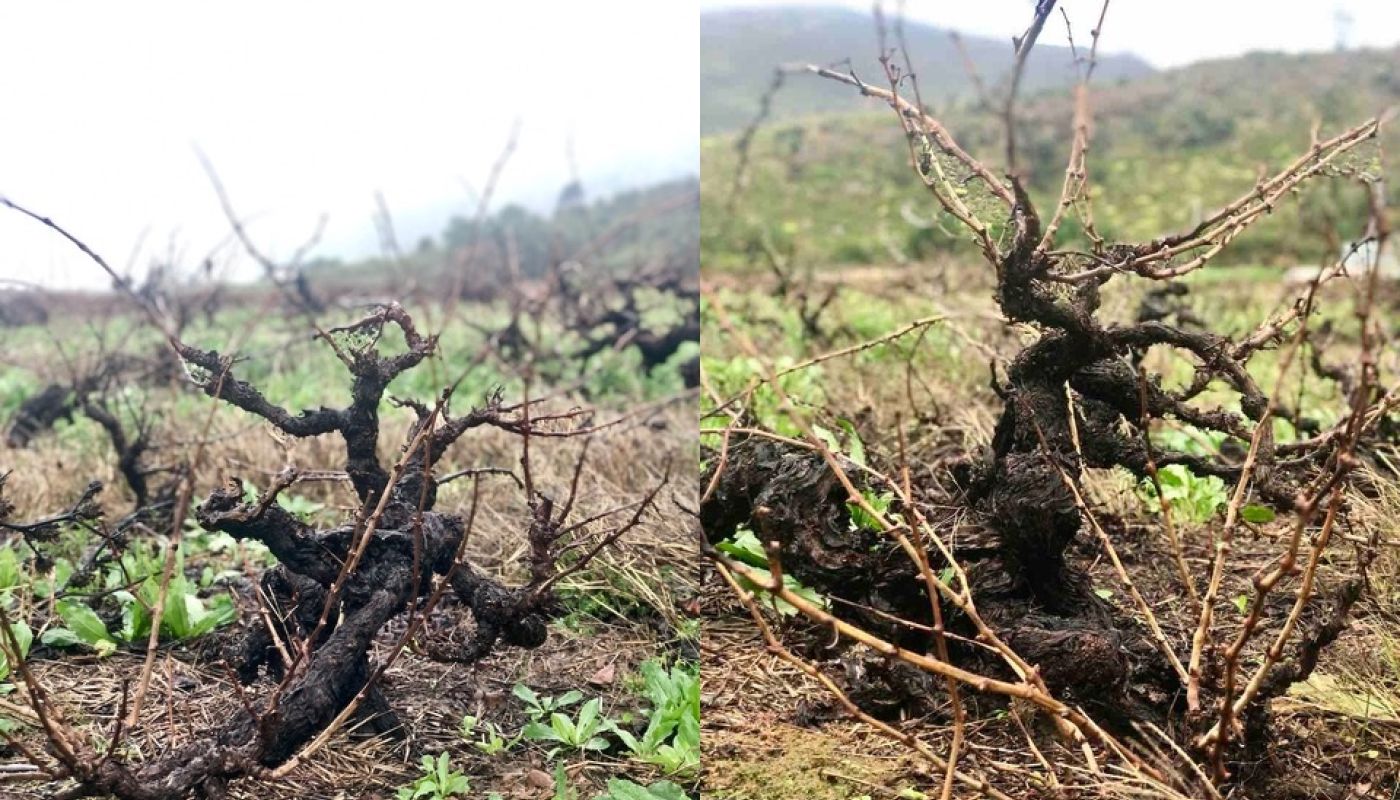
Dead vines walking
Nestled against the duToitskloof Mountains in South Africa’s Breedekloof wine region is the African continent’s oldest block of indigenous vines. And it’s on death row.
“Prehistoric” is a funny word. A more vivid imagination might conjure images of misty jungle-strewn skylines, punctuated by swaying brontosaur necks and hovering pterodactyls. A more analytical mind might define it as “that time before anyone wrote stuff down.” As I stood ankle deep in mud, amidst bedraggled Muscat vines, the word took on an entirely new significance.
The moody Breedekloof sky was in the process of purging its soul, and the towering Isla Nublar-esque DuToitskloof cliffs were spewing white torrents of rain water down the vertical rock faces. On the valley floor, on Gevonden Farm, I was safe from the flash falls, but not from the skyburst. Wearing white shoes was a mistake.
The vines seemed unphased though; ugly as sin, and yet somehow still poised and graceful amidst the downpour. Then again, they’d been standing there since 1882 - predating and outwitting the phylloxera devastation that hit South Africa in 1886. One might suppose that after 139 years and a global vine pandemic, they’d learnt to take life in their stride.
Paperwork is Power
It was a series of old Gevonden farm documents that verified the planting date of the block. The presence of actual paperwork (uncommon for the era) made their claim to the title of “oldest vines in the country” more credible than it otherwise might have been. A significant contributor to their preservation thus far.
It was only in 1900 that the South African government’s penchant for paperwork heaved the country out of prehistoricity and into the gleaming age of bureaucracy. In that year, a decree was issued that farmers in South Africa would require permits before they could plant any new vines. Which is why today there are certified documents verifying the age of all vineyards planted in South Africa after 1900.
“At the time, this was the bane of every farmer’s life - ridiculous bureaucracy - slowing everything down,” said Andre Morgenthal, General Manager of the Old Vine Project.
“But the result of all that paperwork is that we now have this rich, verifiable record of all our oldest vineyards! There’s no other country in the world that has what we have. When you have a written record that says, ‘This is exactly when this vineyard was planted’, it makes it far easier to argue for the preservation of old vines as part of our heritage.”
Of course, not everyone values heritage equally, and many old vines have been destroyed in the pursuit of agricultural profit. But where Andre can’t protect old vines by appealing to a farmer’s sense of nostalgia, he’s not above targeting their vanity. “Not many people relish the thought of being portrayed in the media as “that guy who destroyed the oldest block of vines in the entire country,” he remarks with a wry smile.
Heritage is not a cash flush racket
And yet in the case of the Gevonden Farm’s Muscat block, even paperwork and threats of public shaming might not be enough to save them. Call them crazy, but some farmers are more concerned with profitability than public image.
Gevonden owner Ruan Brink is exactly such a man. Farming is his livelihood, not a pastime. In wine circles, men like Ruan are often painted as short-sighted heartless villains; grubbing vines and money alike. But life is seldom so binary.
“It’s a great story,” said Ruan earnestly. “I’d like to be able to tell it. It’d be lovely to keep this block in the ground. But I have to be realistic about the costs.”
We were using the backseat of Andre’s car as a conference room for the interview; a far cry from the palatial Stellenbosch tasting centres, where discussing the importance of agricultural efficiencies, and the Rands and cents of grape farming would seem incongruous.
“Farming a hectare of land costs a lot of money. Even more so with old vines that need to be tended by hand,” continued Ruan. “A hectare of old vines that yields 3 - 4 tonnes struggles to pay for itself, but with younger vines and a bit of work, I could get twenty tonnes on the same land; the opportunity cost is enormous.”
“But there are exceptions to this rule,” Andre interjected. “The Skurfberg vineyard literally put the owner’s children through University. The farmer struggled to make ends meet before Antonij Rupert Wines and Eben Sadie made wine from those grapes. That old vine money changed the farmer’s life.”
“Ja, but which cultivar, Andre?” countered Ruan.
“Chenin.”
“And what about Eben’s Mevrou Kirsten wine?” continued Ruan.
“Also Chenin.”
“That’s the brick wall I hit every time. Selling an Old Vine Chenin at R900 per bottle is one thing. But selling a Muscat of Alexandria...that’s another story entirely.”

Africa’s Homegrown Star
In South Africa, Muscat of Alexandria is still widely referred to as “Hanepoot” (a sanitised version of the original “Hane Kloot”, which translates as “chicken’s testicles”). This nickname not only makes it hard to respect the grape, but also obscures its origin.
As the formal name suggests, Muscat of Alexandria hails from the eponymous Egyptian city on the Nile Delta. Which means that, far from being the butt of a ball gag, this unique grape holds the esteem of being the sole indigenous vitis vinifera cultivar in Africa.
Back to the Future
Now I grant that claiming the title of “oldest indigenous African vines” is like celebrating the first left-handed Morroccan to summit Mount Everest in a onesie, but for many wine lovers, the thing that makes the Gevonden block so special is not merely its age, but also the very fact that it is a block of Muscat vines.
The cultivar is something of a paradox in South Africa in that it has a poor reputation grafted onto a rich history. But wine geeks and history buffs are starting to shift this perception. Adding impetus to the #MuscatMatters movement is the rise of some rather serious dry Hanepoort wines from winemakers like Bruwer Raats and Gavin Bruwer’s B_Vintner’s label, the Myburgh Bros, or Henry Kotze’s bone-dry Akkura Muscat. The wines are gloriously textured, with aromas of sea spray, honeysuckle, star jasmine and nectarine, layered over palates often brimming with white peach, bitter almonds, grapefruit pith and sultanas. Of course, it also helps that on a global scale there is a growing consumer demand for oft obscure regional cultivars from countries like Austria, Greece, and Georgia.
But the importance of Muscat in South Africa goes beyond current trends. It also gives us clues as to what cultivars will shape the future of the South African vineyard.
“One has to ask why certain cultivars seem to have survived as long as they have,” pondered Annette van Zyl during a showcase of some of Fairview Estate’s Old Vine bottlings. Anette is one of Fairview’s assistant winemakers, and is no stranger to the Old Vine Project. She vinifies at least four Certified Heritage Vineyards wines, ranging from Grenache to Chenin to Palomino to Carignan, and even a fascinating fino-style sherry made from South Africa’s oldest Sauvignon Blanc bush vines (dryland farmed since 1965).
“If you’re going to talk about a “wine of place”, you have to begin by looking at the cultivars that thrive in your local climate,” she continued. “And by ‘thriving’, I mean surviving over a century through often short-sighted farming practises. Those vines that have endured have done so because they feel at home.”
The OVP OGs
So what exactly are the cultivars that have managed to survive? According to Rosa Kruger, co-founder of the Old Vine Project (funded in the early years by businessman Johann Rupert), there are only nine vineyard blocks that remain from the original 1900 census. More than half of them are Muscat of Alexandria. A significant statistic, if one accepts Annette’s thesis on what makes a genuine ‘wine of place.’
Then again, more experienced (or jaded) voices in the South African wine industry would ask what the point was of planting cultivars that “feel at home”, if no one wants to drink the wines they produce. But these naysayers aren’t being entirely fair. Part of the reason that the Gevonden block still exists is that there are experienced industry players still rooting for it. Not least of all, large co-ops and commercial “wine factories”, who are, ironically, often blamed for ruining South Africa’s wine reputation through their non-descript bulk wine. In fact, one such large commercial wine company, uniWines Vineyards, was one of the first members to join the Old Vine Project. They learnt about Gevonden through Rosa Kruger’s website in 2013, www.iamold.co.za (a precursor to www.OldVineProject.co.za) and, recognising its potential, invested huge amounts of money to restore it.
The Politics of Old Vines
But despite all the best intentions, it was at this point that things began to get complicated. Uniwines’s investment in the block was based on a relationship with Gevonden’s previous owner, Janus Boonzaier. The agreement, which lasted from 2014 until 2017, gave Uniwines first right of refusal to buy and vinify the grapes.
In 2018, however, Janus wanted more money for his fruit than uniWines was willing to pay, and so he sold the grapes to old vine rockstar Chris Alheit instead. This turned out to be a costly exercise for Chris as he felt that the 2018 wine wasn’t good enough to release. He fared better in 2019, however, releasing a straw wine, euphemistically named “Lost & Found”. It retailed for R950 per bottle, and sold out almost immediately.
“Now those numbers make more sense,” continued Ruan from the back seat of our rain-soaked conference-car.
“If I make the wine here on the farm, and sell it myself…” His speech tailed off but his calculations continued to click along at an impressive pace.
“... Four tonnes....max 500 litres per ton...it’s a straw wine... 375ml bottles...R500 per bottle...that’s… R2,6-million turnover (roughly €154,000).”
In that moment of mental arithmetic, it felt as if the 1882 block might live to fight another day.
Future Uncertain
But despite (or perhaps because of) Alheit’s success with Lost & Found, Chris and Ruan could not agree on a price for the 2020 vintage. uniWines Vineyards stepped into the gap once more, but in 2021 more problems arose. uniWines felt like they needed a long-term commitment to be able to build a brand around the vineyard and more effectively tell the Gevonden story. They offered Ruan a three-year contract at R100,000/ha, which - given the low yields - would’ve made it one of the highest per ton prices ever paid for South African grapes. Ruan refused the offer, and the grapes were again without a home.
Finally, newcomer Guillaume Nel of LYSA wines stepped in to make a dry wine from the block, but at the time of publishing, Guillaume was undecided as to whether he would release the wine.
Ruan has since implemented plans to grub up half of the 1882 vines and repurpose the land (although he agreed to preserve some vines, and interplant them into the remaining half of the block). “A smaller block retains heritage, but costs less to farm,” he explained.
Dismemberment beats the death penalty.

Postscript: The Value of Time
It’s uncontroversial to assert that wine lovers are accustomed to paying more for older vintages. Especially from estates or producers with a track record of excellence. One must ask, therefore, if time has a very real financial value when applied to vintage wines, could one not hope that vintage vines might access that same financial appreciation? And can that be achieved in combination with Mondavi’s 100-fold multiplier theory (whereby a grape farmer should earn roughly 100x the bottle price for each hectare of grapes that went into that wine)? If so, it becomes possible to envision an economy where the preservation of old vines makes financial sense for farmers, winemakers and consumers alike.
The photos are provided by Jono Le Feuvre.
















