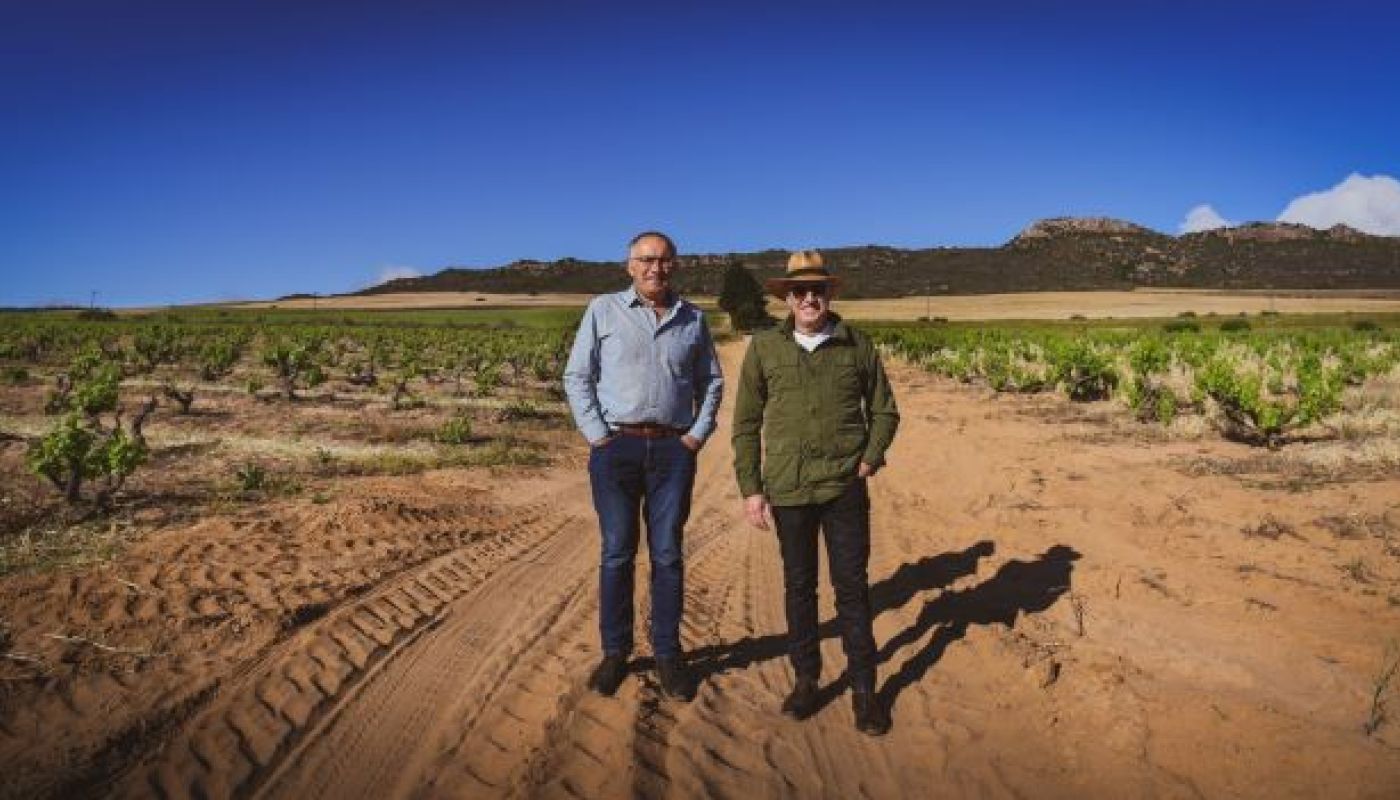
Piekenierskloof is a small wine region accessible from the Piekenierskloof Pass after a two hour drive from Cape Town on the N7 highway towards Namibia. Situated on the border of the acclaimed Swartland and the less glamorous Olifants River to the north, it is South Africa’s unofficial home of Grenache. Between 2009 and 2017 my husband, Jaco, and I were both making wine in the Olifants River before moving to Piekenierskloof Wines to join the winery situated in the town of Citrusdal, at the bottom of said pass.
Formerly Citrusdal Cooperative, the name was changed to Piekenierskloof Wines in 2007 by legendary South African wine personality Charles Back when he bought fifty percent of the shares of the cooperative. A decade later he decided to focus on his main wine and cheese business and sold his shares to brothers Oubaas and Potgieter van Zyl (pictured above with old Grenache vines), 3rd generation descendants of the first farmer to plant vines on Piekenierskloof, Johan Abraham van Zyl. Johan Abraham’s parents lived on a farm that later became part of present day Citrusdal. When the time came for him and his five brothers to venture out from their parent’s home, one option was to move up into Piekenierskloof onto a newly acquired farm. The decision was made by the drawing of lots, but when the lot fell on Christiaan, Johan’s younger, unmarried brother, Wilhelmina, Johan’s wife, urged him to relieve Christiaan of the burden, since he did not have a wife to assist him with this daunting task. ‘A brave wife of a lucky man’, I thought to myself after hearing the story.
By the time we arrived in Citrusdal I was aware of several influential wine makers sourcing grapes from Piekenierskloof, and was pleased to have the opportunity to get to know the old vineyards owned by the Van Zyls more intimately. Between the pair they have six vineyards older than thirty five years, the criteria determined by the Old Vine Project which viticulturist Rosa Kruger pioneered in an attempt to keep South Africa’s old vines in the ground. One of our first major projects after joining Piekenierskloof was to launch a range of wines from these vineyards. The common elements between them are that they are all un-grafted, dry farmed and bush vine trained. Furthermore they grow in sandy loam soils on mostly north-east facing slopes at altitudes of 620 to 750 meters above sea level. In order to create more differentiation than just varietal, we set out to find different names for each of the wines, capturing the essence of the vineyard.

Johan Abraham’s son Carel van Zyl inherited the farm Bergendal where his son Potgieter is at the helm today. Adjacent to Bergendal is Heidedal where Potgieter’s brother, Oubaas, is the caretaker of two and a half old vine vineyards. Heidedal Cinsault was planted in 1976 from cuttings taken from the Piekenierskloof farm Môrewag, where Oubaas Wolf, the first winemaker of Citrusdal Cooperative, initiated the planting of a field blend of Cinsault and Grenache. Oubaas van Zyl has fond memories of Citrusdal Cellars’ ‘Chianti’, as the super quaffable blend was called until the name was discontinued to avoid international conflict.

For humans old age hopefully goes hand in hand with wisdom, as well as peace with oneself and perhaps the world to an extent too. For vines old age usually means less bunches and berries that are smaller in size compared to when the vine was young. The latter being of particular significance for big berried varieties such as Zinfandel, Grenache and Cinsault. While this decrease in berry size is not going to have a Heidedal Cinsault taste and look like a full bodied Syrah, it did illicit an attractive tasting note from Jancis Robinson in her Christmas pick list for the holiday season in 2020: ‘Juicy, red-cherry fruit – juiciness incarnate, in fact, but with quite a grip of fine tannins too’.
Moving on from the Cinsualt, the second old vine vineyard on Heidedal is a block of Pinotage, planted in 1976 from Kanonkop cuttings, arranged by Carel van Zyl’s brother Pan van Zyl, a viticulturist at Nietvoorbij at the time. In 2018 Professor Johan Burger from the University of Stellenbosch released research comparing the grape composition at harvest of old and young Pinotage vines inter-planted in the same vineyard. His work showed that the juice of the old vines had a higher acidity at a lower sugar level and ultimately a lower alcohol and better pH than the younger vines, empirical proof of better balance in grapes from old vines. From own experience I would add that the tannin quality of old vine Pinotage is one of its most prized attributes, especially since tannin management in Pinotage can be tricky. Old Pinotage vines have the ability to produce wines with firm, dense tannin structures, yet with a suppleness and silky texture not always associated with the variety. Oubaas is particularly fond of his Pinotage vineyard and incidentally he is the namesake of Johan Abraham who arrived in the Piekenierskloof in 1923. It therefore seemed apt to name this vineyard after him, or them both, depending on how you look at it.
Moving over to the lookout point on a sandstone rock outcrop on Bergendal, one is intrigued by the unusually curvy rows of a Palomino vineyard lower down the slope, hailing from 1974. Carel van Zyl was a very meticulous farmer but had to leave the planting of the Palomino vineyard in the care of a farm manager since he was called away on military duty. On his return he was very upset about the quality of the planting and contemplated ripping out the vineyard, but thankfully he did not, otherwise there would have been less old Palomino wines signaling the rejuvenation of South Africa’s vinous history. A little bit of alliteration can be a good thing sometimes, so ‘Platklip Palomino’ came to life, named after the flat rock on which one stands to view the magnificent Piekenierskloof and this Palomino vineyard.
The oldest vineyard in the collection is the Bergendal Chenin Blanc, from a vineyard that was planted in 1962. Apart from passing vines onto his children, Carel also instilled a compassionate disposition in them. Modern day Bergendal has been Fairtrade certified for the past seventeen years and both Bergendal and Heidedal provide excellent daycare facilities, clinics and training opportunities for the permanent and seasonal workers on these wine, citrus and stone fruit farms. The work force at Bergendal can vary from three hundred to seven hundred people depending on the time of year. However, back in 1959, things were very different when Carel moved to Bergendal from his father’s home. When Johan’s workers were asked to accompany Carel to Bergendal, only one man was willing to go. His name was Samson and he was a tall, strong man, much like his biblical namesake. He and Carel single handedly planted this Chenin Blanc vineyard that is divided in two by four rows of Muscat de Frontignan which Carel planted for his wife, Jo, because she loved a little bit of sweet ‘Muskadel’. Today a straw wine is made from the Muscat and dried on the trays that are used to dry apricots and other stone fruit in the early summer. When it came to naming the straw wine it seemed fitting, albeit ironic, to name the small 350 ml bottle of deliciously sweet nectar, ‘Samson’, after the gentle giant who was Carel’s right-hand man and friend.
A few years ago, thanks to Rosa Kruger’s passionate drive behind South Africa’s Old Vine Project, a collaboration was initiated which lead to researchers from Interloire collecting plant material from our best old vine vineyards in January 2019. Some of the clonal selections they gathered from the Bergendal Chenin Blanc, as well as from Skurfberg, surprisingly tested negative for Grapevine leafroll-associated virus 3 in a first testing phase in South Africa. Subjected to a second round of analysis at Waite Diagnostics in Australia, the same material also tested negative for a further thirteen viruses. This year Vititec propagated two vines from the Bergendal Chenin Blanc in their greenhouse with the aim of eventually providing commercial material within the next few years.
Opposite the Bergendal Chenin Blanc one cannot miss the magnificent tall, gnarly trunks of a Grenache Noir vineyard planted in 1973. The border between Bergendal and Heidedal runs through the middle of this vineyard, so it was decided to name the Grenache after Carel who planted and tended the entire vineyard before dividing it between his two sons. Ever since Piekenierskloof and its Grenache made it onto my radar, I wondered how it came about that there are such old plantings, of a relatively unknown variety in the South African context at the time, in a relatively unknown wine region in South Africa. A plausible theory was developed over a bottle of wine one day when Oubaas and Potgieter told us more about their uncle, Pan van Zyl, mentioned earlier, who studied winemaking and viticulture in Germany in the 1950s. I am assuming that it was his proximity to the holy grail of Grenache in France and Spain, combined with the viticultural information he received during his studies, which lead him to urge his brother Carel to plant Grenache back home in Piekenierskloof. Over another glass of wine the brothers recollected how, as primary school boys, they helped their father plant this Grenache vineyard by dipping the young vines in cow manure before safely burying them in the sandstone soils that would be their home for the next forty eight years at least.
Fast forward fifty odd years and it was with undivided attention that I listened to my friend and passionate viticulturist Jaco Engelbrecht compare the solar irradiation levels of Piekenierskloof and Priorat in a Wine and Viticulture session with Gus Gluck and Dr Dylan Grigg on YouTube in 2020. Jaco’s first love in life is his family, his second is old vines and his third is Geographic Information System (GIS) mapping. His research was inspired by the question of why the average alcohol level of Grenache, growing in Piekenierskloof, is roughly one to two percent lower at physiological ripeness, compared to its counterparts in Priorat. Both regions have sites with similar altitudes, both are relatively close to a significant water body, however Piekenierskloof’s average temperature during summer is approximately two to four degrees lower. The main focus of the discussion however was the difference in solar irradiation, or simply put, the energy received by the two regions as a function of the sun’s angle in relation to the earth. Piekenierskloof receives significantly more solar irradiation than Priorat resulting in the optimization of Grenache’s ‘solar panel’. This, combined with the other factors, explain at least in part the extremely different styles of Grenache made in the two regions.
For both Jaco (husband, not the viticulturist!) and I it has been a very exciting and rewarding journey as we become increasingly acquainted with this special part of the South African wine landscape and particularly, its old vines.
The photos were provided by Cerina van Niekirk.
















