Apart from genuine old age there are three ways elderly vines cash in their chips - uprooting, disease and pestilence, or, as is common here in California, the old Louis the 16th, whereby the top bits are gingerly detached via chainsaw to make way for a Mary Shelly reattachment of whatever the hip variety du jour happens to be. Put squarely, due to economic, stylistic, and environmental factors, most vines simply are not making it to their golden years. Even vines with the ironclad plant genetics of Helen Mirrin are as endangered as a mountain gorilla if Granddad’s millennial progeny decide the vieille ferme is more profitable as a VRBO, once the youngsters realize Brussels will DHL them a check to uproot any trace of Gramp’s blood, sweat, and toil, Helen Mirrin is done for. If you’re an old vine, the world is gunning for you.
Geriatricide aside, we experience the ineffable magic of Nonna’s Bolognese as a culinary refinement of many decades of ancestral matriarchs chained to a range, literally, scraping by to feed a family of eight chattering little Italians. As Nonna piles on the years, her hereditary ragù making abilities will inevitably begin a terminal decline, conversely proportional to an increase in television volume and a gradual wiring of cash to Nigerian princes. Owning old vines is not unlike having a loving, kindhearted grandparent - you reap the fruits of perspicacious advice and warm nostalgia with the imminent knowledge, the clock is ticking, at any moment the phone could ring to the tune of, “Come right away! Pops just plowed his Oldsmobile into a Starbucks.”
With that sentiment in mind, first-rate old vines are thus captured in-bottle during their prime Bolognese making years, before entropy takes the driver’s seat. No viticulturist I know can elucidate an exact mechanism accounting for the nonpareil wellspring of nuance and grace which flows from the gnarled veterans. It could be a slow adaptation to the local climate, invigorating carbohydrate reserves cached in their contorted trunks, or simply geriatric plant tissues transporting less water and nutrients, begetting more concentrated berries. It could be plain endurance of the Darwinian test of time, being perennially lush and succulent in a green, leafy sea of mediocrity should spare you the executioner's block while your underperforming neighbors are grubbed up like winter leeks.
Considering our roots, I think there is a less tangible reason we are collectively drawn to old vines like moths to flame, humanity has slowly honed the stock over the whetstone of time, sifting out the useful, the intoxicating, the exotic, and the sensuous. Eventually the residual haunting aromas and textures imprinting on our own hometown palettes, be it the bitterness of a young Nebbiolo, Rhône barnyard funk, or the sweet candy of a plush Napa Cab, vines which have outlasted the temporal scythe are a campfire story to the whiffs and scents of our olfactory heritage as well as a palpable connection to our communal agrarian forerunners. Perhaps this is the reason we drop thousands for a weekend in the vineyards, but not, say, a broccoli patch.
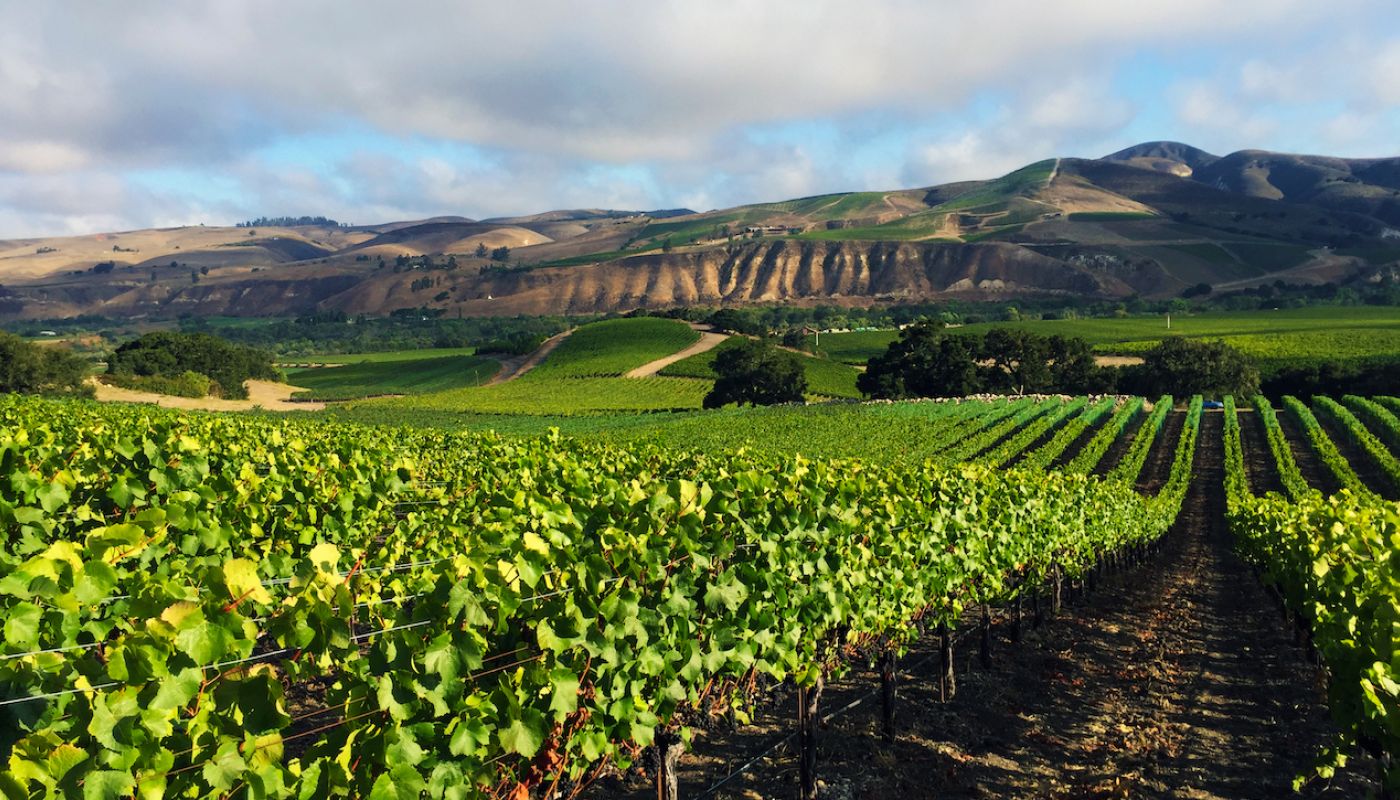
So this is a humble account of a tiny parcel of enduring vines seated in the misty valley below ominous, grey-brown hills crumpled like a Mariachi accordion mid-oompa. The account is mostly a big fish story - how I heard it. It’s better that way.
The story begins not with a weathered, cherry-nosed Burgundian with terroir under his fingernails and skin like andouille. There are no tall tales of a rogue vigneron with a Jacobin-like ideology driven by an irresistible idée fixe to hew grandiose wines of cultivated beauty from hard-bitten New World chaparral. The wine industry has no shortage of ideologues with blinders like carriage horses, and indeed a few are in this story, however, our yarn starts instead with a bright-eyed, pubescent dandy steaming to San Francisco at the height of the Belle Époque.
If you remember the commercials of a scruffy, well-pickled Orson Welles hawking jug California chablis, proclaiming, “We sell no wine before its time,” you might not believe Paul Masson had at one point, years ago, erected a California ‘champagne’ empire worthy of Hearst. At the ripe age of nineteen, Masson digested the bustling high life amongst ruddy-faced grifters, nouveau riche forty-niners, and the sans-culottes of the wild west - all the while considering his bleak future in his ancestral home of Burgundy, ravaged by phylloxera. The young dilettante vowed to return to the ‘Paris of the West,’ and two years later, Sorbonne education in hand, Masson departed France to stake out his gilded age fortune.
Upon arrival Paul set about empire building, quickly lassoing the heiress of Almaden Wine Company into marital bliss and breaking ground on his dusty 500 acre estate, christened ‘La Cresta.’ Shortly thereafter, San Jose customs agents were likely bemused when what appeared to be a large parcel of French kindling arrived on their quay, budwood mailed from Masson’s colleague Louis Latour, allegedly snipped in the vicinity of Chambertin. As fast as you can say, “vin rouge,” the Pinot Noir and Chardonnay were easing their gallic roots into New World terra firma at La Cresta. These two young scions, human and horticultural, form the fountainhead of our ambling tale. La Cresta is ground zero.
Masson’s life would go on to follow a Citizen Kane trajectory. He was christened ‘Champagne King of California,’ for his traditional method sparkling wines and excessive soirées at his Saratoga home, ‘Le Chateau.’ Despite guests including the likes of Charlie Chaplin, Herbert Hoover, and John Steinbeck, the lavish parties would not be attended by his, ironically, prohibitionist wife Louise, foreshadowing the movement which would spell the protracted decay of his empire. Slowly forced to amputate vineyards until his fortune was exhausted, Masson held onto his beloved La Cresta until the bitter end. The brand subsequently sold and was ruthlessly picked clean by several large conglomerates like turkey vultures on carrion.
His beloved vines would live on.
During the 1950’s, as Julia Child was deboning fowl and honing her Crêpes Suzette in the 7th arrondissement, half a world away, a man named Martin Ray worked his precipitous hilltop vineyard by hand, crafting single-variety wines and charging Grand Cru prices to a populace who largely preferred it’s wines fortified and sweet. Two bon vivants, amongst a sea of green bean casserole and hearty mountain burgundy, the obstinate pair both aimed to win over the hearts and stomachs of a nation devoid of flavor.
Martin Ray was a wild-eyed former stock broker, following the ‘29 crash and his subsequent nervous breakdown, he was urged by his doctor, as well as his wife Elsie, to change careers. As an adolescent, Martin had been like a surrogate son to Paul Masson, aiding him in the cellar and learning the trade. In 1936, seeking a bucolic escape, Ray purchased not only La Cresta from his mentor Masson, but also the neighboring mountaintop site, a raw, brush covered slope overlooking the Santa Clara Valley. The budwood Masson had fixed in the Franciscan shale was pushing middle-age, by the mid-forties Ray was preoccupied propagating cuttings from Masson’s vineyard on his windswept new venture, 2,000 feet above the valley floor. For the next three decades Ray nursed his few lonely few acres of expat Burgundy stock, working the nose-bleed grade by hand, haphazardly transforming each vintage into wine and oddly bottling the still wines in Champagne bottles, carefully packed in Mahogany cases.
By all accounts Ray was bombastic, tempestuous, idealistic, and a bit of an enological despot. A man who believed in California’s winegrowing potential with as much fervor as he believed consumers would just stumble two-miles up a desolate mountain road to discover his overpriced, boozy genius. While Julia Child was teaching America how to roast a chicken with her self-effacing wit, Ray was gaining a reputation as the fanatic madman on the lonely hill. He didn’t travel, hosted day-long parties, and oozed the general eccentricity and variable consistency of a starving artist. Ray was clearly ahead of his time, decades later wine club sycophants would worship at the feet of unconventional individualists like Gary Pisoni, Randall Graham, and Jim Clendenen. For Ray, however, the investors came calling in 1970 and he was given the boot. Renamed Mount Eden, the wines developed a persistent cult following under the new leadership. Sadly for Ray, Mount Eden would not be the hill he would die on, but rather beneath, breathing his last on a small parcel below his magnum opus, looming in the Saratoga mists.
According to local lore, a pair of counterculture hippies, post-summer-of-love, bumbled down the Pacific coast in a ’59 Mercedes, one leaning out the window holding a thermometer like a Labrador, bohemian locks flowing in the wind, searching for a Goldilocks site matched to Pinot Noir.
In reality, Michael Benedict and Richard Sanford were sailing buddies, Michael a collegiate botanist, Richard a naval officer fresh from Vietnam. The duo felt the wine industry looming overhead like the Pacific fog, an interest which was piqued by a fallow, 19th century vineyard site on Santa Cruz Island off the Santa Barbara coast. The off-shore site had allegedly produced thousands of gallons annually before prohibition forced the winery to close, leaving a fallow parcel in its wake.
Now, the odd couple may have driven around with a thermometer at some point, however, the duo also poured over geological records and scrutinized climate data from up and down the coast against a few centuries of Dijon records, eventually choosing to exploit virgin vineyard turf in their backyard. As it happens, Santa Barbara County is torqued sideways between two tectonic plates. This geological oddity gives rise to a set of transverse mountain ranges which run east to west, allowing the valley to freely breathe and exhale cool Pacific air, giving the bellbottomed pair the absolutely ideal amount of heat for their Pinot. Not too hot, not too cold.

The terminal stop on our California grand tour is a lonely north-facing amphitheater down a dusty Santa Barbara country road, the amphitheater a result of a landslip several millennia previously, the geological catastrophe churning deep clay-loam with Monterey shale until it was flecked like a robin’s egg. The clouds aligned, the lease was signed, the sun shone brightly, and it was good. They just needed vines. Cab and Riesling were waiting at a nearby nursery, however Pinot proved more difficult to unearth until Michael made a fortuitous call to Karl Wente, the third generation winegrower who just so happened to have a few leftover rooted cuttings after stuffing his fledgling Arroyo Seco vineyard south of Monterey. The cuttings were from an old friend named Martin.
A few years later, the first dry-farmed vines were harvested by a pair of shirtless amateurs, fermented in an oak vat fabricated by the hot tub king of Santa Barbara, and matured in a decrepit lichen-covered barn overlooking the breathtaking valley. The initial wine from the young cuttings was hailed as an ‘American Grand Cru,’ Richard and Michael’s Burgundian litmus test had put Santa Barbara on the map.

The old vines remain, healthy and happy, at the foot of the concave slope, shoots spilling into the wide rows, meant to fit a 1970’s pig-iron tractor. Nearly fifty years on, they’re not particularly old compared to the vines of warm, arid Barossa or Priorat - the viticultural equivalents of Scottsdale, Arizona. They remain a modest testament to a century of human ingenuity, prescience, and sweat. Old vines, young vines - they aren’t awake at night thinking of last years vintage or if their grapes are up to snuff. The story of wine, is the story of humanity, every year offering roots to our past.
The photos were provided by Ben Van Antwerp.
















