Craig Camp writes he has worked in the fine wine industry for almost forty years. He co-founded Direct Import Wine Company in Chicago, an importer and distributor of estate wines from France, Italy, Spain California, Oregon and Washington. After twenty years, he sold that company and has spent the last several decades on the winery side of the industry. After working several years at wineries in Italy, he oversaw vineyard and winery operations as president of Anne Amie Vineyards in the Willamette Valley, then as general manager of Cornerstone Cellars in the Napa Valley. Today, he is general manager of Troon Vineyard in Oregon’s Applegate Valley, a biodynamic estate specializing in southern French varieties.
Life from Life
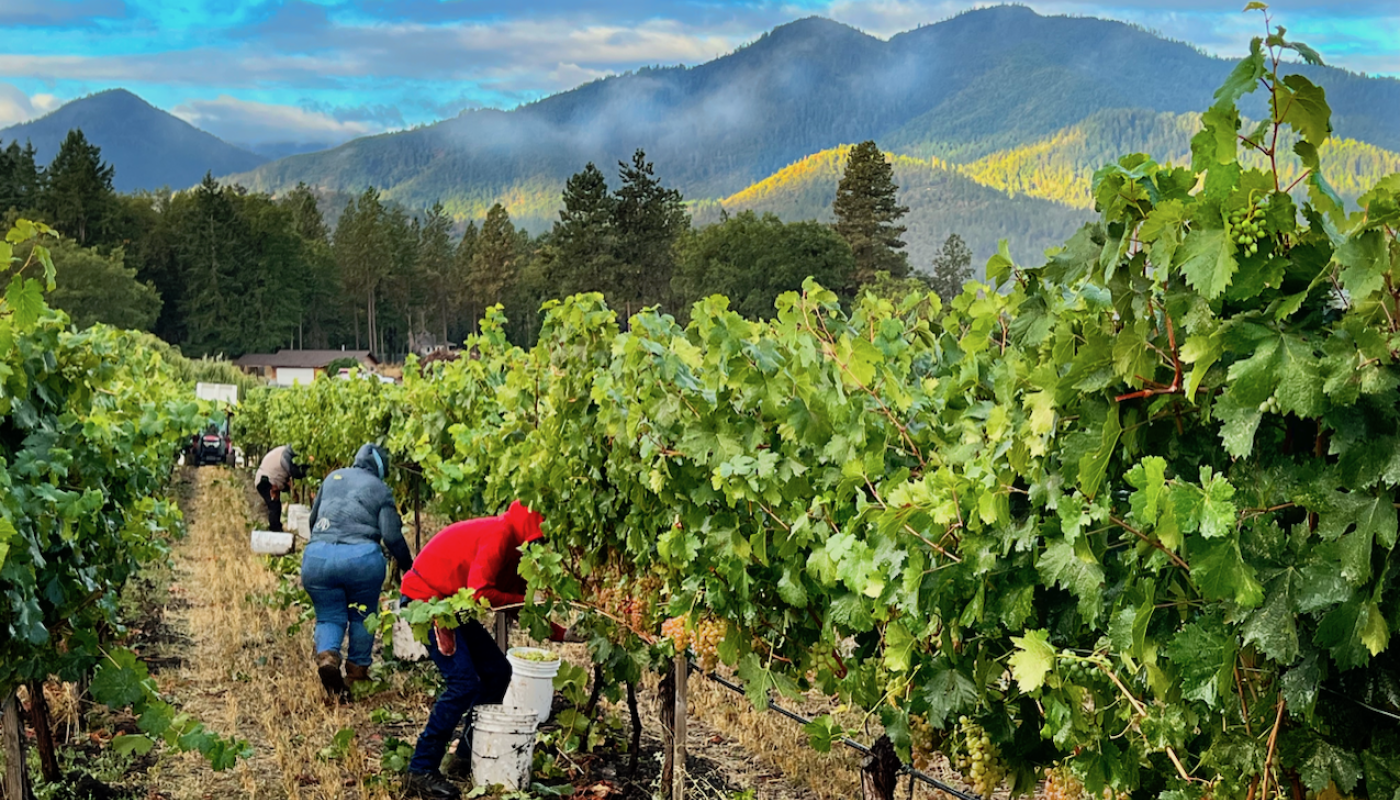
The view [pictured above, in main image] was majestic from Troon Vineyard but the skies were silent. In the distance, Grayback Mountain presided over Oregon’s Applegate Valley as it has for millions of springs. Local legend holds that when the white outline of a “7” formed by snow in the crevices near the peak melts farmers are no longer threatened by spring frosts.
I was surrounded by the wild splendor of the Siskiyou Mountains of southwestern Oregon, but the skies over the vineyard I stood in were silent. Not a bird or butterfly skimmed through the air. As Rachel Carson wrote, this was a silent spring. Walking the rows it was hard to understand how a farm so ideal for life could be so lifeless. Such was my introduction to Troon Vineyard.
The Applegate Valley is beautiful and defined by the ancient peaks of the Siskiyou Mountains. It is a region not fully tamed as rugged mountains and national forests account for much of the AVA. Wildlife abounds. But this abundance did not cross the borders of our farm. There was nothing to invite or entice it in. Over the last years, we have extended an invitation.
Today, Troon Vineyard is teeming with life. We have regenerated life on our farm from the soil below to the skies above. And in the process regenerated ourselves too.
Back in 2017, the problems were easy to identify, but as is often the case, finding answers is more complex. It is much easier to destroy life than rebuild it. A framework was needed to build a new foundation. I turned to biodynamics for that structure.
I had been a biodynamics doubter, I’d even ridiculed it from time to time. But eventually came a tipping point. I would taste a wine that I loved, then discover it was biodynamic. Then it happened again, and again, and again, and again...and then finally I attained enlightenment. There was a liveliness in the biodynamic wines that I loved. Then the connection reveals itself to you — the life in biodynamic wines is coming from life itself.
The first explorations into biodynamics can be disconcerting to those that believe in science. My first step was to attempt, I repeat attempt, to read Rudolf Steiner. This is a step I do not recommend to those with two feet on the ground. It’s better to leap forward a few decades to the writings of Maria Thun, Ehrenfried Pheiffer, or particularly relating to wine, Monty Waldin, and the YouTube videos of Alan York.
Biodynamics respects what we don’t know. As we learn more about the natural systems of soils and plants, science is moving toward the concepts of biodynamics rather than away from them. Probiotics are one of the health trends today and store shelves are full of them. I have come to perceive biodynamics as a proactive probiotic treatment for your soil.

Then there is our search for the natural rhythms of nature. Farming by the Moon is often ridiculed by biodynamic deniers who scoff at the idea that the Moon’s gravity affects plants much as it does tides. Maybe they’re right to scoff? Recent research by Isabella Guerrini, at the University of Perugia points to the light of the Moon itself having an impact on plant growth cycles. An article in the New York Times last year announced the discovery that the Moon has a tail, like a comet, that envelops the Earth once a month like a timepiece in the sky. What does all this mean? I’m not sure — and neither are you. We need to be more humble and have better respect for nature’s mysteries. We need to respect what we don’t know.
Regeneration is a layered process, each year you add new layers to your practice. You don’t just flick a switch and you’re a regenerative farm. It takes many harvests to repair the damage done. You are replacing simple solutions — monoculture, chemicals, tillage — with complex solutions — biodiversity, birds, beneficials, no-till — because nature is a complex system. Using the sludge hammer approaches of conventional agriculture disrupts the beautiful complexity that nature has evolved. We’ve broken nature and, like gluing a broken vase back together, it is no simple task and there is no guarantee it will ever be as beautiful. However, the vase we are trying to repair is a family heirloom. It is worth the saving.
The layers began with compost. A lot of it as more than four hundred tons of fresh cow manure arrived from our organic neighbor Noble Dairy. An annual occurrence now. We had selected a site for the compost pad and it quickly filled up as the manure began to arrive. We supplemented that with organic hay from another next-door neighbor. We are fortunate to live in a good neighborhood. We bought biodynamic preparations from the Josephine Porter Institute and made our first applications. The next year we grew our own hay and started making our own biodynamic preparations. Each year we added layer upon layer of complexity and each year we made progress. Slowly but surely, Troon was coming back to life.
The entire farm is now a vibrant green as the spring rains awaken the vines for a new vintage. This includes the alleys and under-vine areas of the vineyard floor where a blend of more than two dozen plant varieties now cover the ground as we have transitioned to no-till agriculture, an essential element of regenerative agriculture. Tillage destroys the mycorrhizal system we have worked so hard to build. The life underground is as essential as the life above.
Biodiversity builds ever more biodiversity. Today our fifty acres of vineyard are intertwined with fifty acres of cider apple trees, other fruit trees, vegetables, hayfields, sheep, chickens, guard dogs, re-wilded honey bees, and now, wildlife, who have graciously accepted our invitation to visit Troon.

The science of agriculture is moving forward, as always, driven by industrial agriculture as that’s where the money is. Just as they diluted, destroyed, and monetized the terms sustainable and organic, now they are plotting to do the same to regenerative. The Regenerative Organic Alliance was formed to stop them. This new certification goes beyond organic or biodynamic certifications. USDA Organic tells you what you can’t do, Demeter Biodynamic® adds a framework to rebuild and regenerate the microbiology of your farm. The Regenerative Organic™ certification builds on the concepts of both but goes beyond as you actually have to show you are making things better. Regular soil testing is required to show that you are increasing organic matter and carbon sequestration — that you are regenerating your soils. Simple sustainability is not regenerative.
Regenerative agriculture is a quest to understand and connect with the natural systems that make your farm unique. When we try to impose our will on these natural systems a delicate balance is shattered. In the War of the Worlds, Earth is saved from the invading Martians by microbes. Conventional agriculture has attacked the natural systems of our farms and in the process destroyed our soils and much of the nutritional value of the food they produce rather than grow. Once again it will have to be the microbes that come to our rescue and rebuilding those natural systems is the goal of regenerative agriculture.
At Troon, we have regenerated our soils and farm and today life is abundant. The soil is full of fungi and the sky is full of birds. The orchards, gardens, and vines are lush, green, and happy. When we think of regenerative agriculture those are the things that come to mind, but humans are just as much a part of a farm. Regenerative agriculture rejuvenates every aspect of a farm. Along with the health of your soils, plants, and animals, the spirit of those who farm the land is rebuilt.
The slogan of the Regenerative Organic Alliance is, “farm like the world depends on it.” It does and we do. What is more important is that others do too. The Earth is a family heirloom worth saving. It will take all of us to put it back together.
All photographs are the author's own.
















