Josie Phillips writes I am a Food and Beverage Manager/Sommelier based in far North East Scotland. I have been fortunate enough to enjoy several wine immersion and educational trips throughout my career, and I recently attended the Familia Torres annual wine course in Catalunya. I was blown away by their sustainability programme so felt compelled to make a submission to the writing competition, which I usually enjoy as a passive bystander.
The (re)generation game
The Torres family and regenerative viticulture
“The clock is ticking. We need to get on with it.” There is a palpable sense of urgency emanating from Miguel A. Torres as he delivers a presentation on the ambitious ‘Torres and Earth’ sustainability programme of the Spanish wine giant Familia Torres. He apologises a few times for getting “carried away” or being “too gloomy” where the topic of climate change is concerned, but rather than appearing downbeat, to his audience he comes across as impassioned and fired up – motivated by the belief that it is still possible to positively impact the Earth’s destiny.
The octogenarian represents the fourth generation of winemakers in the Torres lineage and is still very much at the helm of the family business, where he has held the position of President since the 1990s. Setting him apart from many of his generation, Mr Torres is an active and vocal advocate of sustainable viticultural practices and has spearheaded the company’s commitment to fighting climate change. Established in 2008, ‘Torres and Earth’ is an all-encompassing approach to tackling global warming. One crucial branch of this strategy is mitigating the effects of climate change by reducing the overall carbon footprint of the end-to-end operation, and a key component of this is the implementation of regenerative viticulture across the entire Torres portfolio.
***
“It all started from a simple question” Miguel Torres Maczassek explains. The son of Miguel A. Torres, fifth generation winemaker, and General Manager of the Familia Torres brand, Mr Torres Maczassek has an air of quiet confidence and appears most at home amongst the vines (and sheep) of the famous Mas la Plana vineyards in Penedès. He explains how he and his father, along with other family and team members, had made the decision to implement regenerative practices in their vineyards. “We asked, how can we make our vineyards capture carbon in the same way forests do?”
The answer – of course – lies in the soil; the more life in the dirt, the greater its capacity to capture CO2 from the atmosphere. At Torres – like a vast majority of vineyards, particularly those who practice organic viticulture - tilling the soil was a common way to tackle weeds in the vineyard without using chemicals and keep the ground clear and free from competitive or invasive plants. The process of tilling, however, poses its own issues from a sustainability perspective. Not only does the cultivation of land in this way use a lot of fuel for machinery, the turning over of the topsoil actively releases carbon back into the atmosphere. This has been described as the ‘Organic Paradox’ – where chemical-free activities which are considered beneficial to the environment, could inadvertently be causing more harm than once thought. So, what is the alternative? According to the Torres Family it is allowing nature to regenerate the soils and creating biodiversity instead of monocultures.
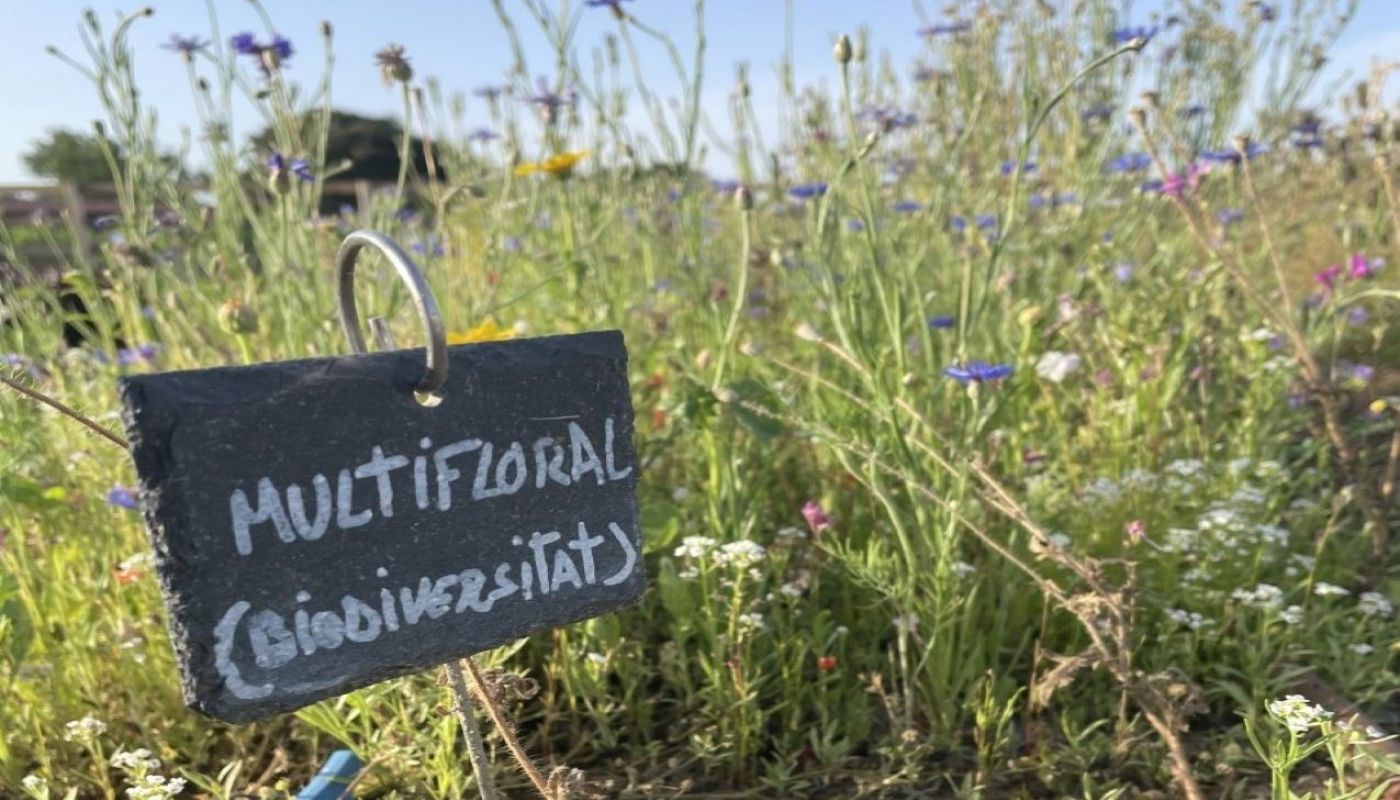
The Torres vineyards are now in their second year of being managed in a regenerative way, whereby grasses and wildflowers have been allowed to flourish between the vines, and the improvement in biodiversity is already clear to see. Bees and butterflies happily dot from flower to flower, and there has been a notable increase in other insect and bird life finding solace around the properties. When they first began to implement these practices, the neighbouring growers were not convinced. “When we stopped tilling the land, there were rumours that we were in financial difficulty” laughs Miguel Jnr, “they said our vineyards were ‘dirty’ because we had all this grass growing.” Now though, he says that they are starting to understand. There is nothing lazy about operating in this way; whilst nature can be allowed to take some control, there is a careful balancing act to ensure the quality of the fruit is maintained. The roots of the cover crops are in competition with the vines for nutrients in the soil, which can be a welcome implication as it forces the vine to work harder and subsequently reduces vigour in the plant, delaying ripening and improving fruit concentration. However, the grasses and flowers are also competing for another treasured resource – water. With particularly hot, dry growing seasons becoming more and more prevalent as climate change takes hold, the growers must ensure the vines have the best possible chance of getting enough water to thrive, particularly when they are young. As well as collecting and reusing rainwater for irrigation, regenerative growers have another clever tactic. The inter-row grass is roller-crimped, or flattened, causing it to dry out completely. The effect of this simple method is that the dried grass is no longer competing for water, but the roots remain intact, so they continue to hold carbon in the soil.

There is more to regeneration of the land and soil than simply stopping the practice of tilling. The Torres family have a wide array of mixed plantings across their estates and put an emphasis on growing ‘productive’ plants that can provide sustenance and nutrition to the community as well as improving biodiversity. There are the obvious olive trees used to produce high quality oils, as well as stone fruit, fig, and almond plantings. The local bee population has had a boost from several hives that have been installed across various properties. A flock of sheep mentioned above have a happy home at Mas la Plana, whilst the steep slopes of the Purgatori vineyards - less suited to hooved animals - are inhabited by hens who help keep on top of the insect population as well as providing organic fertiliser for the crops. It will take some time to truly establish the impact of regenerative viticulture on carbon capture and emissions, but the current estimate is that the vineyards will hold around 1 tonne of carbon per hectare which when spread across the vast parcels of land managed by Torres, is a somewhat impressive number.
Whilst I am aware that I may painting a somewhat idealistic picture of the properties in question, don’t be fooled into thinking this is some kind of whimsical, new-wave tribe. Familia Torres is a serious commercial operation where environmental, societal, and financial sustainability take centre stage, and preserving the family legacy - as well as the land itself - for the next generations is a top priority.
***
With great power, comes great responsibility.
The Torres family are well aware that having five generations of winemaking heritage, and the exposure that comes with being behind some of Europe – if not the world’s – most well-known wine brands, puts them in a uniquely privileged position to wield influence and raise awareness in their industry. The commitment to do exactly that was solidified in 2019 when Miguel A. Torres joined forced with the Jackson Family from Napa Valley, California, to establish the International Wineries for Climate Action (IWCA). This organisation was set up to promote and advance the decarbonisation of the wine industry, and they now have members across the world, all committed to making steps towards net zero by 2050.
The establishment of the IWCA appears to have been somewhat initiated by the US-based branch of the Torres family tree. Miguel A. Torres’ sister, Marimar Torres, is Vice-President of the business, and owns Marimar Estate in Russian River Valley, California. Marimar’s daughter Christina began working for Jackson Family Wines in 2017 and noticed many parallels between their ethos and that of her uncle back in Spain, forming the link between the two prestigious families. Christina now works with her mother at Marimar Estate, and when she eventually takes over the business, it will be the first mother to daughter hand over in the family’s history – something which Marimar is evidently very proud of. Both mother and daughter are equally as committed to the sustainability agenda as their Spanish-based relatives, with the exceptionally pragmatic (and enigmatic) Marimar admitting that it may never be possible to fully quantify the effects of their regenerative practices but that she had to take a “leap of faith”.
Outside of Spain and the US, Familia Torres also own businesses in Chile, having been the first foreign company to invest the country’s wine industry in 1979. The sustainability programmes reach as far as Patagonia where Miguel Snr purchased a large parcel of land which he is working on reforesting. He has planted hundreds of trees there already with thousands more to come in the next few years, and jokes that he could have bought “a nice apartment in Barcelona” for the same price, but he would rather invest his money in the future.
***
While the flora and fauna flourishes in the vineyards restoring nutrition to the soils, behind the doors of the Torres wineries and labs more pioneering work is underway to mitigate the effects of climate change, this time under the watch of Mireia Torres Maczassek – Miguel Jnr’s sister and Familia Torres’ Director of Knowledge and Innovation. One such venture involves capturing the CO2 released from the winery and using it as an inert gas in the production of white wine. The process is relatively inexpensive to put into practice and by next year Torres expect to be able to capture 100 tonnes of CO2 in this way. They are sharing their innovations in the hope that dozens of wineries around Spain will follow suit.
However, despite the numerous steps towards mitigation, there is no escaping the fact that the impact of global warming is already being felt. Miguel A. Torres likens the vineyard to the canary sent down into mines to check for dangerous gases – i.e., the warning signs will be seen in the plants before they become apparent to the wider population. A very striking example of this is that the growers are seeing on average a 7 day per decade advance on grape ripening, meaning the growing season gets shorter and harvest becomes earlier each year.
For this reason, steps have been taken to adapt to the effects of climate change and ensure future viability for the business and wider industry. Some of the more obvious solutions involve planting vines at both higher altitudes and latitudes, to allow established grape varieties to continue to prosper as the temperature rises, as well as delaying ripening using canopy management techniques. But they are also embarking on an ambitious project aimed at restoring ‘ancestral’ varieties to the Catalunya region of Southern Spain.
The notion came about that there must have been many native vines growing in the area pre-phylloxera, and that there is potential they will be better suited to the land and more adaptable to climate change than their national and international counterparts. The challenge, then, was how to find and identify them. The company decided to seek the assistance of the local farming community and took out adverts in regional agricultural publications asking landowners and workers to get in touch if they had noticed any unidentified vines growing on their properties. They were inundated with responses, of which a large proportion were false alarms and turned out to be familiar varieties. However, through careful DNA analysis the process eventually uncovered more than 60 ancestral Catalan varieties that were previously unknown or thought to be extinct.

Many of these are now cultivated in the area, not only by the Torres family but also many other local growers who wished to try and reinstate the native Vitis. There have been varying degrees of success, but some have flourished including Forcada (the only white example) and Pirene which Torres now bottle varietally in small quantities, and Garró which has been included in the Grans Muralles bottlings since 1996. The hope is that these ancestral varieties will prove hardy enough to withstand more extreme climatic conditions and offer a bright future for wine producing in Catalunya.
To the Torres family, regeneration is about more than soil. Viticulture is at a crossroads, on one side is the path of least resistance where we take no action, global warming continues at the projected rate, and wine growing as we know it ultimately becomes unviable. The other path undoubtedly involves more work but given the right level of global commitment, degrees of warming could be halted – even reversed, and entire communities can continue to survive and thrive. Mr Torres’ proverbial canary may be showing signs of distress, but its not dead yet. There is still time to make a difference, but the clock is ticking. Let’s get on with it.
All images are the author's own.
















