Mathieu Brochard writes Hello fellow wine lovers, my name is Mathieu Brochard. I come from France but have lived and traveled in many different countries. Since 2010, I have studied and worked in all areas of the wine industry. I soon specialized in wines made from quality, organic grapes with little intervention in the vineyard. I am a big fan of agroecology and obtained a Permaculture Design Course in 2018 in Australia. I recently started to write about wine for a new project in collaboration with my wife, a blog called terrewine.com. Enjoy this article!
Make Alsace Diverse Again
Every year driving through the Alsace wine region in northeast France, tourists are amazed by the breathtaking landscape. Grapevines grow on every slope of the Vosges Mountains, flanked by too many medieval castles to count. The perfect Alsatian experience consists of stopping at one of the Germanic-looking villages for a stroll, a wine tasting and a two-hour lunch. The weather is usually excellent as it’s one of the least rainy places in France.
This dramatic landscape makes for a great place to vacation, but the longer I spent there, the more I felt something was missing. Little by little, I began to notice I didn’t hear many birds or other animals. Shade was hard to find and I realized I was surrounded by a sea of grapevines with barely any trees or other crops. Above me, on the top of the hills, I saw forests; below me, on the plains, various food crops. But everything in between was almost entirely grapevines. Suddenly, I knew what was missing, diversity!
Some Alsatian winegrowers are worried about this monoculture, or “desert of grapevines” as some call it. The land in the Alsace AOC is very expensive and it is not economically viable to grow any other crops. To compensate for this lack of diversity, a few growers are planting trees in and around their vineyards. They are inspired by their ancestors, as well as a strong movement of regenerative agriculture. They call it agroecology, permaculture, agroforestry or even vitiforestry. They aim for more biodiversity, more life in the soil, and better grape and wine quality.
Historically, grapevines have always grown alongside fruit and nut trees. Shortly after World War II, during what’s known as the “green revolution”, the trees started to disappear. At the time, the average size farming plot in France was a third of a hectare. During the “great consolidation”, the ministry of agriculture decided to combine the tiny plots into larger ones. Their goal was to ease and optimize the work of the farmer. Traveling between plots became quicker and the land was adapted for bigger tractors and heavy machinery. Many groves, banks, ditches, ponds and hedges were destroyed. The trees in the vineyards and fields were ripped out.
It soon became clear to certain experts that the “green revolution” and its monoculture had many downsides. They started to look for other alternatives, like bringing in animals, trees or other crops to add diversity to the vineyards. At the end of the 1970’s, the word “agroforestry” appeared for the first time.
In Alsace, André Durrmann was the first to plant trees in his vineyard. André had taken over his parents’ vineyard in 1979. In the early 1990’s, researchers from the National Research Institute for Agriculture, Food and Environment (INRAE) came to Alsace to study vine moth caterpillars. Working alongside them on their project had a big impact. It showed him the importance of trees in an ecosystem.
The most infamous species of vine moths are Eudemis (Lobesia botrana) and Cochylis (Eupoecilia ambiguella). The moths don’t actually harm the vines, but their caterpillars do. To make matters worse, there are three different generations of these caterpillars. The first generation eats the flower buds, while the second and third generations burrow into the berries and feed on them. This can result in lower yields and a drop in quality. The caterpillars make holes in the grapes, creating the ideal condition for the development of grey rot (Botrytis cinerea) and sour rot.
Now that I’ve introduced the villains, let’s talk about the heroes! Trichogramma wasps are small parasites that lay their eggs inside the moth's eggs. By doing so, they kill the moth embryo before it hatches. This has the double effect of preventing the damage caused by the caterpillars, as well as reducing their numbers.
During their visits, the INRAE researchers found a large population of Trichogramma and other insects in the trees surrounding the vineyard. They thought it explained the low amount of grape moth caterpillar damage in Durrmann’s vineyard. This research project eventually led to Trichogramma diffusers being sold to vinegrowers as an aid in fighting against this pest.
André was still using pesticides at the time, but a seed was sown in his mind. Diversity in and around his vineyard can be a natural way to control pests. He started nurturing some of the trees naturally growing in his vineyard. Even more importantly, he let the grass grow tall. This is crucial as insects and animals don’t move far from their trees unless they have safe zones to hide in. The tall grass offers these safe zones. These insects and animals are much more efficient at pest control when they live inside the vineyard, rather than just on the exterior.
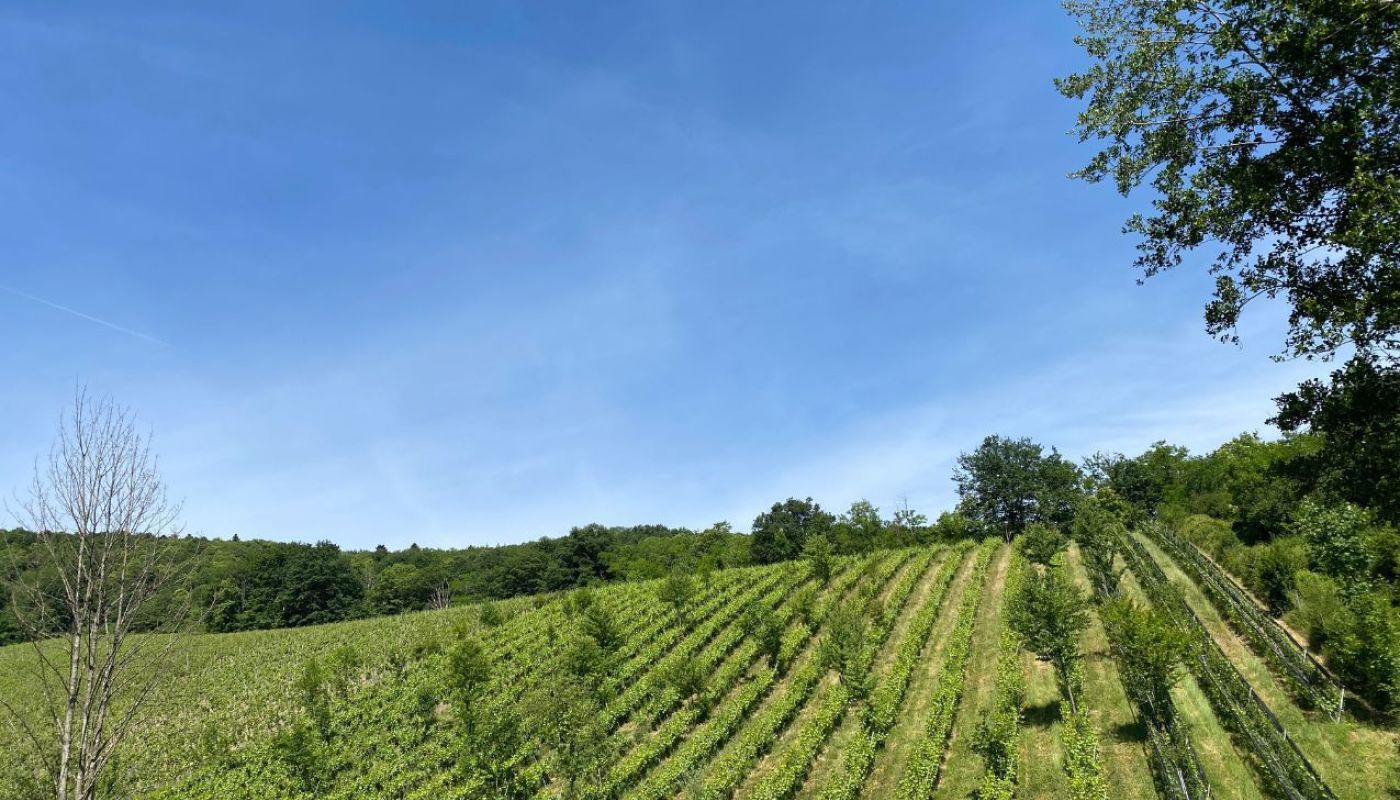
Starting agroforestry was a very slow process. It required him to think outside the box, at a time when trees were considered weeds within a vineyard. Slowly but surely, he began planting more trees within the grapevine rows. He planted some fruit and nut trees, as well as wood trees. This is when his unique trellis system came in handy.
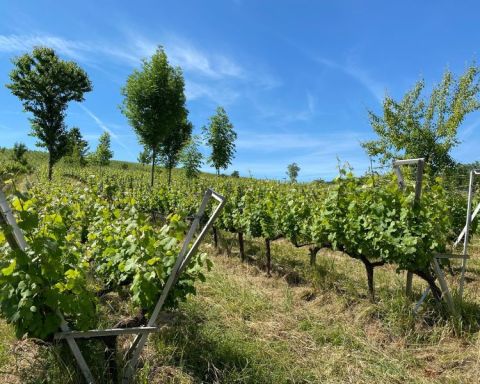
Years before planting trees in his vineyard, André had started to train some of his grapevines in the Lyre trellis system (see photo above). Also known as U-shaped trellises, the vines grow on two different sets of posts and wires. It can almost be mistaken for two separate rows. This system lets more wind through, preventing humidity and diseases, like downy mildew. The leaf system is bigger and can catch more sunlight. The bigger leaf system also acts like an umbrella, giving the grapes more protection from the sun. Some studies have found that the Lyre trellis system gives overall better wine quality. The rows are very spaced out (3.20 meters or 10.5 feet) allowing the use of larger and more stable tractors, which is both convenient and safer on steep slopes.
André soon learned that this system also had a hidden advantage when he began planting trees. In the classic vertical trellises, like the Vertical Shoot Positioning (VSP), there can be some issues. When the trees get older and the trunk becomes wider than the vines, they can block mechanical tools. These trees can also begin to shrink the size of the rows, making it difficult to use tractors, and putting both the tractor and trees at risk. With a U-shaped trellis system, such as the Lyre, the trees are free to grow and don’t prevent the use of machinery. The very wide rows add to the ease of work. “Thinking long term is critical when planting trees as it’s important to keep the vineyard easy to mechanize. If the work is too complicated, it becomes very hard to find workers”, Durrmann explained.
It’s now been more than twenty years since André started planting trees in his vineyard. With all his experience, he has gained great insight into the pros and cons of vitiforestry.
Trees in the vineyard act as natural umbrellas, providing shade and controlling the temperature in the vineyard. André says that trees can keep the vineyard up to 5 degrees celsius cooler or warmer during moments of extreme temperatures. When standing under them, the difference is obvious. These cooler temperatures help keep the sugar levels in the grapes from spiking. This gives an alcohol level around 12-12.5% ABV, when many Alsatian wines are getting closer to 14% ABV. This gives more freshness to the wines and makes them easier drinking. These natural umbrellas also help shield the grapes and leaves from sunburn.
André is a believer in using all available natural resources. He uses solar panels to power his house, his winery and the Tesla he drives. He uses solar ovens (see photo below) to cook outside when the weather is nice. As an added bonus, cooking outside doesn’t heat up the house, reducing the amount of energy needed to keep it cool.

He applies the same philosophy in the vineyard. He sees trees, and all plants for that matter, as tools to catch the sun's energy and then store it in the soil (in the form of carbon). These plants open up the soil with their roots, and slow down the rain water on its way to the closest river. Slowing down the rain water allows the soil to soak up a greater amount of water. The trees act similarly to water tanks, storing water and sharing it through fungal connections when other plants need it.
As we saw earlier, planting trees, especially different types of trees, brings more biodiversity to the vineyard. It’s also brings more diversity to the soil, creating ideal conditions for life. The trees and plants give the soil shade, temperature control, water, nutrients and even aerate it. In turn, the fungi and microorganisms within the soil help the roots reach a wider variety of minerals. The vine roots are encouraged to grow deep to access water and minerals, since there is root competition all around. When it’s time to harvest, the grapes are full of nutrients and don’t need any additives to ferment. Those are ideal grapes for Domaine Durrmann to make natural wines.
Domaine Durrmann doesn’t get fewer grapes from vineyards with trees compared to those without, in fact he even get bonus crops from the trees. Let’s take the acacias as an example. The flowers are used by bees to make honey, and some are harvested. After pruning the leaves are used to feed the sheep, and the wood is used for heating.
Only about half of Durrmann’s vineyards have trees growing within the rows. Many of his vineyards are planted in what he calls the “normalized way”. However good the Lyre trellis system may sound, it’s not allowed in the Alsace AOC. So far he hasn’t had any problems but if he did, he would have to stop calling his Lyre trellised wines “Alsace”. To lower the risk, about half of his vineyard is “normalized”.
The “normalized way” in Alsace is what you see in most other regions. The vines are trained on a vertical trellis, with a smaller space between rows. The reasoning is that the roots of vines need to compete with each other to grow deeper. André believes that the roots of tall grass can compete for space as well, if not better, than vines. In fact, in 2002, the famous soil specialist Claude Bourguignon came to check his soils. He was impressed by the depth of the roots of his vines. They were longer than 1.5 meters (5 feet). He didn’t expect that vines so far apart would grow roots so deep. For André, the AOC forcing the use of the “normalized way” is killing the creativity of Alsatian farmers, and doesn’t allow them room to find better solutions to current problems.
André doesn’t plant any trees in the “normalized” plots. It would make the work harder and create issues with both the equipment and trees. I was surprised to learn he leaves one “creative” plots trained in Lyre without trees. “It takes a lot of time.” he explained, “Between planting, nurturing and pruning the trees, you need to be sure you have enough time and manpower”.
There are other potential problems to consider when planting trees in a vineyard. Too many trees can block the vines’ access to sunlight. André suggests that 80 to 100 trees per hectare is a good amount. The varieties planted are also very important; some trees can actually give too much competition to the vines. Durrmann is careful not to plant any type of evergreen tree, such as pines, that would weaken the grapevines.
Wildlife and biodiversity are important in a vineyard but they are not easy to control. Remember, birds and wild boars have no scruples eating grapes or digging into the vineyard’s nice loose soil! André uses fences around one of his plots to keep the boars out. The trees in the vineyard are pruned using the pollarding method, called “trogne” in French. During the early growth, all the side branches are trimmed to a certain point, a few meters over the grapevines. The top is then regularly pruned so it does not expand up or sideways. When pruned this way, the top of the tree keeps producing more branches, making it very bushy. This allows for more biodiversity and life than a naturally growing tree. It also serves as a perch for big birds to observe the surroundings. The grapes are far below the top of the trees with no safe zone in between. The small birds don’t feel confident enough to go for the grapes, and put themselves at risk of an attack from a larger bird. André also uses nets for rows next to hedges, to stop the birds from stealing all the grapes.
Many organic viticulturists in Alsace are following in the footsteps of André Durrmann. From the younger producers to the old guard, like Domaine Christian Binner, they are all united under the agroforestry flag. There is still a lot to learn and many ideas to experiment with before each of them settle on a solution for their individual situations. Is it better to plant trees within the vine rows, or make one full row of trees? Is it more advantageous to keep the vine under the trees or allowing it to grow up the trees? These are only a couple of questions they are trying to answer. With this idea in mind, they organize visits to each other’s vineyards and exchange thoughts about their favorite practices. They are always down to give a hand to their neighbor because they are all working toward a common goal: Make Alsace Diverse Again!
All images are the author's own.