Nicola Kelly writes Nicola Kelly works freelance in the wine & travel industry and is currently studying for her WSET Diploma in Wine. She has clocked up 103 countries so far, and always tries to combine wine with travel where possible. Where there is wine there is history, culture, connection. Recent trips have been to Algeria, Malta and Azerbaijan, with Lebanon coming up. (Unfortunately none of these are on the Diploma curriculum!).
Azerbaijan – Old & New
When you mention Azerbaijan, most people think of oil, Formula One and possibly Eurovision. The futuristic architecture of Baku conjures up Dubai. Wine certainly isn’t one of the first things that leaps to mind. However Azerbaijan has an incredibly rich history. Part of the Caucasus region that includes Georgia, Armenia and Turkey, there is myriad evidence of viticulture and winemaking dating back to ancient times.
Who can claim the oldest evidence of winemaking? Not Western Europe as many people might reasonably think. In Vayotz Dzor in Armenia, archaeologists have unearthed evidence of systematic winemaking dating back at least 4,000 years - a wine press, storage vessels, drinking cups and grape skins and seeds. Georgia has wine residue in qvevri dating back to 6,000 BC. In Turkey, Anatolia has evidence of tartaric acid from grapes estimated to be from 5,000 - 8,500 BC. The Caucasus can reasonably stake its claim as the birthplace of wine - sometimes called the ‘Noah Hypothesis’. The name comes from the story that Noah planted a vineyard on Mount Ararat when his ark rested there after the great flood. He probably needed a drink after that ordeal - as the story goes he had one too many, but we’ll leave that for another time.
Azerbaijan can throw its hat in the ring too - there is evidence of winemaking in the Nakhchivan region also dating back to 6,000 BC. In Goygol, where there is still a winery today, jars were discovered with the remains of wine from 2,000 BC. There are many more references to wine throughout the Middle Ages, although the Arab conquest in the 7th century did cause a decline in wine consumption. Today, Azerbaijan is still a Muslim country, however it is completely secular, alcohol is freely available, and wine is very much part of the culture.
The wine industry started thriving again with the arrival of German immigrants in the 19th century. Whilst wine was already being made locally, the German settlers bought expertise and investment. Their main occupation became cultivation of grapes and production of wine and other alcoholic drinks, creating the first large-scale commercial wineries in Azerbaijan. These activities set the foundations for the growth and development of Azerbaijan's wine industry, mainly exporting to Russia, and a small amount to Europe.
Azerbaijan became part of the Soviet Union in 1922 and wine production changed enormously. There was a State Committee for viticulture and winemaking, and the industry was nationalised. Large scale state-owned farms known as ‘sovkhoz’, short for ‘Sovetskoe Khozyaystvo’ were introduced, along with enormous processing plants. Production was mainly high-volume, sweet table wine, exported throughout the Soviet Union. This reached a peak in 1984, with over 2 million tonnes of grapes harvested from around 275,000 hectares of vines. By the end of the Soviet era, there were around 180 wineries, employing hundreds of thousands of people.
So if the Caucasus is the birthplace of wine, and Azerbaijan has a history of winemaking, why do we not readily associate wine with this place?
Mikhail Gorbachev’s anti-alcohol campaign, beginning in 1985, resulted in most of the vineyards in Azerbaijan being destroyed. Many of the indigenous grape plantings were destroyed too. This decimated the industry, its expertise and available workforce. The subsequent collapse of the Soviet Union in 1991, conflict over the Nagorno-Karabakh region, and economic turmoil all took their toll. Remaining vineyards were neglected, or repurposed for other agriculture as the Russian market for wine was no longer readily available. Around 20,000 hectares of vineyards remain today in Azerbaijan, with 10 major wineries responsible for production. With serious government backing and investment the industry is slowly but surely growing. The focus is no longer on quantity, but on quality. Many Azerbaijani wineries have been replanted with international varieties - the crisp white Bayan Shira and red Madrasa are the Azeri exceptions.
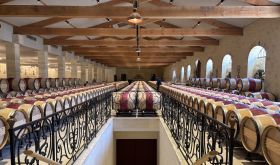
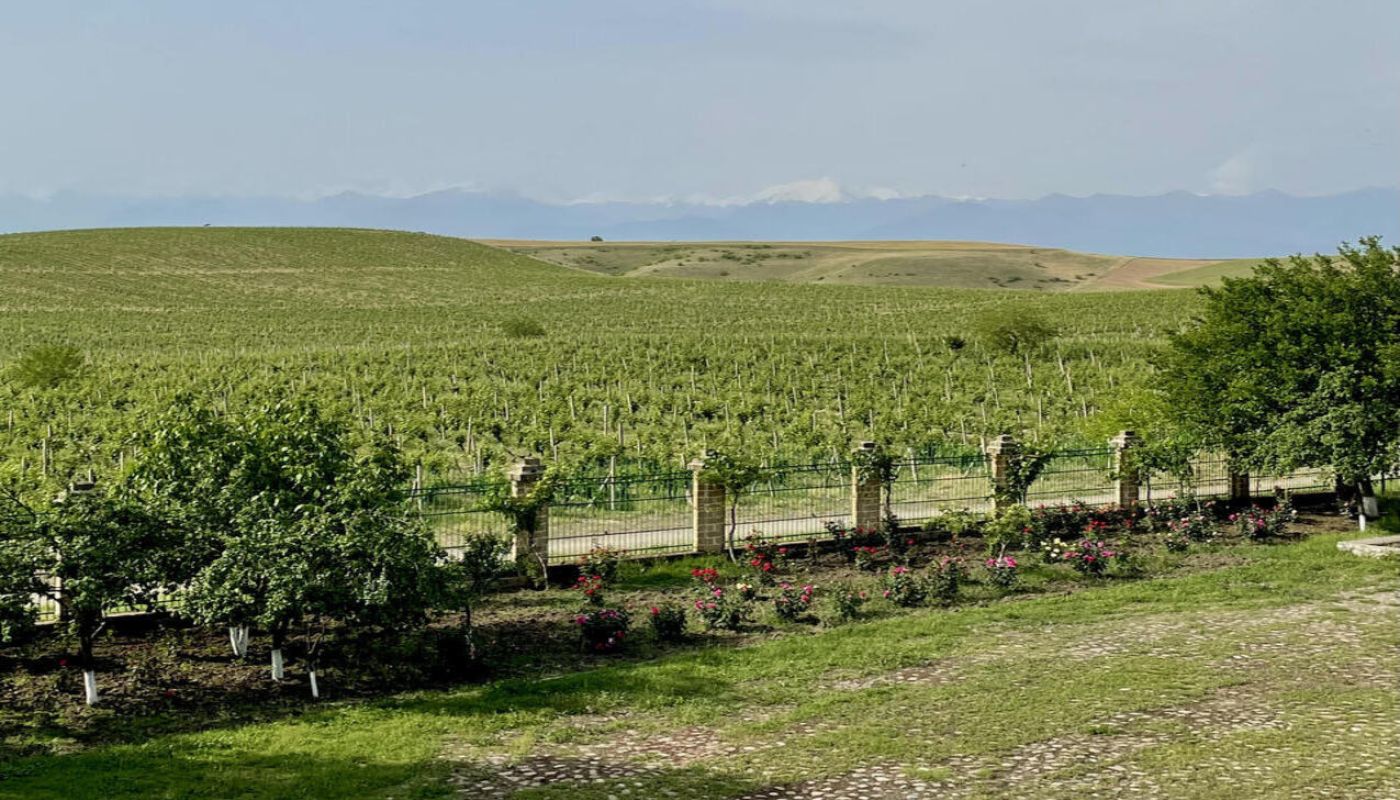
I recently visited Chabiant [pictured above, in main image] in Ismailli, known as one of the best terroirs in Azerbaijan. Originally started in the 1980s as a ‘sovkhoz’, the winery was rebuilt and modernised in 2017. Chabiant focuses mostly on local and indigenous varieties - notably Bayan Shira and Madrasa; Mtsvane, Rkatsiteli and Saperavi, from Georgia and the Caucasus region, with some Cabernet Sauvignon in the mix too. There are about 270 hectares, planted at altitudes between 600 to 1,000 metres, on loam and clay soils.
The Italian oenologists, Andrea Uliva and Marco Catelani, and Azerbaijani assistant winemaker Panah Abdullayev, are definite that the future of Azeri wine lies in resurrecting more of the indigenous varietals to have a unique product and expression of terroir.
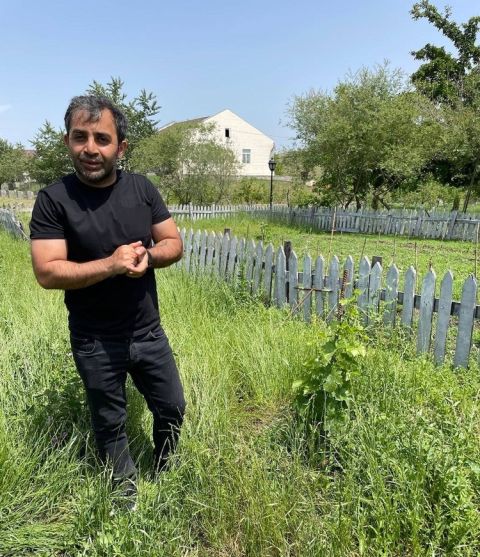
Their passion can be seen in their small experimental vineyard where they are cultivating some of the 'lost' varieties, where examples can be found. It’s impossible to know what varieties exist, or how many, in old vineyards and villages where vines might have survived. They speak with ex-‘agronoms’ - the agricultural experts from the Soviet era to identify the best varieties and clones that might be suitable for commercial viticulture. So far, they have some small plantings; Misgali, a white grape particularly suited to table wine; Khindogny, a red grape for still wines; and Shirvanshahi, a red grape with high residual sugar suited to dessert and late-harvest wines. It will take patience, and perseverance before there is an opportunity to make the wines.
These vines are tended after the day's work in the vineyard is done. It’s a labour of love, and I venture that it’s a tiring project after a long day’s work. “It’s not a project”, says Abdullayev - “it’s my life”.