
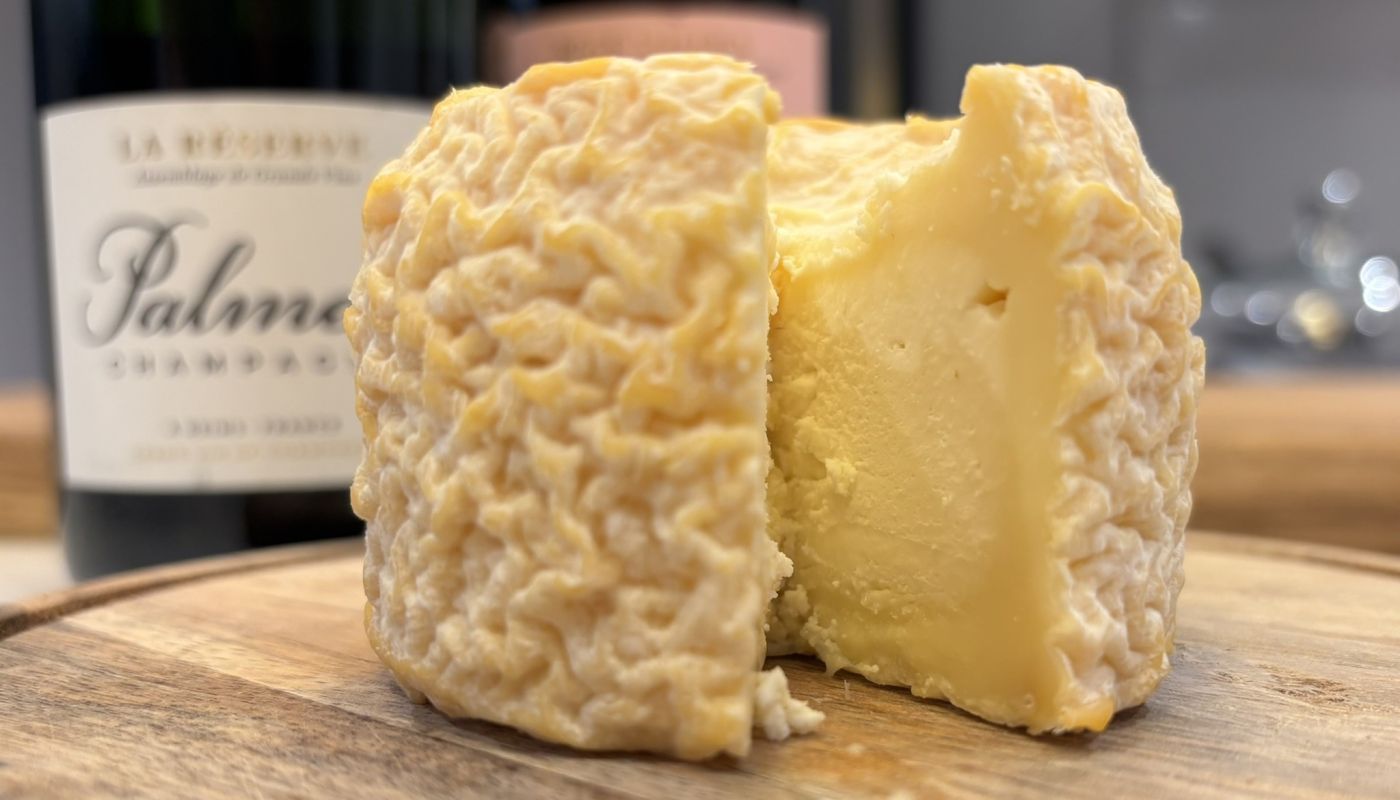
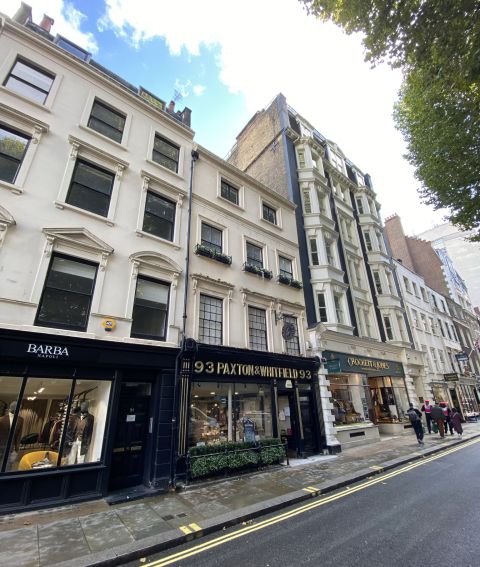
I had a fascinating, if somewhat short-lived, career as a cheesemonger a few years back. Despite writing about and studying cheese for some time, my practical experience had up until then consisted largely of late-night visits to the fridge. So, during one of the merciful breaks in lockdown, I headed over to Paxton & Whitfield, the UK’s oldest cheesemonger, who always need help over the Christmas period – the queue for their festive Stilton alone stretches half-way down Jermyn Street. Gluttony and a thorough knowledge of Penicillium roqueforti being my primary qualifications, I joined their merry band.
P&W central is in St James’s, a pukka slice of London ripe with history and home to the likes of The Ritz, Fortnum & Mason and Christie’s. Just the sort of place where you saunter back from a lunch of duck à la presse with a wheel of Parmigiano Reggiano, a box of exquisitely wrapped macarons and a lesser-known Matisse tucked under your arm. Paxton’s wonderful old building – all serious black and gilt – had its own colourful back story. The rooms upstairs were once home to that most disreputable of Victorian prestidigitators, Aleister Crowley. Serious black indeed, Sirius Black even. Risking demonic possession in the goat’s cheese section and slapping away astral hands as they clutched at the Bleu de Bresse was all in a day’s work. Much fun while it lasted which, in my case, was all of four weeks.
But before I was spirited away by equally suspect types from the wine trade, I managed to learn a great deal from the affineurs, buyers and retailers there. And I even got to serve a nice piece of blue to actor Tom Conti, star of Oppenheimer, Paddington 2 and, best of all, Shirley Valentine. As I hung up my apron and crossed Piccadilly to the razzmatazz of Mayfair, I had time to consider the relationship between cheese and wine, in detail. And I’ve been pondering it ever since.
Freewheelin’ on the chariot de fromages
An awful lot of words are expended on the subject of wine and cheese pairing. Some are wise and considered, but there’s the odd plume of hot air, too. My two particular bêtes noires (no, not you, Aleister) are those erudite commentators who are content to repeat tried and tested partnerships without further explanation; and jalapeño-jack-’n-orange-wine enthusiasts who haunt the Insta web with fantastical accounts of alt pairings that frankly no one needs.
There must be a middle way: pairing cheese and wine may not be an exact science, but we have the right to demand evidence and reasoned argument. Suggestions need to be replicable, too, in the name of objectivity and also so that you can munch along at home. No good me proclaiming the joys of a cheese available only in the Adirondacks matched with Château Unattainable 1912 (lovely ensemble as that might be).
Why do we keep obsessing about the twain, anyway? Because when it’s right, oh it’s right. There’s something about the melding, the alchemical wedding, the cosmic coupling (steady on) of fermentation’s royal love-match that makes it far greater, immensely more profound than, say, Blanc de Blancs and caviar-flavoured crisps/potato chips.
That’s precisely what we’ll be exploring over the coming months: this ineffable something that renders #cheeseandwine greater than the sum of its parts. And all the while thinking about how to put together show-stopping cheese boards and accompanying wines with confidence, elan even! As we do with wine, we’ll also touch on issues that affect or should affect our choices: seasonality, support for artisan producers and rural traditions, sustainable production practices. But mostly just excellent cheese and fantastic wine. Together.
Pairing 101: champagne and Langres
Let’s take a deep dive into one canonical pairing.
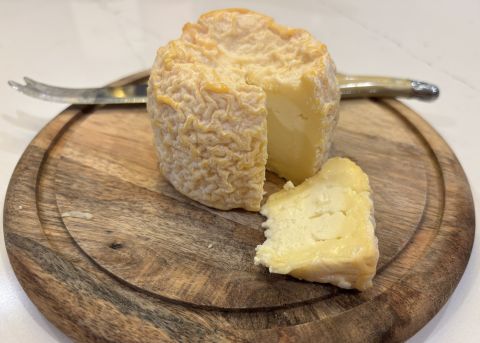
Langres is a washed-rind PDO cheese from the Haut-Marne in France, not far from a certain famous sparkling-wine region. Made from cow’s milk, it’s quite pungent (though considerably tamer than close cousins Époisses and Munster). The rind is washed in saline solution (sometimes with local firewater, like marc) getting its signature wrinkly complexion and funk from the action of the range of microflora that this washing encourages (Brevibacterium linens, Geotrichum candidum and friends). There’s a certain spicy smokiness to its dense, chalky paste when young that resolves into meltingly creamy, nutty deliciousness with age.
The prevailing wisdom tells us it’s made for champagne (quite literally, as there is a dip in the top called the fontaine to fill with fizz in moments of François Mitterrand/Brillat-Savarin joie de vivre). And despite being pretty vague advice, this received wisdom does give us a couple of working assumptions with which to begin. First, that the textural play of fizz works well with creamy soft cheeses; and secondly, that most entrenched of gastronomical ideas, ‘what grows together, goes together’.
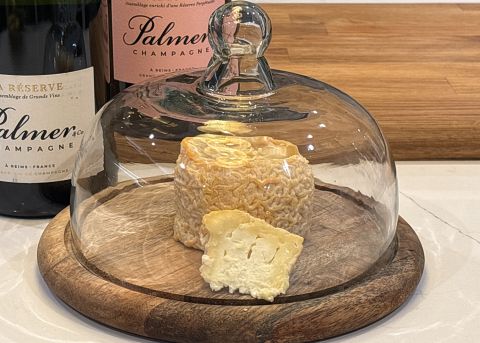
I duly tried my Langres with two wines from the same champagne house, in different styles. Palmer & Co’s delightful Réserve Brut NV usually hovers around 50% Chardonnay (my 2019-based wine had 51%, with 32% PN and 17% Meunier). Its fresh citrus, chewy chalkiness and buttery-brioche notes went well with the Langres but it was the hints of spiced, umami depths from the perpetual reserve that really hit the mark. Pale and austere Blanc de Blancs need not apply, then – with a yeasty, pungent cheese like Langres it’s this added oomph (a technical term) from black grapes that gives purchase on all that funky fat.

To double-check this proto-theory, I opened a bottle of Palmer’s NV rosé champagne that was based on the 2021 harvest, which, despite having slightly less black-grape action (54% Chardonnay), ups the reserve quota and includes around 6% red-vinified wine. It proved an even better pairing: the wine rich but lifted, with baskets of red fruit and some helpful mineral traction and tannic grip. True, tannins can get a little bolshy when encountering flavour enhancers like the salt in cheese. But, if well handled, they can really help to address a cheese’s creamy clag in a way similar to a wine’s acidity.
In turn, the cheese amplified the wine’s redcurrants-in-kefir quality producing some lovely taste and texture combinations. But cheeses like Langres will coat the mouth, potentially stripping out some of a truly complex wine’s nuance. Brave, then, the person who pairs it with Pol Roger Sir Winston Churchill, despite the latter’s perfect saline, baked-apple and toast profile. Texture and the physicality of cheese is something we always need to bear in mind in addition to considering simple flavour pairings and balance of intensity.
And what if we dial up a fizz’s PN quotient further? Cue a Blanc de Noirs from closer to home: Harrow & Hope in Marlow. Their 2018, which Jancis described as ‘bit of a bruiser’ (and they call ‘bold, broad, and almost brutish’), was indeed a little too ‘fighty’ but the more delicate 2019 fared better – salty, biscuity and membrillo-bejewelled, as Tamlyn noted in her recent review, being a lot of what I want with a cheese like this.
Reaching for an English sparkling begs the question of whether champagne is a significantly better bedfellow for Langres than, say, a good Crémant de Bourgogne (another neighbourhood fizz) or even the savoury tones of Graham Beck’s distant but suitably Pinot Noir-heavy Brut Rosé Cap Classique. After auditioning them all, I have to say that it isn’t. I hear the sound of pearls being clutched somewhere in Reims.
So, here are the headlines.
Langres …
Choose: fizz (champagne or other high-quality sparklers), especially those with a high percentage of Pinots and rosé cuvées.
Avoid: anything too pale and wan or, conversely, strident and overwhelming. Plus save the venerable (read expensive!) stuff for another time.
And think big. Once you’ve begun to question the hegemony of ‘local and trad is always best’, you can really unfurl your gastro sail, making for the US west coast or Mornington Peninsula, for example. And while you’re there, why not head down for a good old cheese and fizz fest with Max in Tassie.
To quote ’im upstairs (that P&W’s staircase not Jacob’s Ladder), ‘Do what thou wilt shall be the whole of the law’. And while that shouldn’t invite total libertinage in cheese and wine, it does suggest eternal cheese laws are there to be broken. Deliciously so. And that informed experimentation should be the name of the game.
I do hope you’ll join me as we explore together over the coming months and try to shine just a little light on to these dark, dark arts.
A little extra cheese-and-wine nous
What’s good right now |
|
Mont d’Or (and its Swiss cousin Vacherin Mont d’Or) is made with particularly rich milk at this time of year. OTT lux made for smearing or baking. Any leftover (!) Pinot-heavy bubbles would do well here. And I’ve happily paired it with a lighter still Pinot Noir, too, for smoky, mushroom-and-cream heaven. A Jura Vin Jaune is trad and good. |
Take-away tip |
|
A lot of the cheese we eat is in cooking rather than straight from the board, so think about how heat and additional ingredients will change a pairing. I used my leftover Langres to make a fantastic, oozy omelette seasoned with black pepper and a little thyme. A lighter beaujolais cru (mine Jacques Dépagneux, Vieilles Vignes Cuvée Marius 2022 Juliénas) will add a touch of tannin and a light brush of undergrowth to compliment all that farmyard egg/cheese/butter creaminess. |
Monger in the spotlight |
|
Mons Cheesemongers |
Further reading |
|
The Oxford Companion to Cheese The standard, encyclopaedic reference. You’ll even find contributions from a certain Tara Q Thomas … |
|
The Philosophy of Cheese Lighter (figuratively and literally) but no less authoritative. A deep dive into 11 world-class cheeses. More history than philosophy but still tasty. |
Next month … it’s festive cheese (of course it is!). Spoiler alert: we’ll start with Stilton and port but won’t be stopping there.