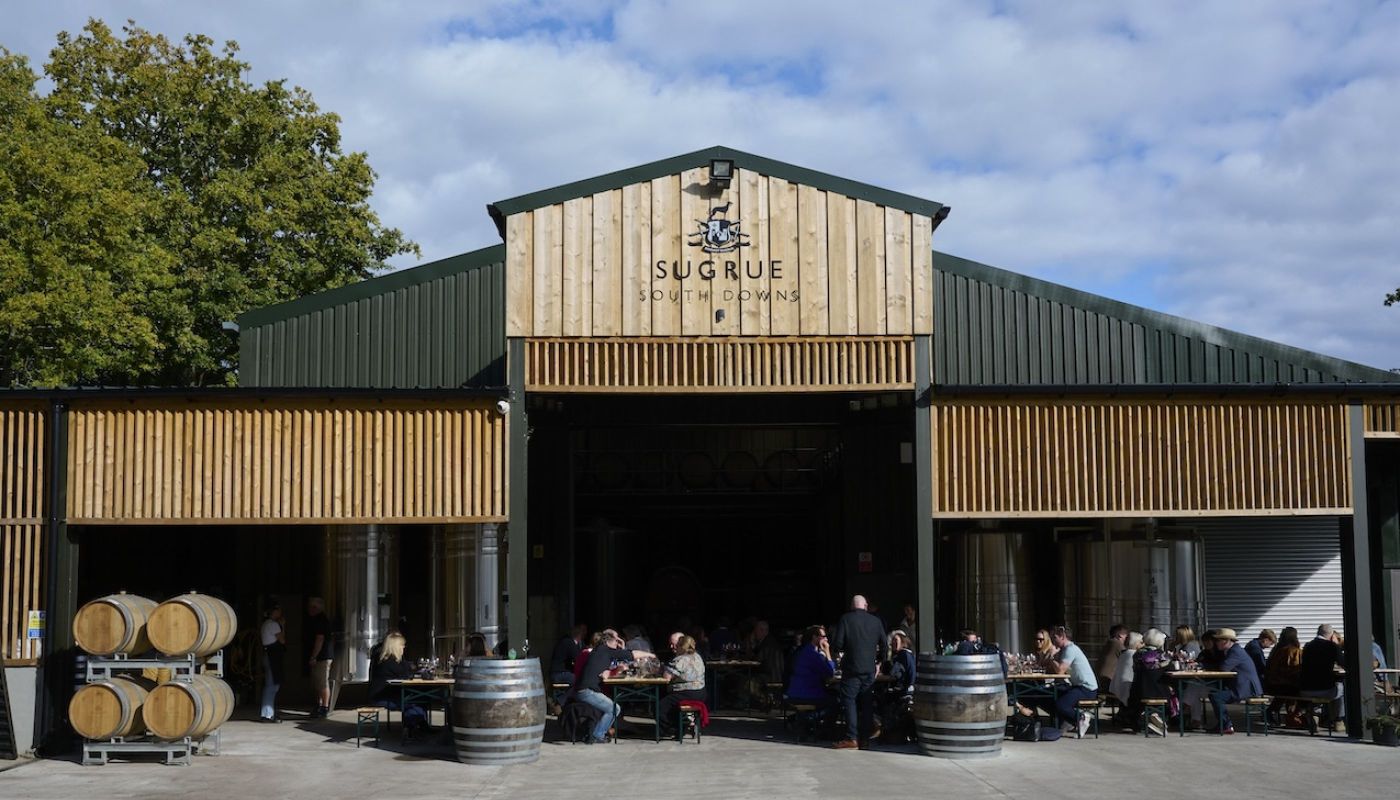
When planning their series of four Sugrue Sundays, gatherings of customers for lunch cooked by a guest chef at their Bee Tree winery near Burgess Hill in Sussex, Dermot and Ana Sugrue thought it was safe to time the last one (pictured above by Sarah Weal) for 21 September. October has been the usual harvest month. The previous record was set in 2020 when the first grapes in Sussex were picked around 21 September, but 2025 broke new ground.
Summer was so hot in England this year that the grape harvest is the earliest-ever by far. In the event the Sugrues were already 11 days into harvest and the guests had to be chivvied out at 4 pm to make way for that evening’s delivery of five tonnes of Pinot Meunier grapes.
The warm weather has delivered unusually ripe grapes but from generally rather small bunches. Yields, dictated to a certain extent by the tiny 2024 crop, will not be generous. But that may be a good thing.
The English wine industry – and it is no longer a hobby activity by any means – has been growing dangerously fast. Encouraged by warmer summers, investors have been piling in to English vineyards. Of the 4,841 ha (11,962 acres) of vines in England and Wales at the last count, nearly 1,000 ha are less than three years old, so not yet in full production. Yet 2023 produced as many as 21.6 million bottles of wine when the previous record harvest, in 2018, filled only 13.1 million.
In this looming grape surplus there is a silver lining for smaller operations such as Sugrue South Downs, voted Best Boutique Producer in 2020, 2021 and 2023 by WineGB, the generic organisation for wine grown in England and Wales (not quite Scotland yet).
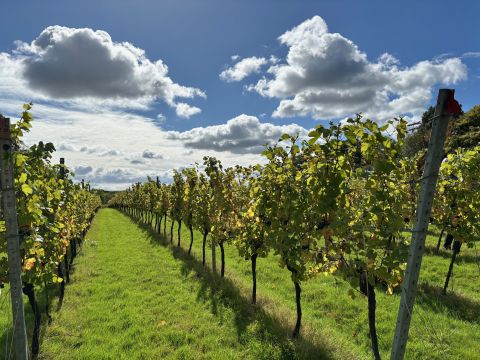
About three-quarters of such wine is sparkling. Ever since Nyetimber proved in the mid 1990s that a fair copy of champagne could be made in Sussex, sparkling wines have dominated the British wine scene. High acidity is an asset in base wines for traditional-method (bottle-fermented) sparkling wines and, with its relatively cool climate, the UK has regularly boasted higher (sometimes dangerously high) levels of acidity in its grapes. Indeed, one of the reasons champagne producers such as Taittinger and Pommery have invested in English vineyards is surely because warmer summers have been reducing acid levels in the Champagne region.
But the traditional method also requires extended ageing in bottle, far longer than for most still wines. So for the investors, most of whom have hung their hats on sparkling-wine production, returns are slow. Vineyards need three years to produce a viable crop and then the resulting wines may not be released for many more years. At WineGB’s recent annual tasting the youngest vintage of most of the sparkling wines shown was 2021, and some were as old as 2013.
No advanced financial acumen is needed to see that the balance sheets of these recent investors tell a sorry tale. At his last Sunday lunch Dermot Sugrue was cock-a-hoop. ‘In 2025 we’ve been offered fruit from Grand Cru vineyards at a great price because the accountants are telling the owners their sales forecasts have been too optimistic and they need to get some cash in.’ (His very experienced winemaker wife Ana cringes at his use of the highly regulated French term but knows well what he means.) He claims to have been offered top-quality fruit that would normally cost more than £3,000 a tonne for less than £2,000.
Northern European weather is no friend of accountants. Higher average summer temperatures may have encouraged vines into the ground in Belgium, the Netherlands, Poland and every Scandinavian and Baltic country, but the growing seasons are horribly unpredictable, as detailed below for England and Wales, by far the most significant northern European wine producer today.
It’s this variability that explains the preponderance of champagnes and sparkling wines without a vintage year on the label, so-called non-vintage or – more fashionable nowadays – multi-vintage blends. They allow a producer to hold back wines from generous years in reserve for creating blends based on smaller crops. To my delight, more and more producers are spelling out exactly what went into their blends on their back labels – a welcome contrast to the time not so long ago when the consumer was told nothing about the difference between various non-vintage blends.
But nowadays, more and more summers in northern Europe are warm enough to produce grapes ripe enough to make still wines. At that Sunday lunch the Sugrues showed their first still red wine, a very respectable Essex Pinot Noir 2022 that reached 13% alcohol naturally and was robust enough to withstand ageing in a mix of French and even (usually less subtle) American oak.
At the WineGB tasting, more than half of the 300-plus wines on show were still, presumably partly reflecting the recent run of warmer summers. For obvious reasons most English still wines are made from the grapes most often used for sparkling wine. Chardonnay and Pinot Noir represent 31% and 28% respectively of all plantings, plus some of an early-ripening mutation known as Pinot Noir Précoce. The third champagne grape, Pinot Meunier, is the third most planted variety, on 9% of total vineyard area, while Bacchus, a favourite with many English growers that makes slightly Sauvignon-like wines that somehow smell of spring hedgerows, represents 7% of all vines. The disease-resistant hybrid Solaris is also widely planted.
Among the 80-odd still wines I tasted at the WineGB event there were even some enjoyable examples from the nightmare cold, wet 2024 vintage, including Balfour’s Sauvignon Blanc. As with the Sugrue 2022 Pinot Noir, the fruit had been grown in England’s driest county, Essex, in the Crouch Valley that is increasingly appearing on front labels. Local viticulturist Duncan McNeill is highly regarded in English wine circles and works with, inter alia, Danbury Ridge, the Essex winery that did for English still wine what Nyetimber did for sparkling, and with Jackson Family Wines now that this global wine force has decided to invest in English wine.
I’m no apologist for English wine. For several decades I was highly critical of it. But there is a new professionalism in English wineries to complement the generally improved conditions in the vineyards. I rated four of the still wines tasted chez WineGB 17 out of 20 – a high score for this curmudgeon – and no fewer than 26 of them a very respectable 16.5, meaning that they are serious, well-made wines that would give pleasure.
The suggested retail prices per bottle supplied were admittedly higher than a supermarket bargain but are not excessive considering that the wines are all produced on a relatively small scale, with no state help (unlike many European wines). The average price of my 17 pointers was £35 a bottle, probably lower than the average price of all the other wines of the world that I have rated 17 points. And the average price of my 16.5 pointers (when supplied) was just under £27. My recommendations of the 16.5 pointers are those priced at no more than £25.
I have given the county in which the wine operation is based rather than the source of the fruit. It is worth noting that almost 20% of English wine is made in a contract winery, and that the majority of producers buy fruit in, sometimes from more than 100 miles away. The word Estate in the name of the producer maximises the chances that they grow and vinify their own fruit. This applied to 13 of the 84 producers showing their wines at the WineGB tasting.
Alcohol levels were not supplied but I have yet to come across an uncomfortably potent English wine. Although if things keep warming up, 14% abv English wines may become routine.
(There is a confusion of terminology. Welsh wine producers object to the term English wine, which has long been used to distinguish wine made from freshly picked UK grapes from what used to be called British wine, wine made from imported grape concentrate. Allow me to persist with ‘English wine’ even though it includes Welsh.)
Recommended still English wines
With recommended retail prices for the wines, most of which can be bought from the vineyards themselves.
17 pointers
Oxney Organic, Woodhouse Pinot NV East Sussex
£27
Simpsons, Rabbit Hole Pinot Noir 2023 Kent
£32
Chapel Down, Kit’s Coty Chardonnay 2022 Kent
£36
Balfour, Signature Pinot Noir 2022 Kent
£45
16.5 pointers
Rowton Solaris 2023 Shropshire
£15
Woodchester Valley Bacchus 2023 Gloucestershire
£17.95
Lyme Bay, Shoreline White Blend 2024 Devon
£18.99
Hidden Spring, Bacchus Fumé 2023 East Sussex
£20
Williams Bacchus 2024 Cambridgeshire
£20
JoJo’s Vineyard Bacchus/Seyval Blanc 2022 Oxfordshire
£22
Mallard Point, No 2 Rosé 2024 Rutland
£22
The Dell, Olwen Solaris 2024 Monmouthshire
£24
Camel Valley Chardonnay 2023 Cornwall
£24.95
Stopham Estate, Barrel Fermented Pinot Blanc 2022 West Sussex
£24.95
Stopham Estate, Barrel Fermented Chardonnay 2022 West Sussex
£24.95
Burn Valley Chardonnay 2023 Norfolk
£24.99
Woodchester Valley, Orpheus Bacchus 2023 Gloucestershire
£25
For tasting notes and suggested drinking dates, see English wine loses its fizz. Wine-Searcher.com won’t be much help in tracking these wines down since less than 10% of English wine is exported. So far. The two most important export markets are Norway and Japan.
Back to basics
| How do English vintages vary? |
|
This far north, crops can be drastically shrunk by spring frosts; by unsettled weather in spring when the vines produce the tiny flowers that will, with any luck, be pollinated so as to create grapes; by a summer that’s simply not warm enough to ripen the grapes fully before autumn sets in; or by one that is so wet that rampant mildew or rot spreads through the vineyard.
2024 10.7 million bottles were somehow filled despite a nightmare growing season that was cold, wet and relatively lacking sunlight.
2023 A record harvest of 21.6 million bottles from a challenging vintage when wet weather in July and August encouraged disease, but fine weather late in the season helped to ripen this massive crop.
2022 The hottest, driest growing season ever yielded 12.2 million bottles from a generally excellent harvest of healthy grapes.
2021 Miserable growing conditions with spring frost, rain during flowering and again in August leading to high levels of fungal disease, although an Indian summer saved what was left to fill 9 million bottles.
2020 A usefully warm late season ripened what was left after spring frost and wind during flowering to fill 8.8 million bottles.
2019 Relatively generous crop filled 10.5 million bottles thanks to the size of the 2018 harvest but it rained pretty much solidly from 12 October. Not ideal.
2018 The best combination of quality and quantity (13.1 million bottles) at that point, ushering in a new era for English still wines. |