At last, Chianti Classico, Tuscany’s emblematic wine region, is acknowledging the importance of its rich geography.
From the much-admired 2021 vintage, wines in its top category Gran Selezione may carry the name of the commune that spawned them. The region’s almost 72,000 ha (177,916 acres) have been subdivided into 11 subzones, each called, not entirely elegantly, a UGA, standing for unità geografica aggiuntiva. These correspond roughly to the region’s most important communes, as shown below, with a little leeway for where geographical and political boundaries disagree.
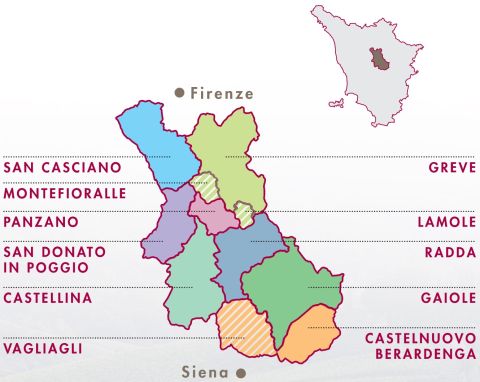
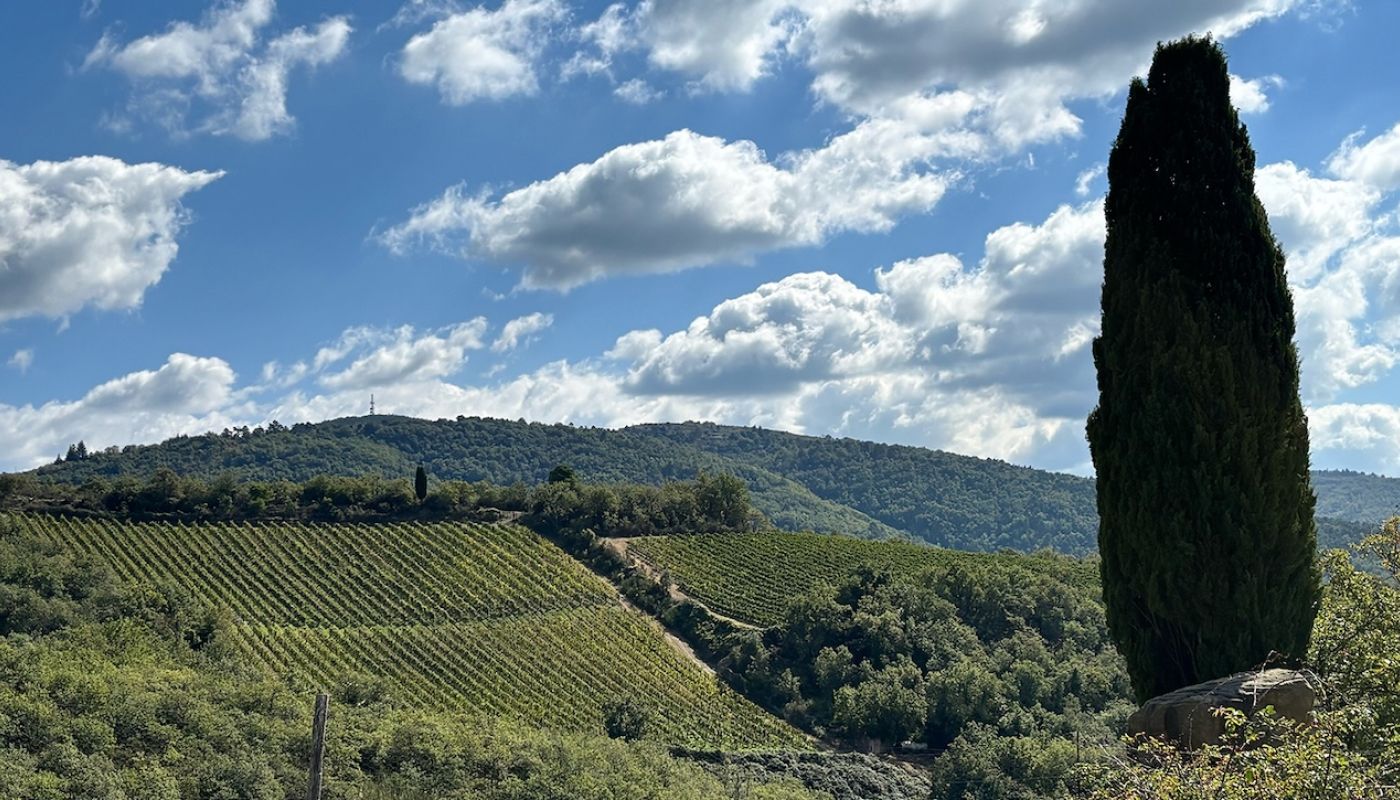
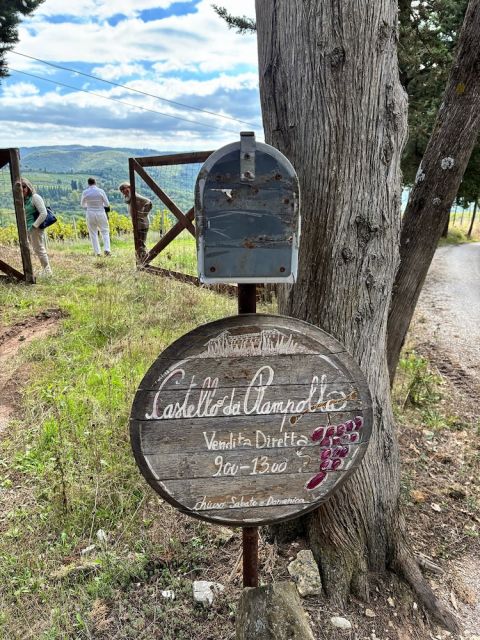
Anyone who has driven the roads that twist round the wooded hills of the region will know just how much geographical variation there is in this historic heartland of Tuscany (see this World Atlas of Wine map). Vines grow at elevations between 300 and over 650 m (984 ft to over 2,133 ft), affected by a richer diversity of factors than in most famous wine regions. Some vineyards are cooled and sometimes shaded by nearby forests; others such as those in Panzano’s famous Conca d’Oro luxuriate in daylong exposure to Tuscany’s extraordinary luminosity. Then there is the question of orientation, both of the vineyard overall and that of the rows of vines, all with different results. Below, the gateway to Castello dei Rampolla’s famous Alceo vineyard in the Conca d’Oro.
In the really old days, vines were mixed in with the many other crops, and animals, raised in the region, the so-called coltura promiscua that is enjoying reappraisal by some hardcore disciples of regenerative viticulture. Then from the 1960s, when winegrowing became a serious business, attracting well-heeled incomers to land previously farmed by sharecroppers, vineyards were deliberately sited on south-facing slopes (flatland does not exist) to maximise ripening in these foothills of the Apennines. Today, acknowledging rising summer temperatures, growers are starting to scout out suitable north-facing sites, and land in Lamole, the highest, coolest commune of all, is now keenly sought. Since the early 1990s, growers have had to fence in vineyards to protect them from marauding wild boar. (Wolves seem recently to be keeping them in check.)
But the most heartening change I found during a long weekend in the region earlier this month as the last grapes were being harvested was the re-evaluation of the region’s signature grape variety Sangiovese. It admittedly took some work in the late twentieth century to find the right clones of this variety that is so obviously well-suited to making uniquely appetising expressions of the region’s many terroirs – designed for the table not for casual sipping. But now that these vines are fully mature they can provide wines with real life and a character derived from vineyard rather than barrel.
The small, new Bordeaux barrique has largely been abandoned in Chianti Classico’s cellars in favour of larger, older casks – or clay or concrete vessels – that leave the fruit to speak for itself.
And, in parallel, the Bordeaux grape varieties, which were all the rage in the 1990s as producers strove to release ever more expensive Supertuscans based on Cabernet and Merlot in the image of red bordeaux, are waning in favour of a newfound respect for Sangiovese. Some producers are even planting the local red-wine varieties that were traditionally blended into Chianti Classico: Canaiolo, Ciliegiolo and Colorino. (The white-wine grapes, once unfortunately mandatory, have been abandoned.)
The Anichini, an ex-sharecropping family who founded their own organic label Vallone di Cecione in Panzano in 2004 after a century of grape-growing, make a 100% Canaiolo. Francesco Anichini, who joined his parents in 2021, told me that he loves this low-alcohol, low-tannin grape because it makes ‘the perfect farmer’s daily wine’.
Currently there are three levels of Chianti Classico: vintage-dated Annata, which must contain at least 80% Sangiovese and be aged for at least 12 months; Riserva is a similar wine that must be aged for at least 24 months; and the relatively new Gran Selezione category must contain at least 90% Sangiovese and be grown and bottled on the estate. It may be a single-vineyard wine or a special selection and, uniquely and recently, it may specify the UGA on the label. Gran Selezione wines may not contain any Cabernet or Merlot, must be aged for at least 30 months, be at least 13% alcohol, and must pass muster with a tasting committee.
Gran Selezione had a difficult birth. The wines initially selected were far from the region’s finest and seemed to be biased towards the biggest companies. This was not surprising because the growers organisation, the Consorzio Vino Chianti Classico, has hundreds of members, most of them small and medium-sized, and there are real tensions between them and the biggest, oldest producers such as Antinori, Frescobaldi and Ricasoli.
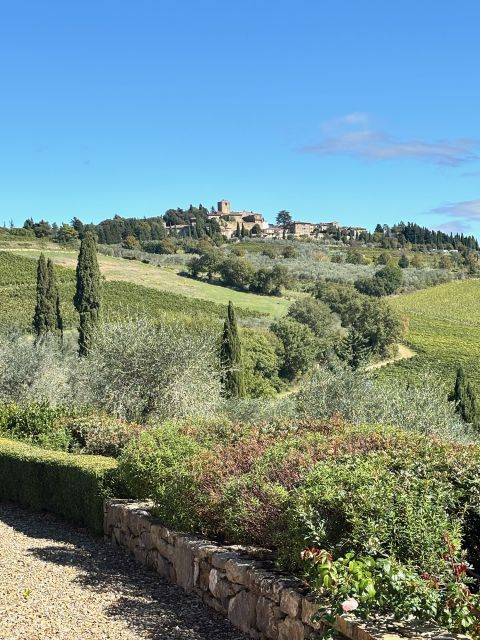
But thanks to the tact and determination of the current Consorzio president, Giovanni Manetti of Fontodi in the commune of Panzano (pictured above), the UGAs have been adopted, giving new value to the category. And there are distinct signs of improvement in the judgements of the tasting panel, which like so many everywhere else, has in the past been made up of older tasters whose views are too twentieth century. Some exceptionally fine wines such as some understandably pale Lamole bottlings were initially turned down, for instance.
According to Daniel Grace of Il Molino di Grace in Panzano, ‘Gran Selezione has really evolved and the high tide is raising all ships. The calibre of Chianti Classico in general is now infinitely better.’
But still some producers prefer to label their best wines IGT Toscana, the old Supertuscan category, rather than fall in with the Gran Selezione crowd. The team at Isole e Olena, one of the earliest family estates of the modern era to earn international acclaim and now part of the same Paris-based EPI group as Charles Heidsieck and Biondi-Santi, say rather sniffily that they don’t need a UGA on the label of their famous all-Sangiovese Cepparello IGT. ‘It wouldn’t help us from a market point of view, and anyway we know where we come from’.
In a way it is strange that it has taken so long for Chianti Classico producers to promote their geographical origins. The medieval rivalries between different communes are still alive and well, and any resident of the region tends to be fiercely, exclusively proud of theirs. The winemaker of 15 years at Querciabella in Greve is a South African who has worked all over the wine world. Manfred Ing loves the fact that his two children are growing up in Lamole but bemoans the fact that it can be difficult to persuade producers to act regionally rather than communally. ‘We’re all facing the same problems today and we would be much stronger together.’
Perhaps the bigger producers, who presumably have the power to lobby the Consorzio most effectively, resisted geographical precision because it allowed them to blend freely across the region. But now, with the widely admired 2021 vintage, no less a force than the 26th generation of the Antinori family has released Gran Selezione wines from each of Gaiole, San Casciano and Castellina.
This is a major endorsement of the Gran Selezione category but one suspects that the rules will continue to be modified. The minimum requirement of 13% alcohol, instituted perhaps to maintain low yields, seems a shame when some wines grown in the highest commune Lamole are just over 12%, yet are chock-full of flavour and character – just the sort of wines the market is looking for today.
And I wonder whether eventually French grapes will be outlawed from wines lower down the pyramid, and whether they too will be allowed to boast of their geographical origins?
One thing was clear from a big tasting of 2015s from Panzano that I undertook over the weekend: these wines may not always benefit from long ageing in cask but the best can certainly evolve delightfully over many years in bottle – just like red bordeaux.
It would be a great shame to confuse the fine wines of Chianti Classico with the most basic Chianti grown outside the heartland.
Some favourite Chianti Classico producers
These are some favourite producers of Chianti Classico and where they are based, chosen by both me and our Italy editor Walter Speller.
- Badia a Coltibuono Gaiole
- Castell’in Villa Castelnuovo Berardenga
- Castello dei Rampolla Panzano
- Castello di Ama Gaiole
- Castello di Bossi Castelnuovo Berardenga
- Castello di Monsanto San Donato in Poggio
- Castello di Volpaia Radda
- Fèlsina Castelnuovo Berardenga
- Fonterutoli Castellina
- Fontodi Panzano
- Isole e Olena San Donato in Poggio
- Istine Radda
- Le Boncie Castelnuovo Berardenga
- Monte Bernardi Panzano
- Monteraponi Radda
- Poggerino Radda
- Querciabella Greve
- Principe Corsini San Casciano
- San Giusto a Rentennano Gaiole
- Tenuta di Carleone Radda
And here are some smaller ones added by Walter:
- Cigliano di Sopra San Casciano
- L’Erta di Radda Radda
- I Fabbri Lamole
- Podere Castellinuzza Lamole
- Terreno Greve
- Tregole Castellina
- Val delle Corti Radda
- La Vigna di San Martino ad Argiano San Casciano
- Montesecondo San Casciano
For (usually multiple) tasting notes, scores and suggested drinking windows, see our more than 3,600 Chianti Classico tasting notes. For international stockists, see Wine-Searcher.com.
Back to basics
Other important Tuscan wines |
|
Brunello di Montalcino is, like Chianti Classico, made from Sangiovese, in this instance from the local biotype known as Brunello, but in a warmer, more southerly, often lower part of Tuscany so the wines are richer and more in tune with the taste for deep colour and concentrated flavour. From beginnings that were even more impoverished than Chianti Classico territory, the region and its wines have found fans all over the world – and higher prices than Chianti Classico. Rosso di Montalcino is made from the same grapes but designed for earlier drinking and can be better value, especially in a good vintage.
Similar but less dramatic is Vino Nobile di Montepulciano, based on Sangiovese but, unlike Brunello di Montalcino, not necessarily exclusively. Here, similarly, a Rosso di Montepulciano is made. Montepulciano’s speciality is Vin Santo di Montepulciano, a long-aged sweet wine made from dried grapes. Vin Santo can be found throughout Tuscany. In this case Montepulciano is a place, not to be confused with the Montepulciano grape variety common on the Adriatic coast.
Some of Tuscany’s most expensive and most famous wines are to be found on the coast, in the Maremma. Sassicaia was the prototype, Italy’s answer to classed-growth bordeaux, but has been followed by multiple others in the Bolgheri region, many of which are more like Italy’s answer to Napa Valley Cabernet. |