On every occasion I return to London from a holiday, particularly one that has included a couple of nights in a fishing port such as Roses in Spain, I come home with the same ambition.
I will open another restaurant. This will focus on serving fish and vegetables: it will be quite small, 30–40 covers, with an open kitchen and the potential to display the fish by the front door. And it will have a small private dining room and a bar large enough to facilitate the service of many different wines by the glass.
And then early one evening I turned into Paddington Street in Marylebone, walked past the long-established Rajdoot (slogan: ‘Best Indian Cuisine’) and came across the restaurant of my dreams. For 30 seconds, I felt disappointed. Then I decided to enjoy it.
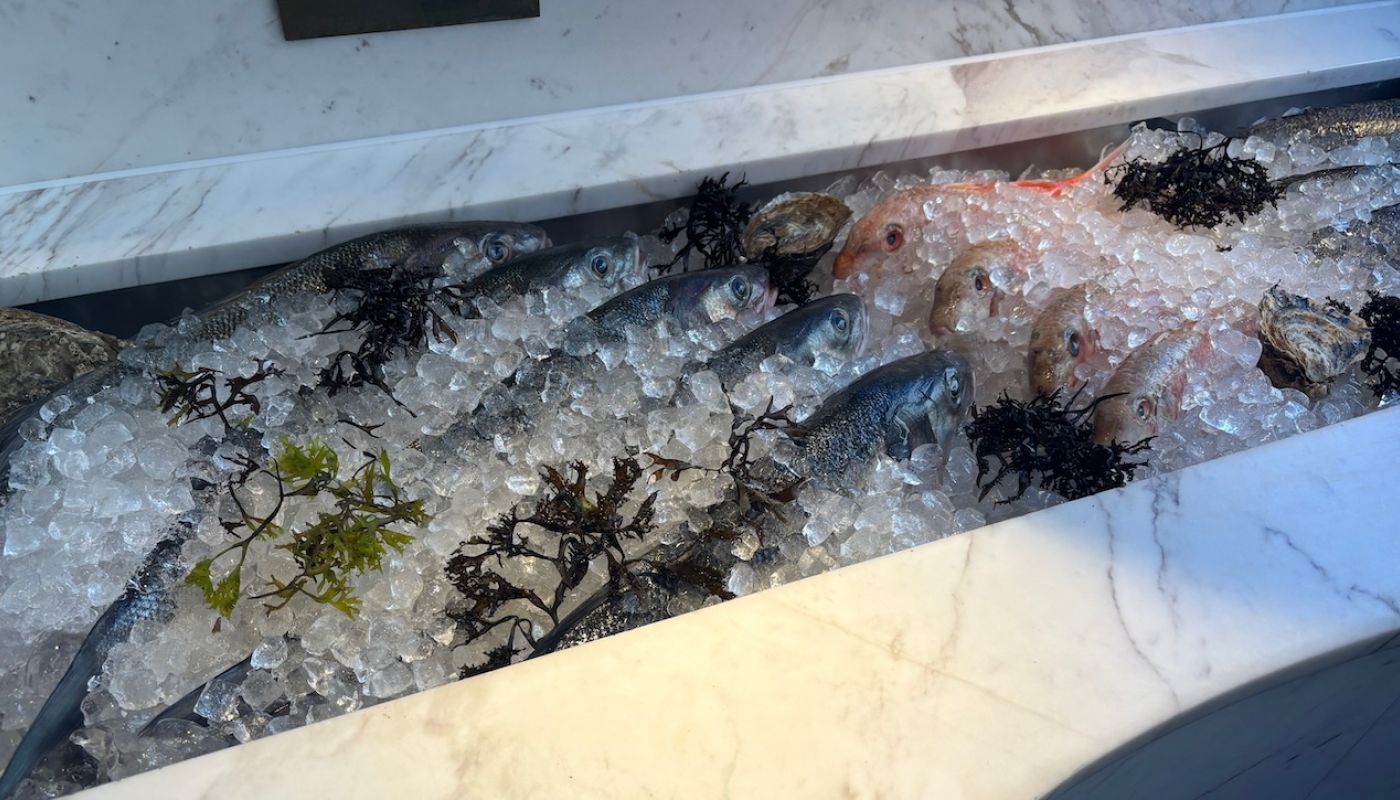
What caught my eye was not the couple of tables laid out on the raised pavement outside – this practice is quite common in London today – but the look of the interior. There was a display of fish under ice by the front door above which there was a description of its contents.
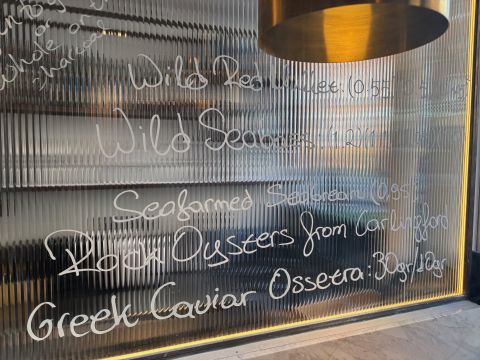
Inside, the narrow restaurant was laid out like an old-fashioned train carriage with tables along both sides and a narrow corridor to the back. I memorised the restaurant’s name – Kima, ‘wave’ in Greek, I discovered – and booked for lunch the following week.
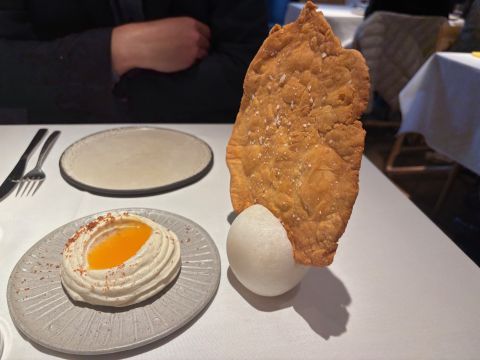
The lunch was impressive. We began with bottarga (mullet roe) on toast (£12), very different from the one I had enjoyed at Labombe a fortnight ago. This interpretation involved small slices of the roe laid out on top of the toast rather than in a sandwich. The taramasalata (£14) was white rather than pink, topped with olive oil and was served alongside an oval of sculpted, and most impressive, crisp, thin rye bread.
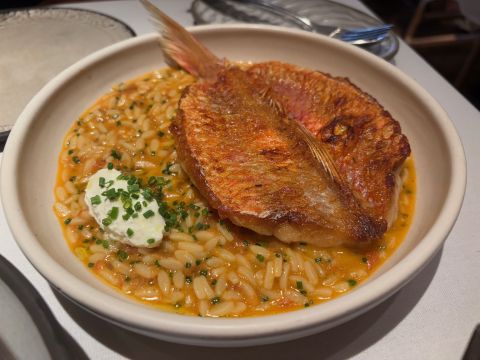
Equally impressive were our two main courses. Instead of the usual meat which invariably accompanies giouvetsi, a Greek tomato-based dish with orzo pasta, the dish featured a filleted red mullet, with a mound of wasabi-influenced Greek yogurt on the side (£39).
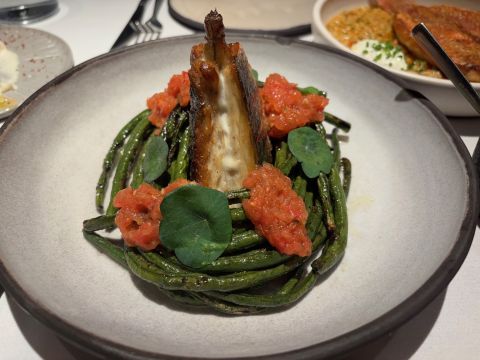
My dish, described as a shank of sea bream (£36), was striking: two fillets of bream, crisp on the outside, standing proud round a mound of green beans (see below) that were so long that they were almost awkward to eat. With no wine (I was with our pensions adviser) and no dessert, my bill came to £124.88 which included a serving of delicious Santorini fava (a local legume) topped with diced onions.
I decided to return the following week for dinner with JR whose company I realised would be a bonus but would also bring one particular disadvantage. JR is not a fan of white fish, so sharing a grilled whole fish was out; I had to make do with watching the table next door devour a whole sea bass. I began with a dish of thinly sliced scallops topped with summer black truffles and then chose a tuna pastitsada, another Greek pasta dish normally served with meat, here served with tuna. Jancis enjoyed a large but tender arm of octopus, highlighted by its time marinating in sherry vinegar and olive oil.
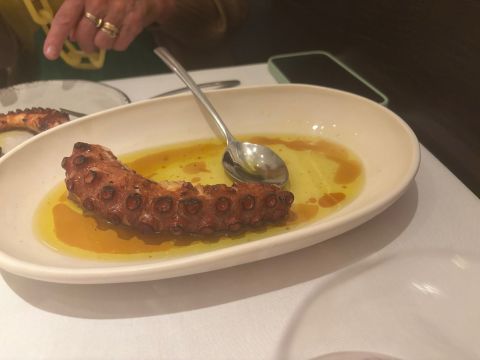
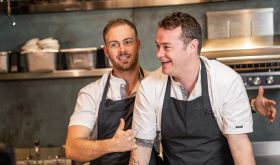
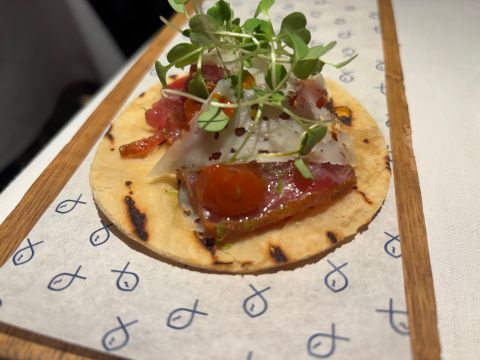
By this stage, we had been recognised. A couple of delicious pieces of tuna souvlaki (below) had made their mysterious appearance, as did the chef, the extremely jolly Nikos Roussos.
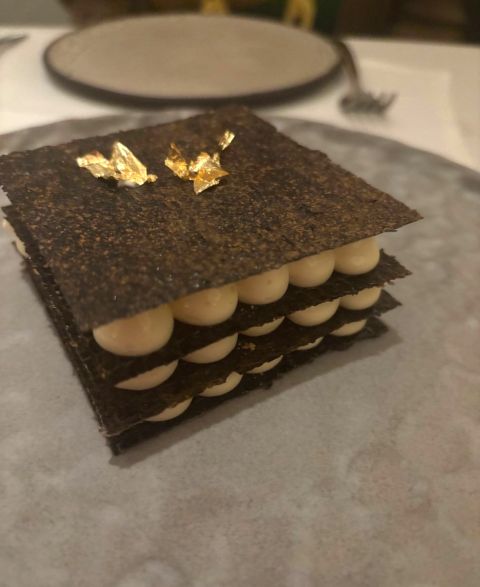
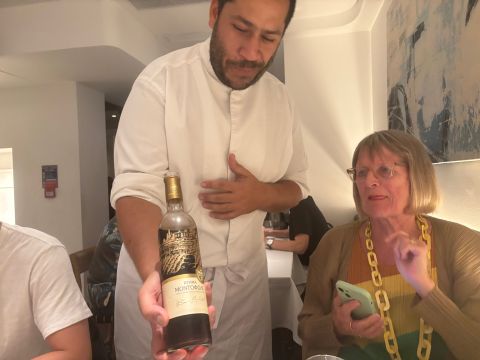
I had attempted to order one dessert – ‘lemon curd, mastic ice cream, extra-virgin olive oil’ – for us to share. He explained that he had a wine he wanted to show us, and while it was being served, there arrived two huge bowls with our excellent dessert (ice cream and olive oil is a fabulous combination) swiftly followed by two glasses of the 2013 Montofoli late-harvest wine from Evia (the chef’s grandmother’s island) and another dessert, the mille-feuille of seaweed pictured below.
With this we enjoyed a terrific bottle of Argyros, Cuvée Evdemon 2020 Santorini that cost £140, almost half of my total bill of £295.88. This from a list of numerous Greek wines which makes for exciting reading. But very few are available by the glass, presumably because there is such limited bar space. This, the absence of a private dining room and the fact that Kima’s kitchen is in the basement are disadvantages which the predominantly Greek, and extremely friendly, waiting staff have to work around.
By the end of my second meal, my curiosity was definitely piqued. At lunch, I noticed the close connections between Kima and Opso, the long-established Greek restaurant across the road (staff going from one to the other, carrying cases of wine). And in the evening sitting in the corner of table no 8, I kept wondering how such a small restaurant survived. It may be very good but is surely too small to make money?
Four days later, sitting at the same table, I had most of the answers from Andreas Labridis, 39, the smiling restaurateur behind the two restaurants. ‘As a child I always wanted to be a chef but my father got my brother to talk me out of it. I worked in finance for years and then the itch became so strong, I finally succumbed’, Labridis confessed.
He and Roussos met and in 2014 they opened Opso on a lovely corner site that the cooking and warm hospitality enlivened even further. It was one of several London restaurants that began the transformation in the appeal of modern Greek cooking at that time.
Then, post-COVID, Labridis spotted the vacant site across the street which had been, in his words, variously ‘a pizza restaurant, then a café, then another pizza place, then a sports bar and finally yet another pizza restaurant. All of them failed.’ When he approached the landlord, the landlord was initially quite sceptical – with good reason. Labridis managed to convince him by pointing to the longevity of Opso.
‘Nikos and I agreed that it had to be fish. After all Greece is mainly a collection of islands; there are thousands of them. But fish is increasingly expensive and we are small, with only 26 covers, so the restaurant’s profitability depends on us following two loosely connected rules and trying to better them.
‘The first is that our costs must never exceed 35% of sales. That is why Roussos is such a clever chef because he insists that every scrap of fish is used – it’s fin-to-gill cooking as far as he is concerned – and we waste very little.
‘And then in the evening, the timing of the first seating is critically important. If we can fill the restaurant at 6 pm, or even 6.30, then we can fill it again later and we can feed 45 or maybe even 50 customers in an evening. Predicting demand at dinner is today much easier than doing so at lunchtime when on some days we can be as busy and other lunches are far quieter.’ Below, Chef Roussos and a salivating JR.
Marylebone has changed a great deal. There are far fewer charity shops on Marylebone High Street, for example, and this must benefit Kima. Labridis observed, ‘the whole feel of the area has improved. And when Lita, the restaurant across the street, received its Michelin star earlier this year, well that really put the whole area on the map as somewhere you can eat and drink very well.’
I said goodbye close to the fish display by Kima’s front door while Labridis stopped to point out the smaller fridges full of ribs of beef, racks of tuna and of sea bream which they age for up to 10 days, swapping the slight shrinkage in size for an increase in the intensity of flavour. Labridis then crossed the street to go to Opso. I walked away realising that my first and only restaurant to date will also be my last.
Kima 57 Paddington Street, London W1U 4HZ; tel: +44 (0)77 4520 5136. Closed Monday.
Every Sunday, Nick writes about restaurants. To stay abreast of his reviews, sign up for our weekly newsletter.