London’s most delicious baguettes are baked every morning in a basement in Fitzrovia by bakers from India, Pakistan and Sri Lanka. (Brexit, followed by COVID, sent most French bakers in London back to France.)
The bakery is owned by a 38-year-old woman who grew up in Mumbai. Her parents constantly, but ultimately unsuccessfully I’m delighted to report, tried to dissuade her from turning what had been her lifelong passion, baking, into a career.
This bakery also produces bags of sablé biscuits which they describe as ‘mixed with dark chocolate and sea salt’. These, more accurately in my opinion, should be labelled ‘dangerously addictive’.
Miel, a treasure trove of a bakery which supplies thirsty and hungry customers throughout the day, is on Warren Street, 100 yards from Warren Street tube station and 200 yards from the extremely busy University College Hospital. As I was interviewing Miel’s owner, founder and inspiration Shaheen Peerbhai, she stopped talking, walked over to the window and waved at a nurse who was just about to walk in.
Many qualities are needed to establish yourself as a top-class, independent baker: determination, commitment, skill at adapting and enhancing basic recipes, the ability to plan, and a willingness to put in long hours.
Cooking in any restaurant involves quite a lot of repetitive work but this is as nothing compared to a retail bakery with café attached. And Miel is open every day of the week from 7.30 am, including many bank holidays, which means that the bakers start work at 6 am, although Peerbhai admitted that she herself is no longer on the rota. Miel was the first of Warren Street’s shops to open on a Sunday, which has played a part in making the whole street much friendlier.
Baking has preoccupied Peerbhai for the past 20-odd years. While she obediently took a day job in marketing, she pursued a secondary career teaching baking classes in Mumbai and Delhi. When her husband was offered the chance to study for his MBA in France, she won scholarships to study French cooking and patisserie at Cordon Bleu and the École Ducasse in Paris and it was there that she discovered that she had the ability to inspire others.
A move to London for her husband’s job ensued and Peerbhai began to refine her thoughts. Could she find a small space where baking, teaching and distributing her skills could be put to profitable use? She was convinced that London was ready for all that she had to offer.
But the landlords she approached initially didn’t seem to share that opinion and the fact that she did not have a track record was another serious disadvantage. ‘I must have looked at about 60 sites’, she confessed with a brave smile, ‘but I never got very far. Then one day I was walking down Warren Street – for some reason which I cannot remember – and I saw a board outside number 57 that the property was for rent. It was small, it had been a nail salon, but the agent was immediately so encouraging, as were the landlords who liked the idea of a bakery on their premises. My presentation by this stage was pretty impressive and we opened Miel in 2019. And then after COVID we moved along the street to number 61.’
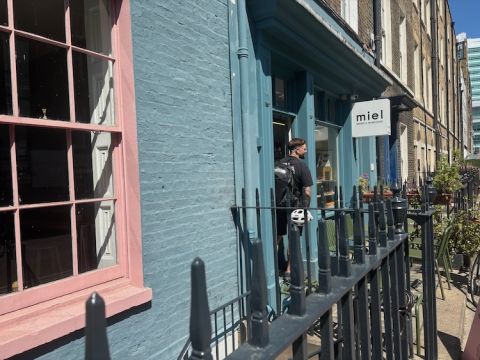
Peerbhai now has 2,500 sq ft (230 m2) over two floors, which she laughingly describes as ‘my playground’. Miel occupies the ground floors of two neighbouring properties, of which the intervening wall has been cleverly refigured.
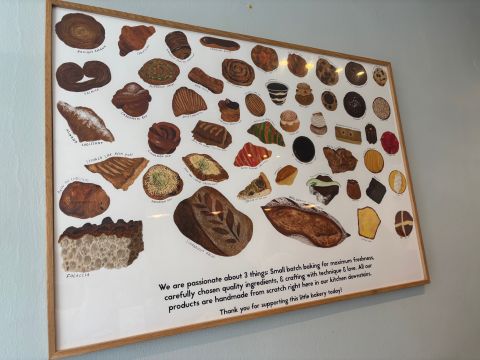
The right-hand side is the shop with its ground-floor window full of just-baked croissants, palmiers, canelés (a particular favourite of Peerbhai who uses antique moulds for them), pains au chocolat and their extremely popular cinnamon buns (go early for everything!). There is invariably a queue with customers waiting on the left for their coffee order to be fulfilled under the picture of Miel's repertoire shown above. At the back are ovens, fridges and stacks of baking trays as well as cooks filling the sandwiches of the day. Just past the coffee station is a winding staircase that leads downstairs to the bakery proper.

I have been in quite a few bakeries but Miel’s certainly wins the prize for the tidiest. Even the sourdough loaves seem to have been artfully arranged close to the deck oven which Peerbhai showed me with great pride. ‘Before you ask, this was craned in in layers’, she added with a smile and then somewhat unnecessarily added, ‘I planned it all’. And my compliments as to its tidiness were quickly dismissed, ‘I’m flattered that you think it’s tidy because, honestly, it needs to be tidier. I’m quite particular about each tool or ingredient being in its place’, came her reply.
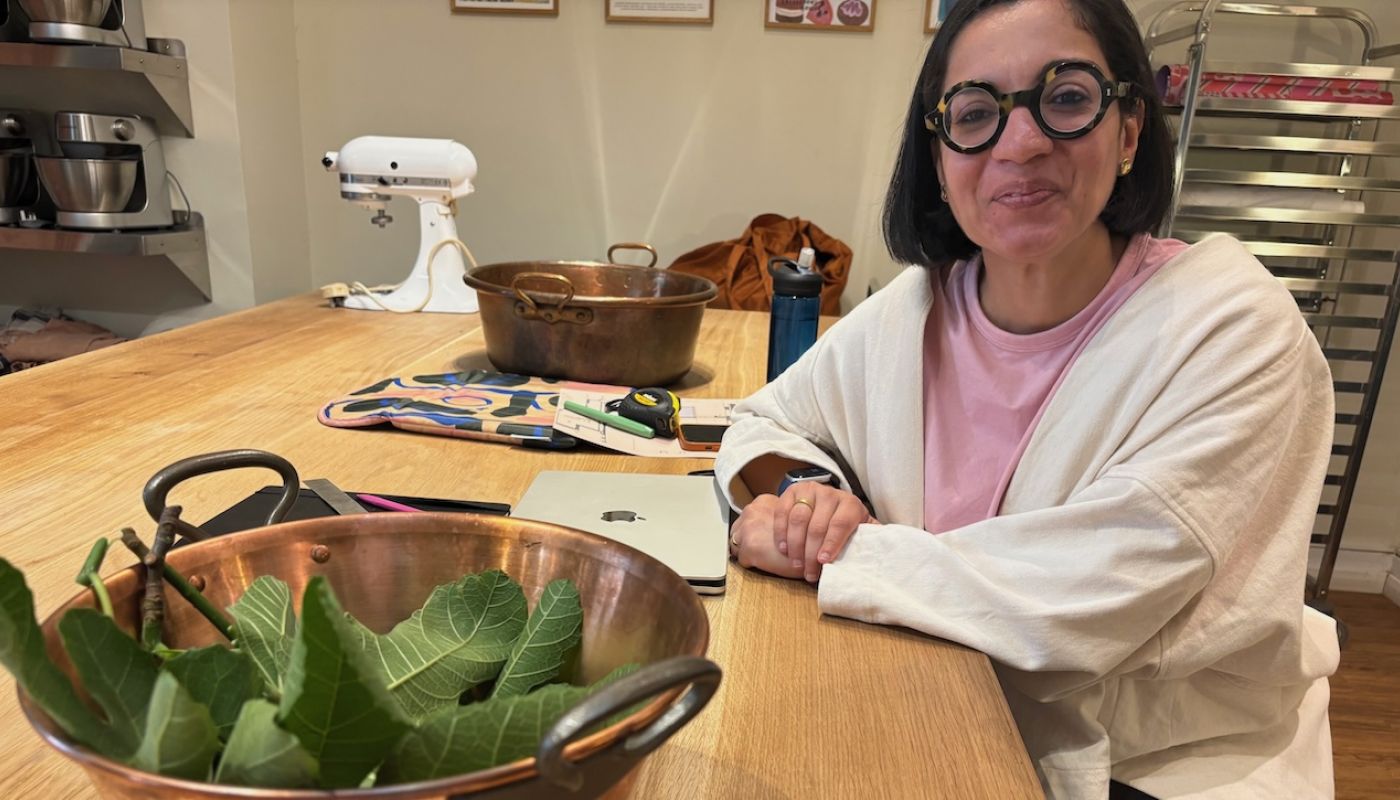
On the ground floor, in addition to the two tables outside on the pavement, the left-hand side has been divided into two, with the café in the front room under a large window. The rear half is the room in which I found Peerbhai sitting in front of her laptop, facing a large bowl of recently-picked fig leaves with which she planned to experiment, and a shelf crammed with books on pastry. This is where all her recipes originate.
She showed me her screen and let me into her world. Each particular item of bread, patisserie or viennoiserie has a page to itself. Across the top she lists the chefs and bakers who have delivered their particular recipes and below are the various ingredients prescribed and the percentages of each which they stipulate. ‘It’s these I play around with, trying to minimise the sugar in most cases but bearing in mind the consequences for the overall taste and flavour when I do that. Because that is what I am after: the best overall flavour of everything we produce.’ When I prompt her to disclose the two baker-authors she respects the most, her response is immediate, ‘Without a doubt it is Pierre Hermé and Philippe Conticini’.
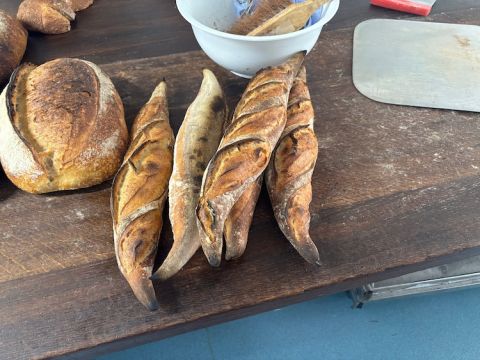
When I complimented her on the taste and flavour of her baguette, she smiled modestly before replying. ‘I use a traditional recipe for a 330 g baguette, using sourdough flour and salt.’ When I interject that its overall length, which is relatively short, must concentrate its flavour, Peerbhai declared that her baguettes are the correct length, rather than the more common longer ones, for the weight of the loaf. Discussion over, I wrote in my notebook.
The week before I had listened to Australian wine producer, Michael Hill Smith MW, describe the difficulties he and his colleagues had when trying to find an original name for their new McLaren Vale winery, eventually settling for MMAD, the initials of the four partners. How, I asked with my final question, had the name Miel, French for honey, come about?
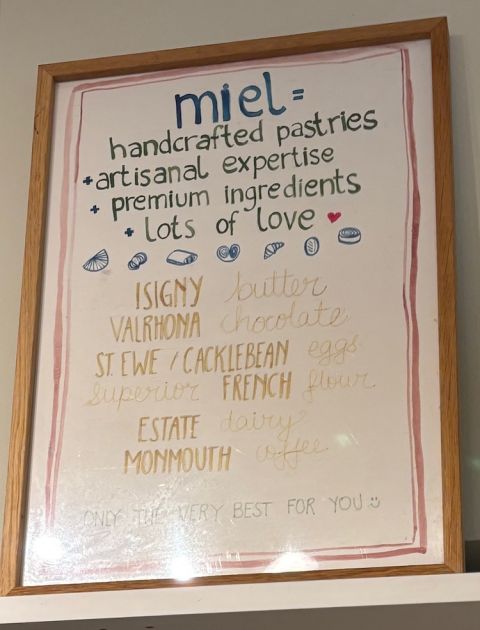
‘Well’, came the reply, ‘the name had to be French even though, or perhaps particularly because, I am not. Most of what we produce is based on French recipes and the flour, the chocolate and the butter we use are all French. The name had to be short, sweet and easy to pronounce. Miel fitted all these criteria.’ Almost as happily as today Miel fits into Warren Street.
Miel 60/61 Warren Street, London W1T 5NU
Every Sunday, Nick writes about restaurants. To stay abreast of his reviews, sign up for our weekly newsletter.