
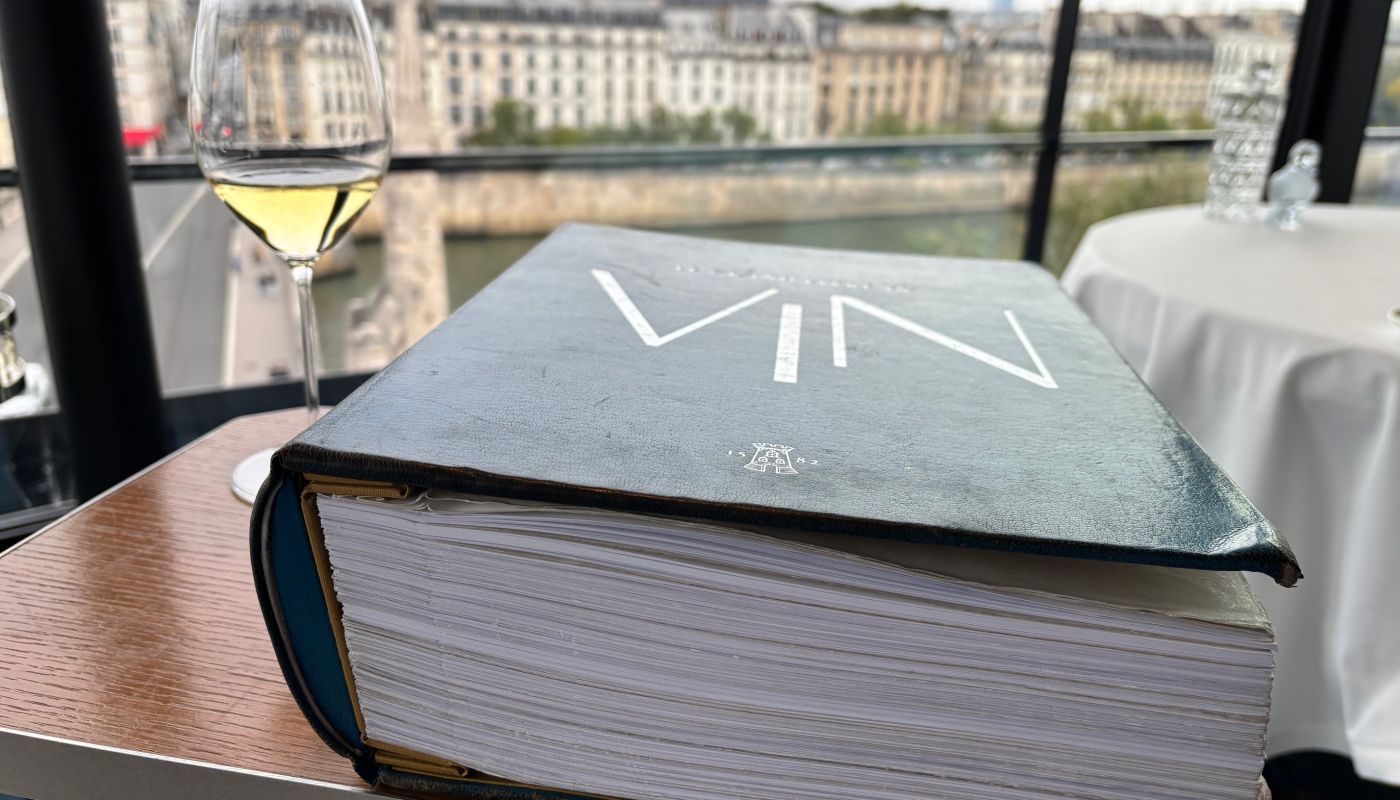
It was a wine-minded Singaporean friend who urged us to revisit the smart sixth-floor Parisian restaurant La Tour d’Argent after its recent makeover. Since we’d already accepted an invitation to last month’s evening celebration of the 45th anniversary of Willi’s Wine Bar in Paris, lunch at the Tour d’Argent beforehand seemed, if not sensible, and if not cheap (our lunch for two cost €604), then certainly fun.

The ‘Silver Tower’ is known for all sorts of things. With its three-star level of service (maintained since it lost two of them) and stunning views over the Seine, Notre-Dame with its banks of builders’ portakabins, and the quayside facades on the Île St-Louis, it’s a popular destination for well-heeled tourists, the sort of place many Parisians would pride themselves on not visiting. It’s also famous for its duck, served from the special théâtre à canard pictured by Matthieu Salvaing below.
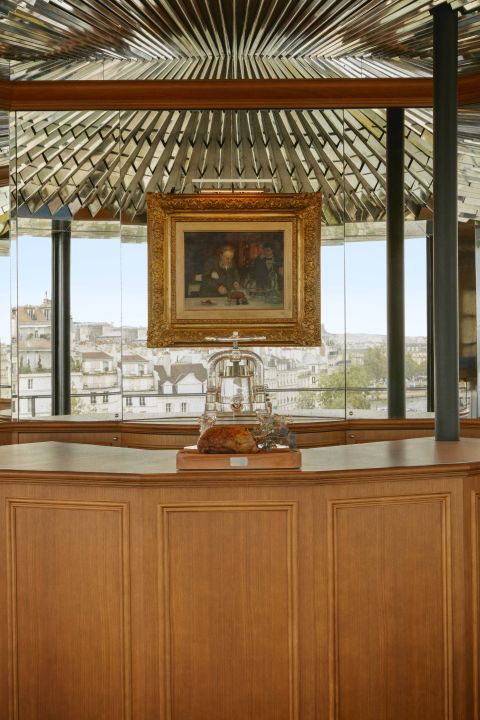
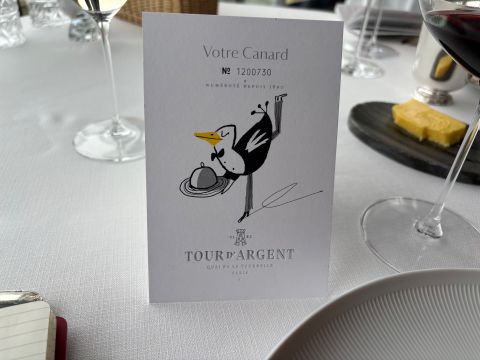
I was even given a thick, silver-embossed postcard reminding me that my two slices ordered as part of the set lunch menu (€165) came from the 1,200,730th duck served at the restaurant since 1890, when, as the Café Anglais, the establishment first bought the celebrated Burgaud’s exceptionally dense Challandais duck meat, presumably made denser by being subjected to the duck press shown above.
But for those of us who care about wine, the Tour d’Argent is most famous for its vast underground cellar, surely almost dangerously close to the river, and its 400-page wine list that warrants its own special trolley. They have seven of them in the restaurant, which, awkwardly, is on two slightly different levels. I would guess each thick volume weighs about 5 kilos. It lists nothing but French wine – other than some vintage ports at the end. A port in its prime such as Dow 1963 will set you back €1,050 a bottle.
It’s one of those lists that persuades you to regard any wine with ‘only’ a one or a two as the first of its three-digit price as an absolute steal. About 14,000 wines are on offer, with the most famous wines typically sporting a long list of vintages below their names. Domaine Leflaive’s Premier Cru Clavoillon Puligny-Montrachet, for instance, goes back to 1988 at €590 a bottle. The youngest vintage on offer is the 2018 at €710. The 2019 to 2022 vintages are listed as en vieillisement, sleeping seven floors below the restaurant in the 1,200 m2 cellar.
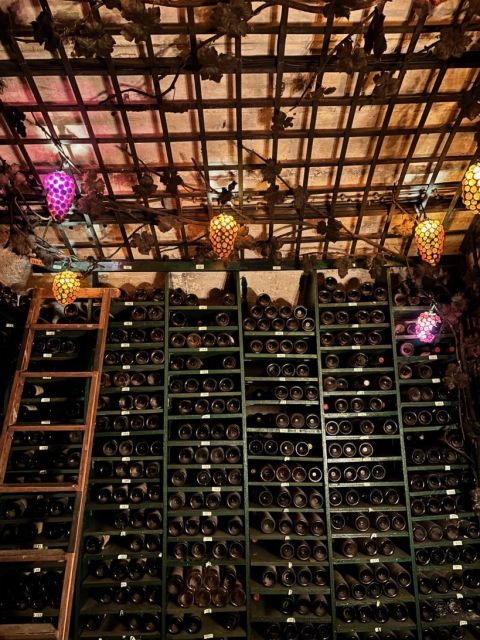
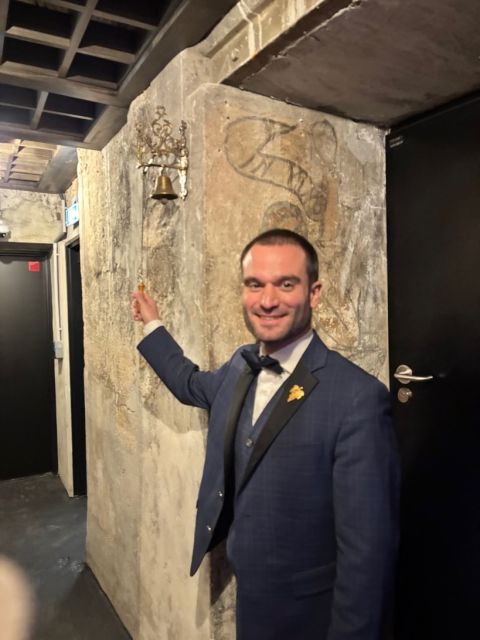
The man in charge of the 300,000 bottles, tightly stacked, four-deep, in bins in near-darkness, is 34-year-old Victor Gonzalez, who joined the Tour d’Argent from The Ritz four years ago. He took over from the well-known Englishman David Ridgway, who has retired to Normandy after 42 years in charge of the Tour d’Argent’s famous cellar. Gonzalez (his father is Spanish and he still has family in Rioja) was hired by the current owner of the establishment, third-generation André Terrail, with the specific brief to bring the wine collection into the twenty-first century. Gonzalez is seen below with the bell to be sounded by visitors to the famous cellar.
Roughly one day a month, Gonzalez, occasionally accompanied by Terrail, goes off to a wine region (within France of course – let’s not go mad) scouting out up-and-coming younger producers. They are proliferating all over France but are especially important in Burgundy, where the prices of wines from the old guard have got out of hand. Burgundy has been a speciality of the Tour d’Argent for decades, with Ridgway betting on it particularly early. (Its freshness and less tannic structure makes it a more versatile food partner than red bordeaux.) In fact Ridgway bought so much burgundy that André’s father, Claude Terrail, thought there was something shady going on.
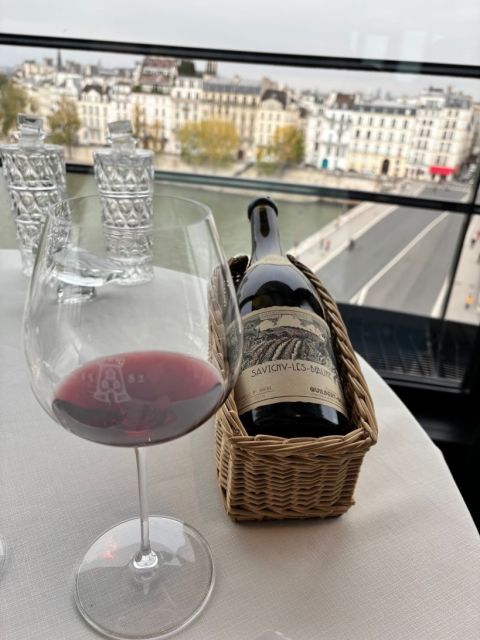
Once we’d chosen our food – turbot and duck main courses – I asked the immaculately suited Gonzalez to recommend a suitable red burgundy from a newish producer I hadn’t come across. He chose a 2022 Savigny-lès-Beaune, Les Échalas, from Domaine Guilbert-Gillot, €250 on the wine list. Made in determinedly traditional fashion, it was beautifully smooth and fresh, though perhaps a little less persistent than I would have expected at the price – until I looked up Wine-Searcher.com and found that the average price of a bottle of simple village Savigny from this producer is £400.
I asked Gonzalez how working at the Tour d’Argent compares with working at The Ritz. He smiled. ‘There was much more bureaucracy at The Ritz. You needed to ask about four people before you got permission to buy a Sancerre to serve by the glass. Here I have both freedom and a budget.’ Apparently, he was torn between this and another project when offered the Tour d’Argent job but was won over by the latter’s determined expansion since a 15-month refit two years ago. The restaurant now has a roof terrace open all summer (the views must be amazing; you can even see the Sacré-Coeur on the horizon); apartments on the floor below the restaurant; and on the ground floor a rôtisserie, a boulangerie, and a bar where Gonzalez is encouraged to try out wines less expensive and more esoteric than those on the main restaurant wine list. ‘I’m so happy. I have a real wine team, with great people not just from France but from Italy, Korea, India and Switzerland.’
We asked the young Korean wine waiter which was the most expensive bottle of wine he had served: a 1989 Romanée-Conti (about €20,000 a bottle retail) to an Asian customer. But by no means all diners come here for the wine list. Next to us an American man asked the sommelier to recommend ‘a nice glass of full-bodied red’. The huge list includes 32 wines by the glass, and a few half bottles are offered on the lunch menu. Château Bellegrave 2010 Pomerol is €50 for 12 cl, for example (about £49 a bottle from Lay & Wheeler).
After lunch we were invited to tour the many-chambered cellar, staffed by young Guillaume Delvert, ex Ritz, and Laurène Malavasi, ex Taillevent. Malavasi was having a terrible time fitting a shipment of tall Alsace bottles into the bins. It is Delvert’s job to fulfil orders from the restaurant. The cellar is kept at a carefully monitored 12–13 °C, fine for burgundy but too cool for young, tannic red bordeaux (‘which is why we don’t really like to serve young Bordeaux vintages’, according to Gonzalez), and too warm for many whites. The tiny wine lift is fitted with ice buckets whose job is to cool the whites as they slowly ascend seven floors.
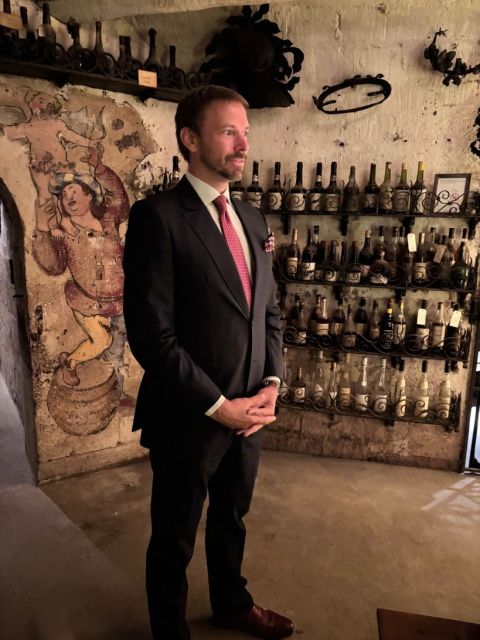
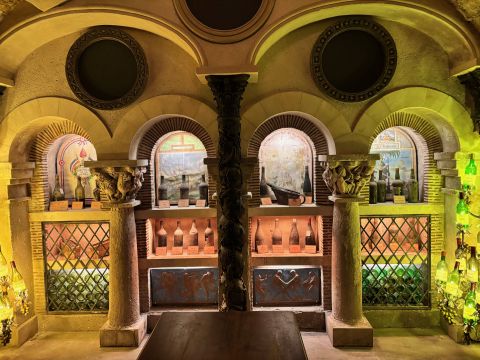
Above is André Terrail, the current owner of the Tour d’Argent, in one corner of the cellar. Below is another corner, one of two chambers within the cellar that have recently been renovated.
You may not be offered a cellar tour at the Tour d’Argent but you can now book one, and even if you don’t take advantage of this opportunity, I can think of nowhere else that offers a similar combination of fine wine, fine service, and the sensation of being on the roof of the City of Light.
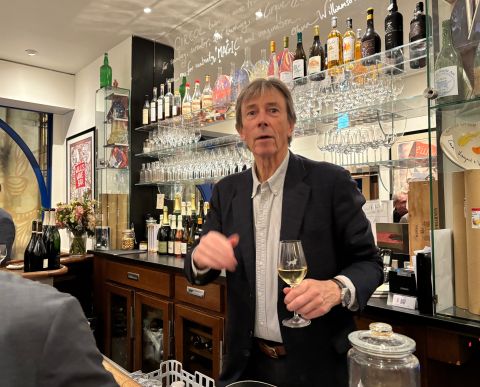
And that Willi’s celebration? It was a blast, a very warm occasion lubricated by Clape 2016 Cornas and Jamet 2011 Côte Rôtie, magnums all the way. Steven Spurrier’s widow Bella and I had the honour of flanking our host Mark Williamson, seen above just before delivering his 45th anniversary speech. Also there were Tim Johnston, former business partner at Willi’s, who since established the highly successful Juveniles round the corner, Roy Richards and John Livingstone-Learmonth of Drink Rhône – as well as a bevy of friends and family. Here’s to the next 45.
Wine lover’s Paris
Some recommendations of a varied range of restaurants and wine bars of likely interest to those who like wine. See also Star Wine List’s Paris recommendations.
- Juveniles, 47 rue de Richelieu, 75001 Paris
- La Tour d’Argent, 15 quai de la Tournelle, 75005 Paris
- Le Baratin, 3 rue Jouye-Rouve, 75020 Paris
- Le Petit Sommelier, 49 avenue du Maine, 75014 Paris
- Le Petit Verdot, 75 rue du Cherche-Midi, 75006 Paris
- Macéo, 15 rue des Petits Champs, 75001 Paris
- Parcelles, 13 rue Chapon, 75003 Paris
- Pétard, 70 rue Jean-Pierre Timbaud, 75011 Paris
- Vantre, 19 rue de la Fontaine au Roi, 75011 Paris
- Willi’s Wine Bar, 13 rue des Petits Champs, 75001 Paris
For many more restaurant reviews, see Nick on restaurants.
Back to basics
How to get the most out of a restaurant wine list |
|
First of all, don’t be intimidated. You are the customer and it is in the interests of the waiting staff that you enjoy your meal enough to come back and/or recommend the restaurant to others. Most wine experts seek out the bargains on wine lists rather than splash the cash, so hovering around the lower reaches of the wine list is not a sign of meanness or ignorance.
Unless you’re familiar with every wine on the list and able to make your own selection, the most important thing is to engage with someone at the restaurant who knows a bit about wine. Just ask to speak to the wine waiter or the person who knows the wine list best. This won’t necessarily be the first waiter you are assigned. Then tell them what sort of wine you like, or have liked in the past. Let them know roughly how much you want to spend and ask them what they recommend. (They should have seen your food order.) This is the sort of customer a restaurateur likes – someone who is clear about their wants rather than being determined to complain.
If there doesn’t seem to be anyone really knowledgeable about wine in evidence – common in many less expensive places – and your party has ordered a range of different foods, one of the most versatile wine styles is dry rosé. Preferably one with a bit of character and guts rather than aperitif mouthwash.
When you’re given a sample ‘to taste’, you’re checking it smells nice and fresh (not the mouldy cardboard of a cork-tainted wine) and the temperature. If it’s too warm – and this is more likely for a red than a white – request an ice bucket or ask them to stick it in the fridge for a few minutes. If it’s too cold, you can warm it up by cradling your wine glass. You are not being asked whether you like it. It’s too late to send it back! |













