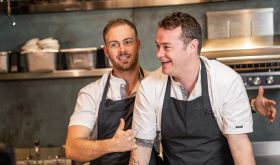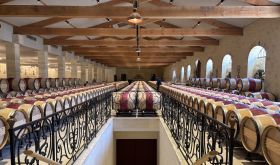
On 3 March 2003, Sam Hart opened Fino, a Spanish-themed restaurant in a basement off Charlotte Street in central London, with his brother Eddie and a loan secured on the surety of his house.
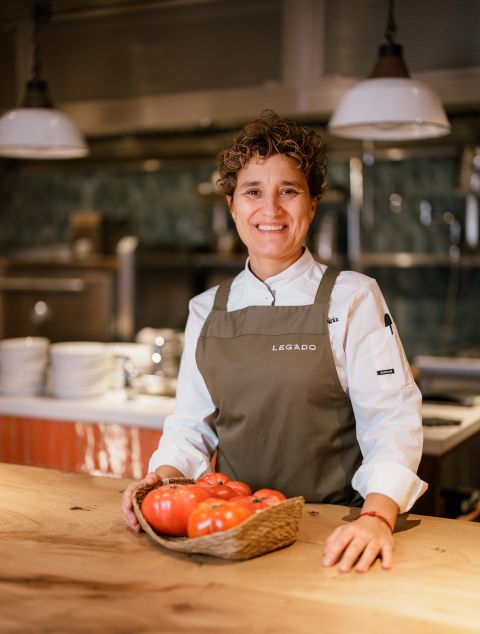
The sous chef was a young woman from Bilbao in northern Spain, Nieves Barragán Mohacho, who soon rose to become head chef of Fino and then the Hart brothers’ branches of Barrafina, their even more successful take on the legendary tapas bar Cal Pep in Barcelona. Nieves is small, strong, seemingly full of energy, and blessed with a smile that can light up a room in any restaurant.
After 15 years, Nieves and the Harts split and she found a financial backer with even wider experience in the restaurant business, the family-owned group JKS Restaurants. Nieves then opened Sabor (‘flavour’ in Spanish) just off Regent Street with her business partner José Etura, allowing JKS to add a first-class Spanish restaurant to their portfolio which already included first-class Indian restaurants (Gymkhana and Trishna), a Persian one (Berenjak), Sri Lankan outlets (Hoppers) and Kitchen Table (based on tasting menus).
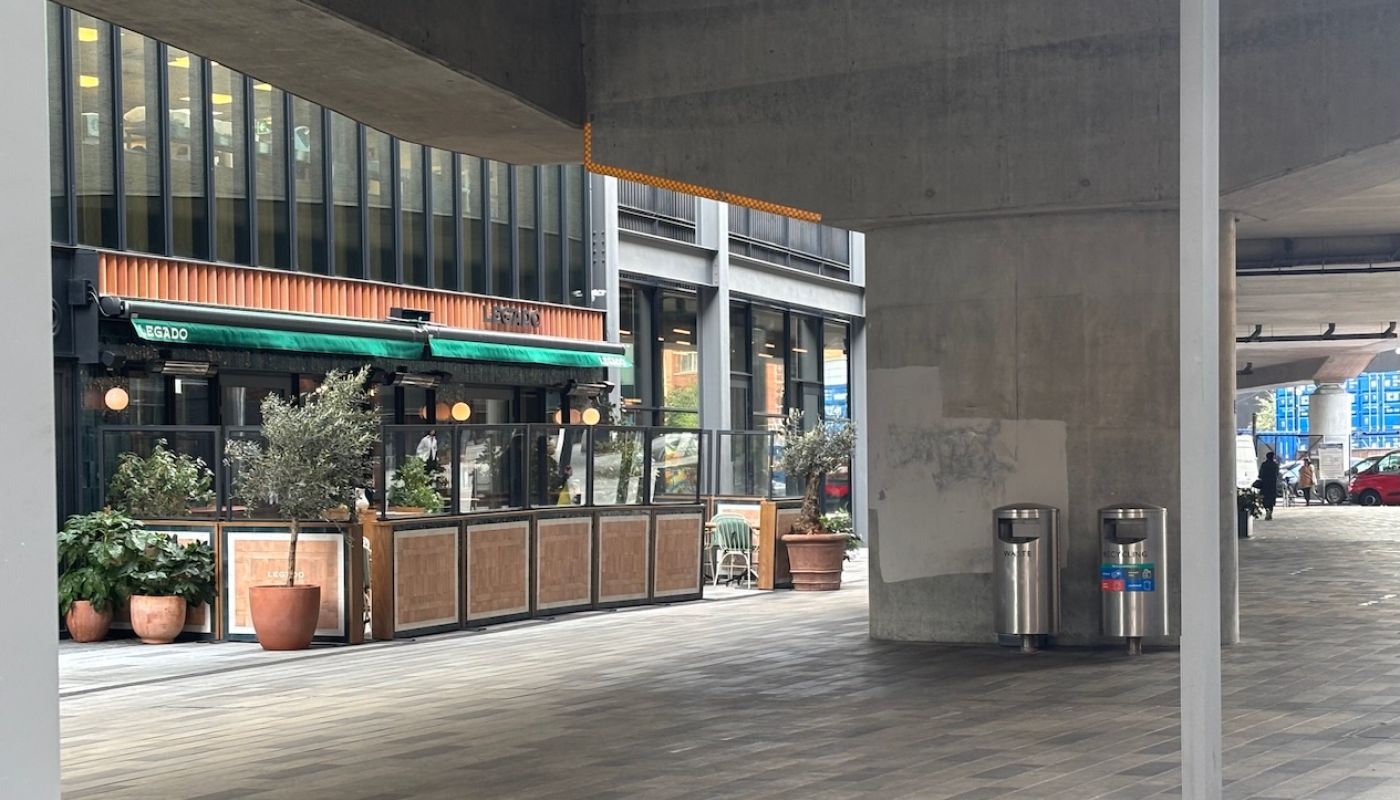
In 2025 Nieves, with JKS, opened Legado (‘legacy’ in Spanish) in the new Montacute Yards development in Shoreditch in East London. On my initial visit, on a windswept morning, the location seemed somewhat isolated and forlorn (see the main image above), directly opposite the second branch of Meet Bros, an ‘Asian-fusion’ halal steakhouse, and with Singburi, the renowned Thai restaurant, a minute’s walk away.
On my second visit, on a Friday evening, my feelings changed as soon as I walked through the door. To the left is the ‘taverna’, a bar that was sparsely populated at 1 pm on a Wednesday but was now busy. Straight ahead was a large room full of happy diners and to the right the vast open kitchen with a large counter that runs the length of the restaurant.
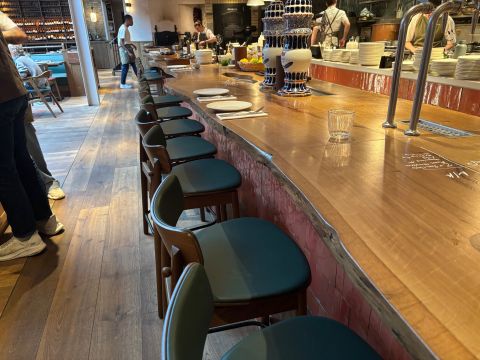
On my first, solo visit, I was greeted by a young man and a young woman with a cheerful ‘¡Hola!’, smiling as though in competition with each other. I handed over my coat, watched it disappear into an old armoire, and took a seat at the edge of the counter.
The menu is long, almost overwhelming and lacking in colour. It is broken down into eight categories, from ‘To start’ to ‘Desserts’ but it missed one essential item: there were no salted almonds! To help me concentrate, I ordered a generous glass of Manzanilla Pasada from Lustau’s Almacenista range (worth every penny of its £17) and considered my many options.
The more I studied the menu, the more difficult my choice became. I like both Basque morcilla and pan con tomate; I like the sound of gambas cristal (glass shrimp) with a fried egg; of a marinated chargrilled quail. I have always enjoyed Spanish lamb and I am intrigued by a 90-day chicken steak from Maison Garat, a first-class producer based in the Basque country. I also remain intrigued by arroz de cangrejo, a crab-flavoured rice dish.
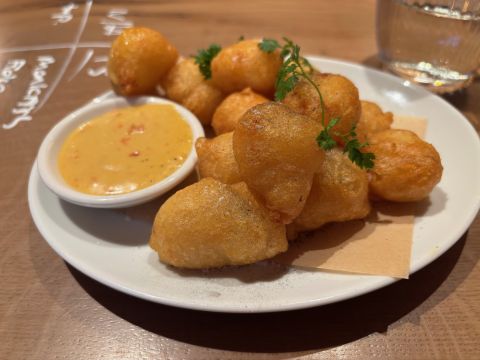
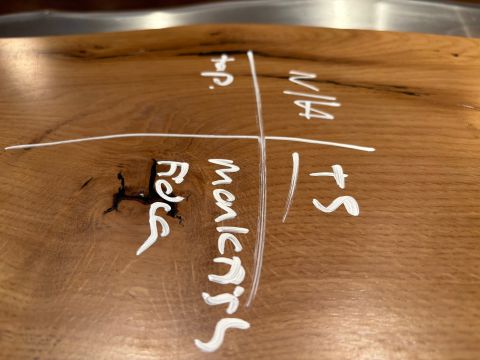
In the end, I somewhat meekly ordered monkfish tempura with chilli jam alioli (£16 and shown immediately above), the fideuà, short strings of pasta blackened by cuttlefish ink with rock shrimp (£24), and watched my waiter as he drew a diagram of my order on the piece of wood in front of me (see above). He wrote down my order in his shorthand as I returned to my glass.
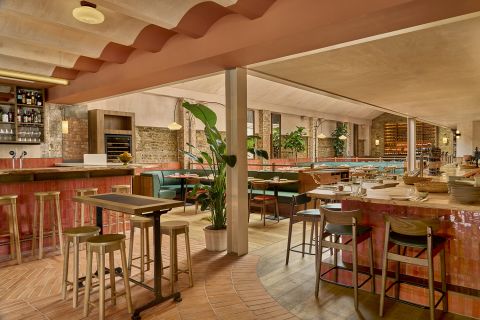
I kept looking over my left shoulder trying to take it all in. Skylights have been put into the room which in daytime allows sunlight in to illuminate the seating area which must hold at least 50 to 60. Everything has been built for the long term, with no expense spared on the tiling on the kitchen walls or on the staircase up to the lavatories which provides a balcony reminiscent of our time in Seville. The waiting staff are in colourful T-shirts, the assistant managers and managers in light-brown jackets. The chefs are immaculate in white jackets under embossed aprons, apparently competing for who can field the most pens. There seem to be scores of waiters and chefs, their faces illuminated by a long row of lights.
Then from across the counter I heard another ‘¡Hola!’. I looked up and saw a smiling Nieves. We waved – there was a wide counter in between us – and met at the end. We chatted and she proudly escorted me around the kitchen pointing out the nine sections and introducing the chefs in charge. At the front is the larder section, next to it the dessert section and at the far end the two ovens, imported directly from Segovia, in which the milk-fed lamb and suckling pig are roasted over wood.
I got the impression that Nieves is happy – extremely happy. She is now the chef, and in a small way part-owner, of the restaurant of her dreams. Legado, unlike Sabor, is all on one floor – there is no unnecessary division between the grill and the tapas bar – and she has a talented team serving the food of her country of which she is exceptionally proud. All that remains is for her, and her team, to delight the crowds and to make a financial return which, given the vast number of staff in both kitchen and restaurant, may take longer than anyone has anticipated.
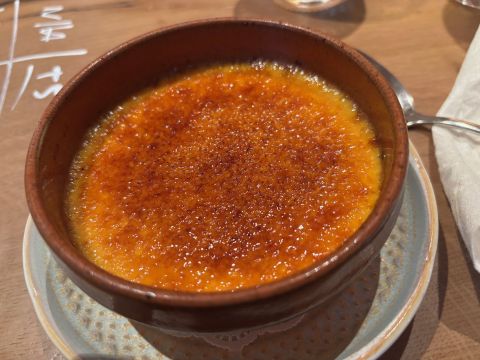
Nieves was flying off to Hong Kong to promote Sabor that night, and I returned to my seat. I enjoyed the monkfish and relished the fideuà, as well as the rice cooked in lush prawn stock and topped with three pieces of rock shrimp tempura, their flavours enhanced by the emulsified garlic and olive oil sauce. I finished with the crema catalana shown below that was a little deeper and creamier than perfect for me, and a bill of £75.90 for one.
Two nights later, on my return with JR, another Fino connection revealed himself in the form of Legado’s wine director Marcos Rapado Segurado, who has worked in several top restaurants since. (The current wine list was compiled by Emily Jago, JKS’s head of wine.) He approached us with the copious wine list in one hand and an open bottle of Viña Corrales de Balbaina, a delicious sherry from Peter Sisseck and Carlos del Rio González-Gordon.
The list opens with a map of Spain and its islands and then reveals its many charms: 12 sherries; half a dozen rosados; wines from Galicia, Andalusia and the Canaries; 15 from the Duero including Alión 2002 for £400 and Pingus 2013 for £1,800! But most bottles are considerably less expensive, including the £55 bottle we were recommended, a Jarrarte Tempranillo 2023 Joven that had been made beaujolais-style by Abel Mendoza (a producer recently highlighted by Ferran Centelles in his Rioja at 100 coverage).
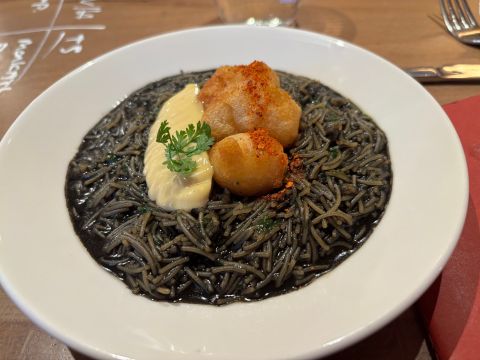
With this we enjoyed a combination of morcilla (for me) and piquillo red peppers (for JR); a herb-crusted shoulder of rabbit (also for me); the sublimely comforting fidueà again (for JR this time and shown above); marinated quail; and the skate tortilla with bottarga, which we shared.
To finish we shared an excellent dish of saffron ice cream, rich white-chocolate mousse and olive oil topped with crystallised almonds. Then came a bill of £202.98.
We left with a doggy bag of the leftover fidueà and quail which I inadvertently left behind on the table outside as I buttoned up my coat against the harsh north wind. I hope its contents were appreciated as much as we enjoyed our evening in Legado.
Legado 1C Montacute Yards, London E1 6HU; tel: +44 (0)20 3962 2700. Closed Sunday night and Monday.
Images not otherwise credited are the author’s own.
Every Sunday, Nick writes about restaurants. To stay abreast of his reviews, sign up for our weekly newsletter.