
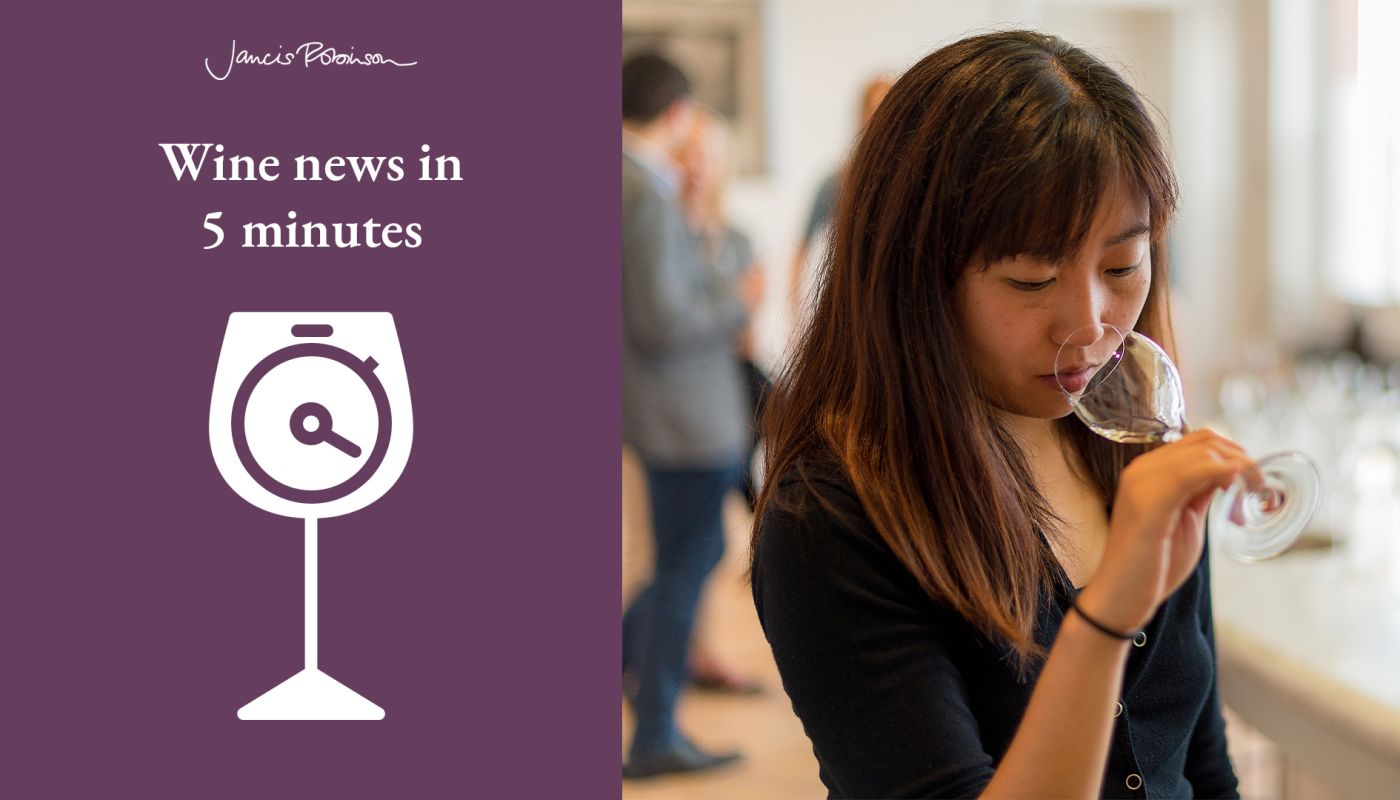
Before I get to the news, a huge congratulations to the world’s newest MW, Qian Janice Wang. Wang is an associate professor of consumer psychology in the Department of Food Science at the University of Copenhagen
Tariff effects
On 21 August the European Commission announced that the EU and US have agreed on a ‘Framework Agreement’ for fair, balanced and mutually beneficial trade and investment. Nowhere in this agreement is alcohol mentioned. Requests from the wine and spirits industries in the US and EU have been ignored. EU wine, beer and spirits will remain subject to a 15% tariff. The tariffs are not only hurting US importers of European wine but also US producers as prices rise on corks, barrels, glass and winery equipment. Wine drinkers can expect to see increased prices on US wines shortly. On 12 August, The New York Times published an article showing that the month of July saw faster price increases than any of the previous five months – illustrating that all US businesses, not just wineries, are having to raise prices to offset the cost of the tariffs.
Wildfires in Spain, Portugal and Napa Valley
Euronews has reported that Spain is experiencing its worst wildfire season since 1994 with over 382,000 ha (944,000 acres) burned. Five of the most destructive fires have occurred in the last 15 days and fires continue to burn in Galicia, Asturias, Castilla y León and Extremadura. El País reported that in Galicia, the DOs of Monterrei and Valdeorras have lost vineyards to the fire. And Noah Chichester, who runs the blog winesofgalicia.com, has just sent over his latest post detailing the damage done to vineyards and wineries so far in three of Galicia’s five DOs. Harvest, which was due to arrive in the next week, is uncertain.
The fires have also damaged vineyards in neighbouring Bierzo though I haven’t found any data on the extent of the damage; if anyone has any details, please email [email protected].
Fires are raging in Portugal’s Douro, too. Vineyards of the producers Golpe Wines and Titan of Wines have been destroyed. Winemaker Luis Leocadio of Titan Wines told Wine-Searcher that two of his six plots of centenarian vines – which produced his most valuable wines – have burned.
Yesterday, I received an update at 4 pm PST from Napa’s automatic emergency communication system, Nixle, informing me that a fire had broken out in Calistoga and covered 30 acres (12 ha). When I checked Napa Valley Register three hours later, the fire had spread to 1,000 acres (405 ha). As of this morning, the fire had consumed 2,133 acres (863 ha). Cal Fire shows that Eisele Vineyard Estate (still labelled as Araujo Estates on the map), Kelly Fleming Wines, Kenefick Ranch, Venge Vineyards and Phifer Pavitt Family Vineyards are under evacuation orders. Frediani Vineyards and Poggi Vineyards are not pictured on the map but are also in the evacuation zone.
Harvest begins in Baden, Columbia Valley, Alsace, Muscadet and Champagne
On 18 August, Wines of Germany announced that harvest had begun in Germany – starting in Baden. Quality is expected to be very good.
On 19 August Washington State began harvest in the Lake Chelan AVA in northern Washington, reported by Northwest Wine Report. The first grapes to be harvested were Chardonnay for sparkling wine.
On 19 August, Alsace started its earliest harvest in recorded history. The first grapes to be picked are destined for Crémant. Harvest for still wines will begin on 25 August. Gilles Ehrhart, president of the Alsace Winegrowers' Association, told AFP that this is 20–25 days earlier than the harvest would have been 30 years ago.
On 21 August, Muscadet kicked off harvest in the Loire Valley. The vintage is expected to be generous – replenishing the historically low stocks after the poor 2024 vintage.
Also on 21 August, harvest began in Champagne. The Comité Champagne told The Drinks Business that grapes have ripened incredibly quickly and quality looks to be very good. It is expected that yields will be determined by the cap set by the Comité at 9,000 kg/ha – equating to approximately 255 million bottles – rather than by the natural yield, which looks to be at 10,000–11,000 kg/ha. The cap is due to a soft market for champagne sales.
Minuscule harvests on Santorini and Lanzarote
If last year was painful in Santorini, this year is worse. Yiannis Karakasis MW posted on his Instagram account on 19 August that, with the island in its third year of drought, the entirety of Santorini’s production is expected to total 350–400 tonnes. When I emailed Stellios Boutaris of Kir-Yianni he was slightly more optimistic, expecting around 450 tonnes. This is two-thirds of last year’s yield and less than a quarter of what a good vintage would yield. In line with yields, prices have shot up to €10–13 per kilo. Quality looks to be very good.
On 15 August The Drinks Business reported that the island of Lanzarote in the Canary Islands is suffering their worst yields in 30 years, also due to extended drought. Harvest began in mid July and the island is expected to yield around 600 tonnes – less than half of last year’s yield and a bit over a quarter of the historic average.
To Kalon a trademark
If you are a fan of Napa Valley’s wines, you’ve probably heard of To Kalon. If you are a super-fan, you likely know that there has been a running argument, for at least the last decade, over whether or not To Kalon is a place or a trademark. In brief, To Kalon was once a very large vineyard established by a man named Hamilton Walker Crabb and named in 1886. That historic site was sold off in parcels. In 1987 Robert Mondavi, who owned the largest parcel of that historic vineyard, dug up the name and trademarked it. When the Robert Mondavi brand sold to Constellation Brands in 2004, Constellation got that trademark. So both the historical vineyard – which includes land owned by Opus One, MacDonald, Detert, Beckstoffer, the Wilsey/Traina family, the Napa Valley Grapegrowers and the University of California at Davis in addition to Constellation – and the trademark exist. But generally speaking, the name has been tied to the vineyard area closely enough that most wine collectors would tell you that To Kalon is a vineyard.
In 2017, Graeme MacDonald, whose family owns a piece of the historic vineyard, put forth records and maps in order to have a nearby creek officially recognised by the US Board of Geographic Names (BGN) as To Kalon Creek. Constellation, who originally supported the creek’s naming, filed a petition earlier this year to remove the name of To Kalon Creek because it could interfere with their trademark. In the petition they say, ‘To Kalon as a defined geographic place doesn’t exist, and never has … Constellation's right to use “To Kalon” is not constrained by history or geography—it may call any wine “To Kalon” regardless of whether it is sourced (either wholly or in part) from Mondavi's Oakville lands.’ MacDonald defended the historical existence of To Kalon to the BGN during a hearing in Washington DC on 10 July.
On 14 August the BGN ruled that To Kalon was a trademark, not a place, and changed the creek name to Doak Creek. Graeme MacDonald was quoted in Wine Spectator saying, ‘What’s at stake is not just the legacy of To Kalon but the concept of place in American wine.’ And he’s correct, because prior to this ruling To Kalon was about as close to a US ‘grand cru’ as you could get. However, if To Kalon is a trademark, it can’t be a grand cru. Andy Beckstoffer, who won a legal battle in 2002 that entitled his clients to use ‘Beckstoffer To Kalon’ on bottles made from fruit purchased from his section of the vineyard, told Wine Spectator that the ruling was ‘a shocking reversal of a sound decision based on solid historical research. To Kalon is a place. It has been for 139 years.’
Knowing that Constellation does not consider To Kalon a place, it’s hard to see why anyone would buy any of their wines labelled To Kalon – which include Robert Mondavi, Schrader and To Kalon Vineyard Company. They’ve demonstrated that they do not care about vineyard sourcing – which is the only way you could possibly justify the cost of these wines.
That’s all for this episode of the wine news. If you enjoy this newscast and would like to see it continue, please become a member of JancisRobinson.com. And if you have breaking news in your area, please email [email protected].
Photo at top of new MW Qian Janice Wang kindly provided by the IMW.
This is a transcript of our weekly five-minute news broadcast, which you can watch below. You can also listen to it on The Wine News in 5 Podcast. If you enjoy this content and would like to see more like it, please become a member of our site and subscribe to our weekly newsletter.