
It was the most glorious late summer day in England. A bright blue sky with fluffy white clouds. Peaceful rolling parkland punctuated by ancient oaks. A village green with a post office in a little old-fashioned brick cottage. In its carefully tended garden locals were sitting at wooden tables sipping their morning coffee in the sunshine. The only clue that this was the twenty-first and not early twentieth century was the fact that the headlines on their morning papers mentioned Donald Trump.
I was visiting Windsor Great Park, the 5,000-acres of parkland around Windsor Castle, the Queen’s country house a short drive west of Buckingham Palace, used as a hunting ground by William the Conqueror, a picnic site by Queen Victoria and now overseen by the Duke of Edinburgh, who, as official Park Ranger, is responsible for the local speed limit of 38 miles per hour, a typical Prince Philip quirk.
I had come to see evidence of a thoroughly modern English phenomenon, a vineyard, this one just about to release its first bottling. Wine was grown and made in England in the balmy Middle Ages; the Domesday Book lists 38 vineyards. But the modern era of English viticulture began only in the middle of the last century and I have to confess that for two or three decades I found it difficult to be particularly enthusiastic about English wine. Too many producers were hobbyists. Too many vines were German crossings whose only attribute was the ability to reach a fermentable sugar level in cool climates. But all this changed in the 1990s when an American couple, advised by a French winemaker, showed just how good a Sussex sparkling wine called Nyetimber could be.
Today, thanks to this spur, warmer summers and a massive injection of capital, expertise and ambition, the English wine scene is transformed. Chardonnay and Pinot Noir have replaced the Müller-Thurgau and Huxelrebe and all the most admired wines are made in the image of champagne, which constitute about two-thirds of what is now produced on England’s 2,000-plus hectares (5,000 acres) of vineyards. Most of these are in the far south of the country but, thanks to climate change, the vine is marching northwards too – and has long had a foothold in Wales.
There have been complaints that English sparkling wine is too expensive. It tends to retail at £25-35 a bottle, more or less the same as one of the cheaper champagnes – a reflection perhaps of the relative youth and limited size of most English wine enterprises. I promise I am not remotely chauvinist but a blind comparative tasting of English fizz and similarly priced champagne in 2015, with a fair few French fellow tasters, suggested that the best English sparkling wine, always brisk but usually well-made and long-lived, can more than hold its own (see English fizz trumps champagne in blind tasting).
Most of those who have invested heavily in English wine have come from outside the wine trade but the most prominent backers of English fizz from within have been the Laithwaites, Tony and Barbara, who, from scratch in 1969, built the world’s most extensive wine mail order company with operations that dominate the UK wine market and also operate in the US, Australia, New Zealand and Hong Kong. Laithwaites have been selling English sparkling wine since the 1993 vintage, and played a major role in the establishment of now-prominent producer Ridgeview of Sussex, who make Laithwaites’ own brand of English fizz, South Ridge. They planted their own small vineyard by their offices and distribution centre at Theale near Reading in Berkshire at the turn of the century. Barbara has her own vineyard project, Wyfold near Henley, which she tends herself with co-owner Cherry Thompson. Son Henry Laithwaite has his own vineyard Harrow & Hope near Marlow, also in the Thames Valley, with his wife Kaye. But the English wine project closest to founder Tony Laithwaite’s heart is their newest one in Windsor Great Park, seen here in its debut livery.

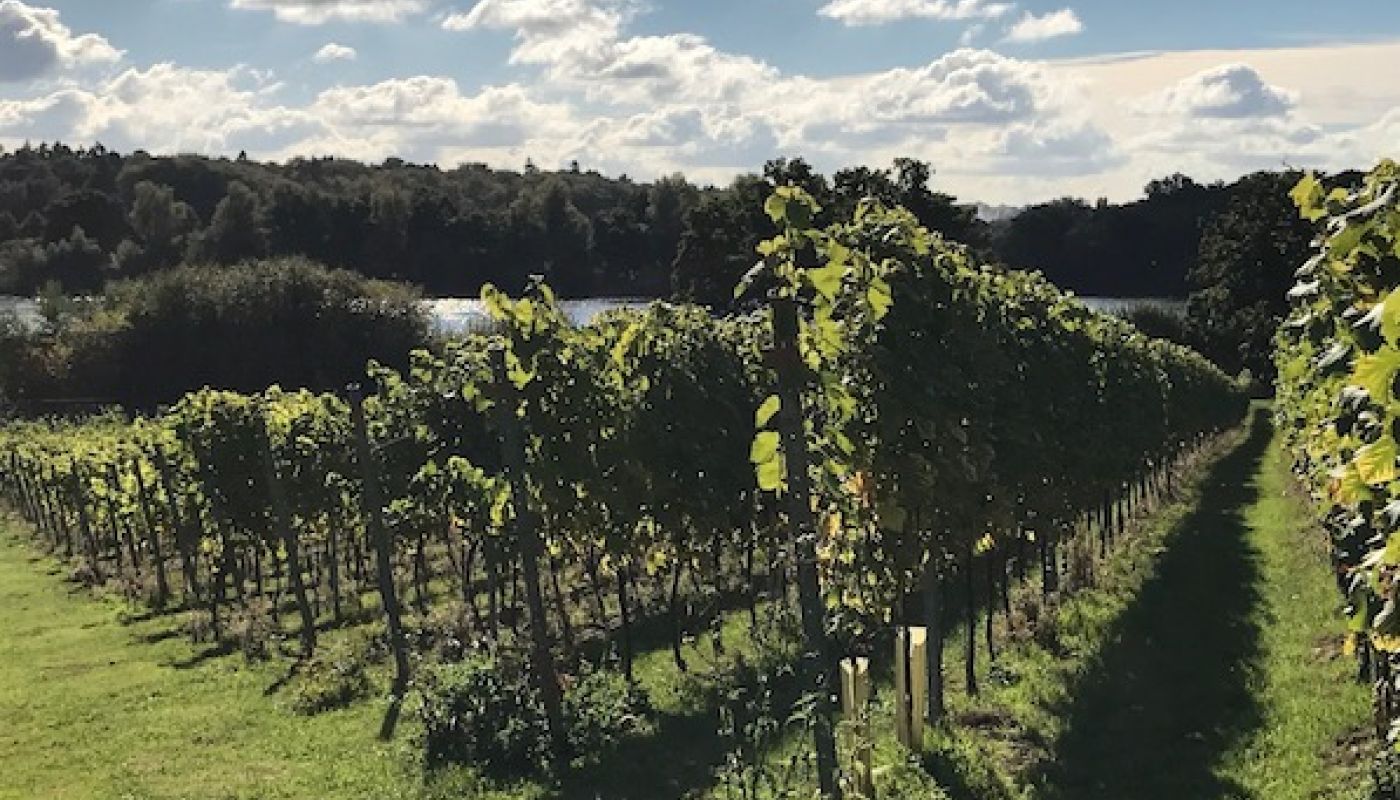
Tony Laithwaite grew up in Windsor and used to play in the park as a child. He remembers coming to buy sweets in that village shop. It was he who greeted me on that glorious sunny morning at the top of the four-hectare slope that was planted with Chardonnay, Pinot Noir and a little bit of Meunier in 2011. It came about when Anne Linder of Laithwaite's went to placate a disgruntled customer who happened to live in the grounds of Windsor Castle with a bottle of Theale fizz. She happened to remark that several parts of the Great Park looked like promising vineyard sites. He went on to introduce her to the park’s Deputy Ranger and the rest will become history, or rather history continued since Anne has been digging around in the archives and has found records of vineyards at Windsor Castle from the twelfth century. (The picture below shows, left to right, Anne Linder, Tony Laithwaite and Robert Large, Yeoman of the Royal Cellars, whom I usually see in be-medalled black tailcoat and red waistcoat and who visited the vineyard at the same time as I did.)

The Royal Farms are apparently very keen on this vinous project – it adds a particularly exciting product to what they can sell in the Windsor Farm Shop – and allowed Laithwaite's to choose the site, a south-facing slope called Mezel Hill that leads down from some tumbledown farm buildings (see below) that the Royal Farms have promised to renovate, to a pretty lake surrounded by old oaks. Tony is not-too-secretly chuffed that, while Henry’s vines were devastated by frost in April 2016, ‘his’ vineyard was untouched. Mind you, it has a pretty soggy bottom and the vines at the bottom of the slope are in a serious way. Before planting, I was told, they sent off soil samples to a lab in Champagne, without divulging their provenance, and got the go-ahead that they would be suitable for champagne production. My fellow Master of Wine and English wine specialist Stephen Skelton was recruited to advise on planting. He suggested draining some of it but they were in a bit of a hurry. It has ended up as one of the highest-density plantings in the country, with 6,500 vines per hectare, 55% of them Chardonnay.

When the first grapes ripened, a few sample bunches were sent up to Balmoral in Scotland where the Queen was on her usual late-summer break. And Tony got to have tea at Windsor Castle with the Queen and the Duke, leading to one of the most prized images on his iPhone. ‘Look – there she is laughing and scratching her back!’ (People are always amazed that the Royals are human.)
Of the under-2,000 bottles of the first vintage, 2013, all have already been sold, at £34.99 a bottle, via Laithwaite's, the Sunday Times Wine Club and the Windsor Farm Shop, and Robert and I have done our damnedest to ensure that the Royal Household Wine Committee acquires some of this very respectable, delicate wine, made at Ridgeview’s winery, for the Queen’s cellar.
While we toured the vineyard, Laithwaite's photographer's drone hovered overhead. Below is one of the results, giving Windsor a rather Marlborough look.













