The sort of champagne most commonly drunk is the main non-vintage blend made by all producers. The sort of champagne most commonly written about and discussed by champagne aficionados, on the other hand, is each house’s prestige cuvée made in much, much smaller quantities (although the amount of Dom Pérignon produced by Moët & Chandon is a much-debated and closely guarded secret).
Other particularly famous examples of these steeply priced, distinctively designed bottles of liquid luxury are Cristal from Louis Roederer and any wine from Krug (like Moët, owned by LVMH). But virtually every champagne house has one fancy top-of-the-range product.
But most of them produce other wines too, priced somewhere in the wide gap between NV and prestige cuvée. Rosé champagne has become increasingly popular and nowadays the houses are putting real effort into ensuring these pink wines – generally much darker than the very pale salmon that was all the rage a decade or so ago – are well made and satisfying.
Then an increasing number of houses are now offering wines that are deliberately drier than the non-vintage norm and, sometimes, one that is made much sweeter, for drinking with desserts or perhaps well into the night. And some producers such as Lanson now offer a champagne sold specifically as organic (even though Louis Roederer has been making giant strides in that direction across the board).
But the most traditional offering other than NV is vintage champagne, one carrying the year in which all the grapes were harvested, as opposed to the (generally much cheaper) non-vintage champagne that is a blend of the produce of different years that is usually younger than the house’s current vintage champagne.
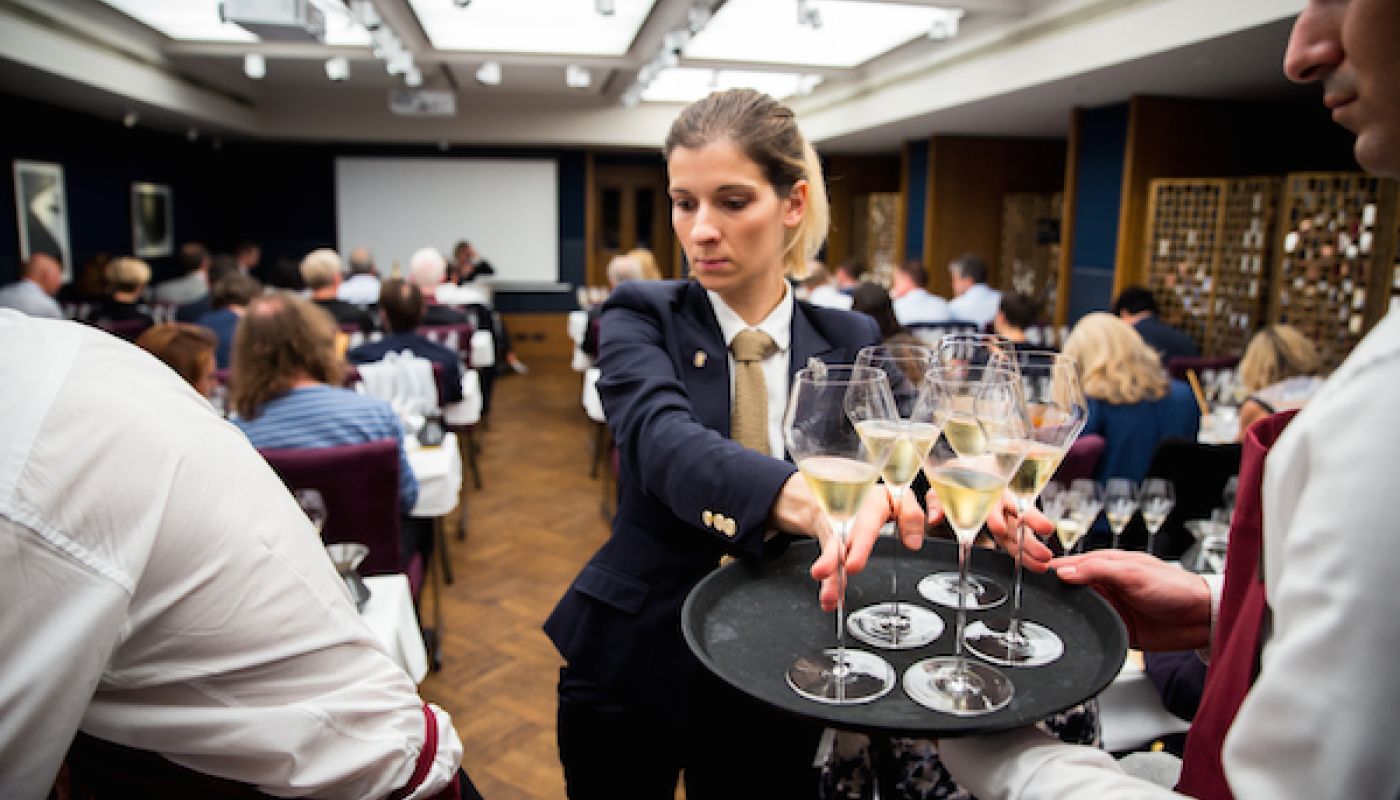
Aware that the champagne houses put a great deal of effort into their vintage champagnes and yet they tend to be rather overlooked in comparison with the prestige cuvées that can cost more than twice as much, Nick Baker of champagne specialist retailer The Finest Bubble organised a blind tasting last month that pitted current vintage offerings against prestige cuvées from the same house. So it was that more than 50 of us sat down to compare eight pairs of wines, from each of Bollinger, Charles Heidsieck, Lanson, Moët & Chandon, Laurent-Perrier, Pol Roger, Louis Roederer and Taittinger. (We did not include Krug in this exercise as Krug acknowledge in their pricing policy that their non-vintage Grande Cuvée is worth about the same in every way as vintage Krug.)
Twenty of the tasters voted in each case for which of the pair they preferred and which they thought was which. The most striking aspect of the results was that two of the four favourites, Louis Roederer vintage 2009 and Pol Roger vintage 2008, were vintage not prestige cuvée champagnes. Indeed they garnered exactly the same average score, 18.2 out of 20, as Taittinger’s prestige cuvée, Comtes de Champagne Blanc de Blancs 2006. Louis Roederer Cristal 2009 nudged into first place with 18.4.
Of these top four, Roederer 2009 is undoubtedly the relative bargain of the whole lot, selling for just over £50 a bottle at the particularly smart wine shop Hedonism in London. The Pol 2008 has unfortunately already garnered such réclame (2008 is a year for champagne with a reputation approaching that of 2002) that it is already retailing at over £60 a bottle.
Furthermore, of the eight pairs of wines, in exactly half of all cases, four to be precise, the vintage champagne was not seen as inferior and was often even preferred by the tasters to the prestige cuvée from the same house. Pol Roger 2008 was preferred to its stablemate Cuvée Sir Winston Churchill 2006. More unexpectedly, Bollinger’s current vintage champagne offering, Grande Année 2007, got exactly the same average score, 17.9, as Bollinger’s late-released prestige cuvée RD 2002 at twice the price. The two offerings from the excellent Charles Heidsieck, the Blanc de Millénaires 1995 that has been their prestige cuvée for years and was by far the oldest wine in the tasting, and their vintage champagne that was exactly 10 years younger, garnered exactly the same average score, 17.7.
The two wines from Moët, Moët & Chandon Grand Vintage 2009 and the recently released Dom Pérignon 2009, also got the same score, 17.6, from the crowd but I suspect it was a bit skewed. Moët, by far the biggest champagne house, has long been saddled with the reputation of making rather ordinary, sweet champagne even though the winemaking team of Richard Geoffroy and Benoît Gouez have made huge strides and this view is outdated. The 2009 vintage of Dom is particularly rich and ripe, and I suspect many tasters were misled by this to confuse the prestige cuvée Dom Pérignon 2009 with the vintage 2009, which may well have exerted a downward pressure on the scores of this pair, both poured, uniquely in this tasting, from 75 cl bottles.
Bottom of the rankings – just, with scores of 17.4 and 17.3 respectively – were the two Lanson wines, Lanson Gold Label vintage 2005 and the debut vintage of their new prestige cuvée from a small walled vineyard next to the cellars in Reims, Clos Lanson 2006.
As for how correctly the wines were identified, the pairs that caused most puzzlement apart from the two from Moët were the two from Charles Heidsieck (a testament to the apparent youthfulness of that exceptional Blanc de Millénaires 1995, perhaps) and the two Lansons, that didn’t really seem so very far apart in either age or quality. Some were also foxed by the difference between Laurent-Perrier’s unusual Grand Siècle prestige blend of three different vintages (unspecified on the label but apparently 1997, 1999 and 2002) and their vintage 2007.
I should point out, however, that Baker chose to serve all the vintage champagnes, except for the Moët 2009 that is so far available only in 75-cl bottles, in magnums, on the basis that this is the most flattering bottle size, with 150-cl magnums generally tasting more youthful than regular bottle sizes. But I think the point was made despite this. If you are looking for the best deal in really superior champagne, think seriously about buying a vintage-dated bottling rather than one of the much more expensive prestige cuvées.
BETTER BUYS IN SUPERIOR CHAMPAGNE
Louis Roederer 2009
£50.10 Hedonism, £54.95 The Finest Bubble, £55 The Wine Society
Pol Roger 2008
£62 Swig, The Wine Society
Laurent-Perrier 2007
£46.99 Ocado, £50 Laithwaite's
Taittinger 2009
£45 The Finest Bubble, £51.95 Lea & Sandeman
Moët & Chandon 2009
£54.95 The Finest Bubble
See tasting notes on Purple Pages, particularly this tour of nine major champagne houses, a trek made in preparation for the event described above.