Rachel B Allison writes Rachel B Allison is a postdoctoral scholar at The Pennsylvania State University, specializing in redox and wine flavor chemistry. Passionate about wine education and science communication, Rachel is an enthusiastic tasting host and nerd, weaving science into the storytelling tradition of wine. She’ll be finishing up the WSET Diploma any day now. In her academic work, she bridges technical research with practical applications in the wine industry, exploring the sensory and chemical impacts of packaging, processing, and storage on wine quality.
Riesling made me smarter
“What wines do you like?”
The question was tossed my way, in the friendly sizing up that happens when new wine people get to know each other. Fellow graduate students settled around a table in the classroom alcove, passing around their carefully concealed bottles and bickering good-naturedly over a contentious wine from the previous week’s blind tasting (Aligoté, I think). The classmate who had invited me leaned over, giving me a quick lowdown on the gathered group - experienced cellar rats and harvest interns, a scion or two of wine families, a fine dining sommelier.
In a room of wine people with wine histories, I had just stumbled into wine from science. A disillusioned engineer, I had pivoted into a doctoral program in wine chemistry. I had a little experience tinkering in flavor chemistry, but beyond drinking a glass of wine here and there, I had no idea what I was doing at the table.
So, when the fateful question was asked, I answered honestly with what I figured would be an innocuous and unobjectionable wine, a neutral answer that would elicit zero follow-up questions.
“Riesling.”
I felt vaguely apologetic, silly even, for giving such a boring answer. After all, this was the grape I saw everywhere, growing up in Ontario. Riesling was prominently displayed in the standard provincial stores, the grape with name recognition, the wine everyone drank. I remembered that it felt like sunshine, smelled like flowers and lemonade, sometimes honey, that it was sometimes a bit sweet but always very refreshing. I remembered that it seemed to defy my total ignorance of how to pair wine and food. Importantly, I remembered clearly that I liked it, and that even though I understood next to nothing about wine, Riesling readily gave me enough to get on board.
I grew up with no exposure to wine until I went to university, where my fancier friends impressed upon me the importance of wine in the dining experience. Eager to fit in, I set out to find some wine. The store near my dorm proudly displayed Canadian bottles right at the front, the whole section seemingly curated to proclaim: these wines are for you! A nearby couple debated a wine called Pinot Grigio, which I didn’t recognize. I noticed an intimidatingly named Gewürztraminer, which frankly seemed a risky proposition. But as I paced up and down the aisle, I saw Riesling after Riesling – people must really like this grape, I reasoned.
In a time-honored tradition, I opted for the prettiest label, grabbing a bottle with a butterfly print in a cheerful orange and yellow color scheme. Opening the bottle later that evening, I took a moment to assess my choice. I liked it – though in retrospect, it probably wasn’t a remarkable wine. What struck me, however, was not only did I like it, it was interesting. The second sip was different from the first, all flowery one moment, and fruity the next. Unexpected. For a lifelong student, Riesling was irresistible.
“Riesling,” I answered, glancing around the room.
I took in a few expressions of surprise. A pair of briefly raised eyebrows. A murmured “interesting choice”.
In the hour that followed, I came to understand that Riesling had an entirely different persona than the one I knew. Riesling wasn’t ubiquitous, and it certainly wasn’t a neutral answer! Despite my mild Canadian temperament, I had inadvertently acquired a controversial opinion on wine. And thanks to that unlikely endorsement from Riesling, something funny happened; people started overestimating me.
This was not an isolated experience. For years, my affinity for Riesling continued to imply that my wine knowledge was greater than it was, that my palate was well-traveled, that I knew of gastronomic wines, that somehow, I’d seen the rest and declared the best. I came to learn it was a favorite among sommeliers, who with their wealth of experience seemed to appreciate it for largely for the same reasons I had stumbled on in my early university days. Meanwhile, Riesling gained me access to tables with serious wine people, where I tasted the variability of the wine. This was “serious” Riesling for experienced palates, where the nose was described in poetic language, hinting at beauty and harmony, the structure was given in geometric terms, all angles, lines and precision. The wine felt so unknowable it seemed like an entirely different grape.
I wondered how this could be the same unassuming Riesling I knew.
Science gave me a path to reconcile serious Riesling with the easygoing grape I’d first encountered. Riesling had always reminded me of sunshine; sunlight was key to the vine’s metabolism in developing ample flavor precursors to the distinctive petrol aroma compounds. My own work on flavor chemistry across the reduction-oxidation spectrum revealed the relative stability of many floral and honeyed notes, how they coexisted in metastable energetic states, drifting across an equilibrium that changed the nature of Riesling over time.
Turns out, the serious and the unassuming Riesling were one and the same.
Riesling was a great teacher and mentor, an advocate of both science and art when it came to grappling with wine and claiming a seat at the table. Somehow changeable yet always able to profess a strong sense of identity.
“What wines do you like?”
With years under Riesling’s tutelage, I jump at the chance to expound on whatever wines du jour come to mind. While the answer definitely changes, I am always happy to share a glass of Riesling while we talk.
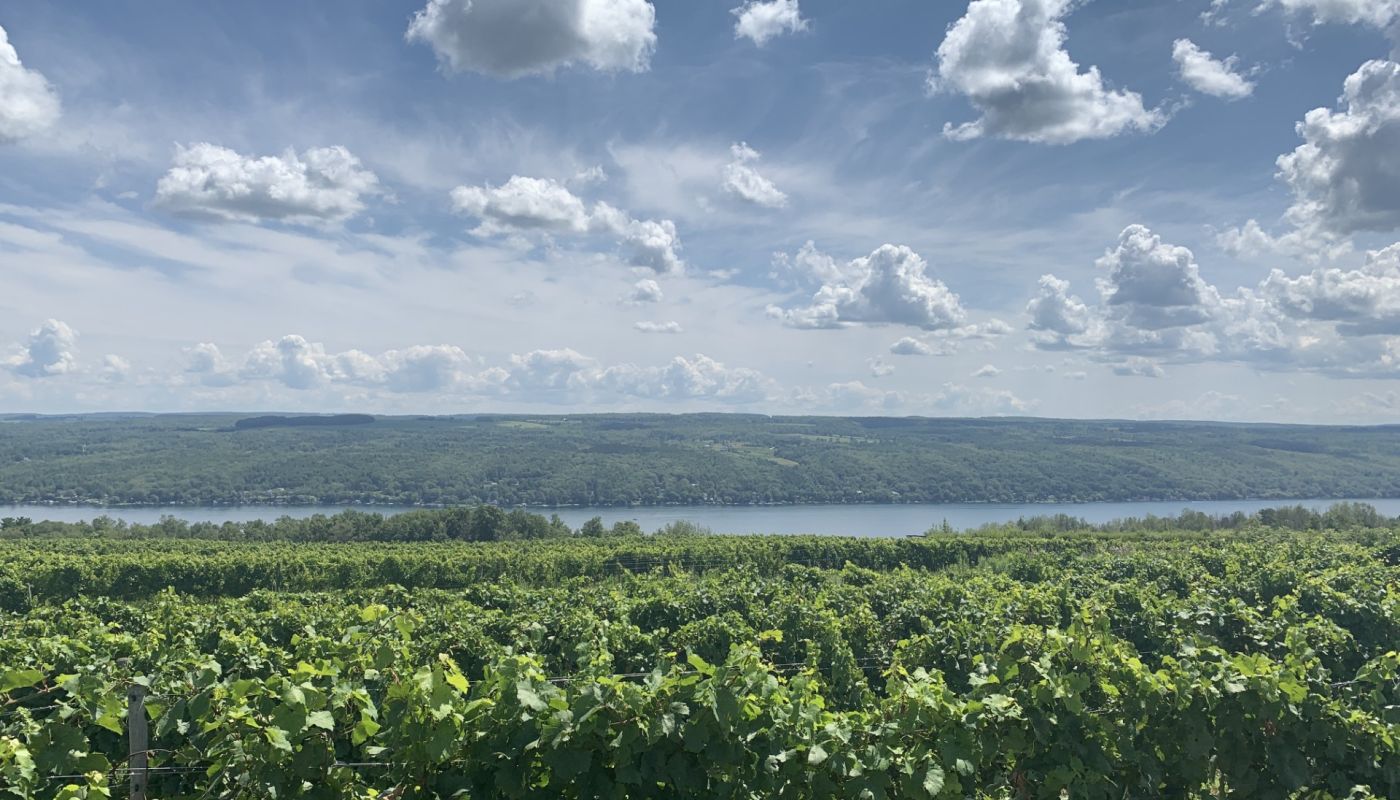
The photo is the author's own. Caption: 'overlooking the Finger Lakes, or the place I learned wine chemistry'.
















