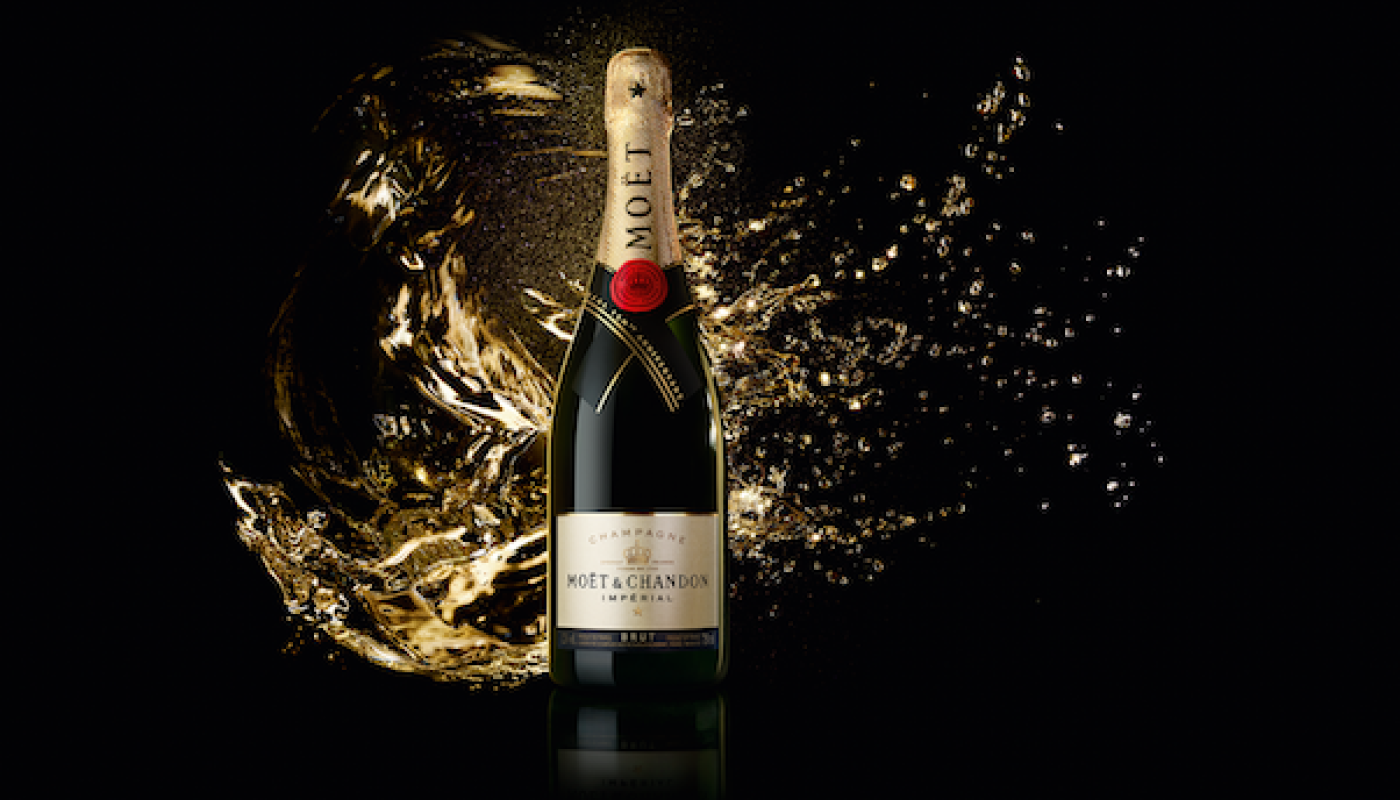
One obvious sign of how much someone knows about wine is how they pronounce Moët. Insiders say ‘Mow-it’ (‘Mwet’ in French) rather than ‘Mo-way’.
There are ample opportunities to get it wrong. Moët & Chandon is by far the dominant force in the Champagne region, the biggest landowner with 1,200 ha (2,965 acres) of vineyards. It’s also the dominant force in the Champagne market, with all that that entails.
Size rarely spells glamour. And the image of Moët over the years has been one of a mass-market crowd pleaser, producing acceptable but un-thrilling wines that tend to be sweeter than most. Moët was rarely the choice of wine insiders.
But nowadays they’d be wrong. The champagne industry’s flagship has undergone an impressive makeover. Today Moët’s Brut Impérial, the non-vintage blend that is the company’s most important product by far, made in almost unimaginable volumes, is a thoroughly respectable champagne, and much drier than it used to be. Twenty years ago the blend was sweetened up to 13 or 14 g/l of sugar. When Benoît Gouez became chef de cave in 2005 he reduced the so-called dosage, a regular aspect of champagne production, to 11 g/l, then 9 g/l and in the last two years it has been only 7 g/l.
The current blend of Brut Impérial, so-named because when it was launched 150 years ago it was exactly a century after Napoleon’s birth, is based on wines from the 2015 vintage, deepened with reserve wines mainly from 2013. The crucial champagne statistic is how long it spends ageing on the lees of the second fermentation in bottle. Bottle age means complexity and integration. The legal minimum for non-vintage champagne is 12 months but for Brut Impérial this has been extended from 18–20 months to 24–32.
Then there’s a further six months' ageing in bottle after the wine has been disgorged, when the lees are expelled from the bottle as a cylinder of ice, a process that carries on throughout the year for the massive volumes of Brut Impérial. This extended ageing must have had quite an effect on owners LVMH’s finances, so I urge any champagne drinker still prejudiced against Moët to reward this expensive new policy by giving Moët Brut Impérial another try.
The wine is admittedly the polar opposite of the stereotypical grower’s champagne with its austerity and high acidity. This was perhaps the style Gouez had in mind when he commented rather huffily recently, ‘we’re not obsessed by acidity. We want bright freshness with delicacy. Some people overreact to the evolution of grape ripeness and think consumers are looking for acid. But I’m sure that most champagne consumers don’t like excess acidity.’
The vintage-dated Moët Grand Vintage has also been spruced up, and drinkers of it are deemed sufficiently well-informed to be given the date the wine was disgorged on the back label – information supplied routinely on the labels of grower champagnes. This information is not given on the labels of Brut Impérial (seen below in its 150th anniversary livery) because Moët’s research suggests that too many consumers think it’s a ‘Best before…’ date.

Moët champagne is by no means the only wine that has gone from naff to nice. Rosé of course, once dismissed as irredeemably frivolous, has become thoroughly respectable. Sacha Lichine, for example, prices his top bottling of Ch d'Esclans Provençal pink, Garrus, so that it’s about £100 a bottle in the UK.
The giant category of Australian Chardonnays would be another obvious candidate. It was not that long ago that we all looked down our noses at how oaky and overblown they were. But now the typical Australian Chardonnay is a lean, clean, refreshing answer to white burgundy at a fraction of the price. Some specific recommendations are given below. My theory as to how Australians manage to change direction so nimbly and comprehensively is that the leading winemakers all get together regularly at the wine shows that are still so important to the Australian wine scene.
Lambrusco used to be synonymous with sweet mass-market froth of the worst sort but now it’s a rather serious category, with a host of dry, gently sparkling reds seen as the connoisseur choice with many an Italian dish, notably the pig-based products of Emilia-Romagna. UK specialist Italian importer Passione Vino lists six Lambruscos of real interest.
A little further north, in the Veneto, Soave and Valpolicella probably deserve a bit of an image upgrade too. The best producers such as Agostini, Fattori, Gini, Inama and Pieropan in Soave and Allegrini, Corte Sant’Alda, Dal Forno, Quintarelli and Viviani in Valpolicella make wines worthy of any cellar rather than cheap supermarket bottlings.
Prosecco’s an interesting one. For some wine drinkers it represents sophistication. For others Prosecco is a clever, more youthful, better-priced alternative to champagne. It is now so ubiquitous, and made from such a massive region, that Prosecco can hardly claim precision, but fine Prosecco does exist. I’m no big fan of mass-market Prosecco – it tends to taste a bit too sweet for me – but thanks to the late Gianfranco Soldera of Case Basse in Montalcino, I have experienced top-quality Prosecco, in the form of Casa Coste Piane’s from the Prosecco heartland of Valdobbiadene – although even that is not my favourite fizz.
Cava definitely has an image problem – which is most unfair since it’s much more difficult to make Cava with its a very similar recipe to champagne, than it is to make Prosecco in tank. Recognising this, an increasing number of producers of Cava in the Catalan region of Penedès, which is where the sparkling wine industry is based, are leaving the appellation. Instead they are choosing to call their carefully made sparkling wines something obviously different from Cava such as Conca del Riu Anoia or Corpinnat, meaning ‘born in the heart of Penedès’.
Like Moët, Harveys once dominated their particular wine sector, sherry. Although the fine-wine merchant Harveys of Bristol was hugely respected in the mid twentieth century, Harveys Bristol Cream was far from the sherry aficionado’s choice. Nowadays Harveys don’t even have their own bodega in Jerez, but there are now some tiptop sherries available under the Harveys name, based on particularly venerable soleras. Most of them are labelled VORS (for Very Old and Rare Sherry) and are at least 30 years old on average, yet they retail in the UK at around £30 a half-litre. Extreme bargains indeed. Compare and contrast with the cost of a fine 30-year-old bordeaux or burgundy.
All in all, it’s becoming increasingly difficult to think of wines that are beyond the pale, so keen are producers to up their game, fortunately for us.
SOME FINE AUSTRALIAN CHARDONNAYS
Bindi
BK
By Farr
Cape Mentelle
Coldstream Hills
Cullen
Curly Flat
De Bortoli
Fraser Gallop
Giaconda
Giant Steps
Hardys, Eileen Hardy
Kooyong
Leeuwin Estate, Art Series
Marchand & Burch
McHenry Hohnen, Calgardup
Oakridge
Ocean Eight
Paringa
Penfolds, Bin A and Yattarna
Pierro
A Rodda
Shaw + Smith, M3
Sorrenberg
Tappanappa, Tiers
Tolpuddle
Vasse Felix
You can find reviews of these wines in our tasting notes database, and retailers on Wine-Searcher.com.