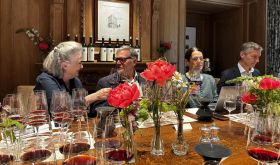
Over a cup of Costa Rica La Laguna filter coffee, made by Anita Le Roy, proprietor of the Monmouth Coffee House, Covent Garden, unquestionably London's most dignified coffee shop, five men and two women gathered to dissect the current state of the British coffee market.
There was not a single representative from Starbucks, Costa Coffee, Caffe Nero or Aroma in the room. But, these seven coffee aficionados (who had never previously met so intimately until 'the business' brought them together) are the people behind your daily cups of espresso, cappuccino and latte wherever you buy them. These are the people who seek out and roast the best; who decide which beans make the best espresso blend and seem to care not a fig for profit or fashion but are mad about coffee. These are the people who have set in motion Britain's coffee revolution but are only too aware that as a nation we still have a lot to learn about this magical bean.
Annual world coffee production is around 100 million bags (each bag is 60kg) of which 80 million are traded between producing and consuming countries. After oil, coffee is the world's most heavily traded commodity but unfortunately for the producing countries coffee has to be picked every year – unlike oil it cannot simply be left to increase in value. At the moment, thanks to abundant crops and in particular the emergence of Vietnam as a major producer of inexpensive low quality coffee, a great deal of which today makes its way into every cup of British instant coffee, world coffee prices are at an all time low.
Coffee and wine have a lot in common (for example, the higher the grapes and beans are grown the better the quality) although in origin coffee is much simpler to understand. Whereas there are 20 major grape varieties worldwide there are only two different coffee beans, arabica (from Arabia where coffee was first discovered) and robusta. Arabica is the more distinguished and refined, is often twice the price of robusta and to show their relative quality levels it is a maxim of the coffee trade that there is a close inverse relationship between a country's import of robusta beans and its citizen's coffee connoiseurship. Despite all the new coffee bars on our high streets, Finland, Norway and Sweden still import far more top quality coffee beans than the UK.
The big difference between coffee and wine merchants is that whilst the latter deal with finished samples, picking from a row of 20 masked bottles the one they consider to be the best Chardonnay after it has been picked, fermented, blended and bottled, coffee merchants buy the beans green, after they have been simply picked then dried and packed. They then proceed to weave their magic over them via roasting and blending. This process now takes place all over the country, from Newcastle to Harrogate, from north Lincolnshire to south west London.
But according to this magnificent seven, what is exciting is that British coffee knowledge today is at the same stage that British wine knowledge was 20 years ago. The product is no longer foreign; we all want to learn more and with the right teachers the world of coffee is not at all intimidating – certainly no more difficult than reading a wine label. Learning to appreciate good coffee is not a question of money but more of discovering the blend you most like and realising that the whole coffee making process is not at all as intimidating as it seems. This is how the professionals see the coffee world and their role in it.
The Coffee Hunter: Stephen Hurst has spent 15 years in the coffee trade and visited at least 43 producing and consuming countries in the process most notably surviving a Jeep trip over a precipitous 4000 metre Andean pass to the Chanchamayo Valley in Peru. Having run Goldman Sachs coffee trading division, Hurst set up Mercanta, his own trading company, in 1996 to deal in raw, green coffee. His knowledge of the coffee world is encyclopaedic and he is generous with his knowledge. Whenever there was a dispute in the room over a coffee fact the shout went up, 'Ask Stephen'.
'In outline the coffee trade is simple. The quality levels start with blended coffee at the bottom, then progress to single origin coffee – Cuban, Ethiopian or Indian for example – and finally to the most distinguished, single estate coffee such as Ethiopian Limu, Sidamo or Yirgarcheffe. In size it resembles bulk commodities like sugar or coal but the difference is that coffee requires skilled cup tasting ability to be traded properly.'
Cup tasting is to coffee what swirling, sniffing and spitting are to wine. A small amount of coffee is roasted, then ground and put into a ceramic bowl. Water, just off the boil, is poured over the sample and stirred once, gently. After a couple of minutes the grounds rise to the surface and form a crust. The coffee taster, or cupper, using one spoon in each hand, breaks the crust and sniffs. The crust is then scooped off with both spoons, preferably silver or silver plate. When the liquor has cooled slightly the cupper slurps it from the spoon loudly which aerates the coffee and coats the palate. This is done twice, once when the coffee is hot to assess the body of the coffee, the second for acidity and varietal flavour.
'The problem all of us who care passionately about coffee in the UK have to face up to is the insistence on instant consumption at home. The Trevor Eve ad for Gold Blend had an enormous impact and you just have to look at the UK import figures, 85% of which are for instant coffee, to realise that there is a long way to go before we catch up with the rest of the world. My ambition is that in the not too distant future British coffee drinkers can associate directly with the estate the coffee has come from in the way that you can now associate a bottle of wine with the vineyard. Time will tell. The multinationals, the owners of Gold Blend, Nescafe and Maxwell House have huge advertising budgets and what I fear is that instead of steadily better coffee we could follow the example of Germany where price cutting amongst the retailers means that quality is actually going down.'
The Coffee Alchemists: Jeremy Torz, Steven Macatonia, James Sweeting, Simon Herring and Victoria Hardman.
'Roasting coffee', according to Jeremy Torz, 'is not a question of turning green beans brown. Over 800 different flavour compounds have been identified in a cup of coffee and it is our job to supervise this volatile combination of fats, sugars and oils and then combine them into the best blends.'
This process brought Torz, formerly an optician, and Macatonia, then an immunologist, together in San Francisco, where they were inspired by the success and aromas from Pete's Coffee to set up their own company. Initially based in a shed in Essex, they have gone on to blending coffee for Waitrose and until July this year to supplying the beans for the 150 strong Starbucks chain. The same passion but in different locations brought Herring, from Lincolnshire, together with Sweeting, a Yorkshireman, to form Lincoln & York which in the wilds of north Lincolnshire roasts the coffee for a variety of national brands including Whittard's; and Victoria, who with her brother Hugo, runs Darlington's in south London which supplies cafes and restaurants across the country, most recently creating the blend for the Feed the 5,000 chain in Manchester.
Before they turned their attention to the changes the coffee chains have played in their lives, they all sought to disabuse me of one coffee fact – don't dismiss filter coffee. 'In fact', explained Sweeting, 'there is more complexity in a cup of filter coffee than there is in an espresso. Filter coffee is not the dregs, the problem is that restaurateurs will not throw it away so if it has been sitting there too long you can be served a nasty, bitter brew.'
The relationship between these alchemists and the high street names is complicated. On the one hand they acknowledge the kick start Starbucks, Pret and Costa have given to coffee consumption, on the other they point out that they purvey more milk than coffee with one rather acidly adding that 'perhaps they deserve a medal from the Milk Marketing Board'. 'A single espresso shot, the basis of every cappuccino or latte is 1oz, 7.5gr', explained Hardman, 'but they are sold in 8oz, 10oz and 16oz cups with Starbucks now introducing a 20oz venti mug, more of a bucket in my opinion. The coffee/milk ratio is quite obvious.'
And that is the nub. Whilst these coffee alchemists love the coffee they roast, blend and sell, they believe that what the retailers sell is not coffee so much as a lifestyle dividing us not into those who know the difference between Costa Rican and Dominican coffee but those who only think it is cool to carry a Starbucks mug rather than a Coffee Republic one.
But if we want to drink better coffee in restaurants and coffee bars the alchemists are continually surprised and disappointed that coffee in the home is still not much better. 'Instant, which is really only a distillation of the cheapest beans, is still socially acceptable', fumed Victoria Hardman. 'If you think of it as a hot drink it is OK but it certainly is not coffee.'
The Coffee Merchants: Anita le Roy and Paul Crocetta.
For the past 20 years Hodgson of Monmouth Coffee and Crocetta, proprietor of the Algerian Coffee Store, Soho, have been the source of your restaurant espresso or cappuccino. They also still enjoy explaining coffee's charms over their espective counters and in particular just how easy it is to make good coffee at home.
'All you need is a jug and a filter or ideally a cafetiere – if you can make tea at home you can make good coffee', Hodgson explained. 'But whilst we are all naturally grateful for what the coffee chains have done for our business, they have created a myth that if you want a good coffee you have to call in at one of their branches. That just is not the case.'
But selling good coffee is not only what excites Hodgson. With the roaster downstairs producing rich, warm aromas she led me over to a bag of coffee that was marked KOORGHULLY, CORAMMANDEL, INDIA. 'This was the first estate I ever visited and it has inspired me ever since. The owner, Teddy White, cares for his workers by supplying healthcare and housing and he does not tolerate any abusive behaviour of the women who now care and prune the plants. About 7 years ago they stopped using pesticides – they still have to use some chemical fertilisers because the monsoons leech so much from the soil – with the result that birds and butterflies are now back all over the plantation. The coffee is fantastic, too.'
Over an espresso in Soho I asked these aficionados for the coffee producing countries of the future. Opinion was divided between Cuba, the Dominican Republic and Columbia although many believe Brazil, already the world's biggest producer, will soon provide a number of top quality single estate coffees.
As to coffee etiquette, there was broad agreement. Follow the Italian example and do not order a double espresso – if you want the caffeine shot only an espresso supplies, order two singles. And drink them quickly as an espresso's aromas and flavours are good for no more than 30 seconds. As to decaffeinated coffee, that fell into the hot drink category together with instant: caffeine is integral to good coffee.
And, finally, expert advice on how to drink better coffee and still enjoy the coffee bar lifestyle. Buy the ground coffee you like from a coffee merchant, a cafetiere, and a Starbucks, Coffee Republic or Caffe Nero travelling coffee mug. Before you set out each morning make the coffee in the cafetiere, pour it into the mug and take it with you. You will be part of the coffee crowd but drinking better coffee – and avoid the queue.