
The phrase 'chefs' toys' is an expression in the restaurant trade that has come to distinguish the invariably expensive tools professionals cook with from those that can be found in even the most committed amateur's kitchen.
Over the last few years the gap between the two has narrowed as manufacturers have cleverly induced us to believe that we can cook so much better if we have so much more. A display of Japanese knives, breadmakers, ice-cream makers and induction hobs are now de rigueur in many new homes, although a price tag of more than £3,000 ensures that the Swiss made Pacojet remains mainly in professional hands. This small, counter unit purees food in a frozen state and magically concentrates the flavour of the raw ingredients.
This toy is emblematic of a cooking style that manifests itself in mousses, foams and splodges of colour across the plate, a style that is currently moving out of fashion. Taking its place, and top of many chefs' current shopping lists, is the far more expensive Josper.
A Josper is a hybrid. It is first and foremost a grill but the secret of what it adds to whatever is cooked on it – whether steaks, chicken, fish, vegetables or anything enterprising chefs can turn their hands to – is that it has a front door which, when closed, ensures that none of the natural moisture or flavour escapes. More often than not, a Josper is described as an oven, although grilling is its primary role. Burning top-quality charcoal, the Josper is, in layman's terms, the hottest indoor barbecue available.
I encountered my first Josper five years ago in Moscow at Goodman's, the steak restaurant. The meat was exceptional. One was subsequently installed in their London outpost.
Raphael Duntoye, the charming chef at La Petite Maison in Mayfair, was a very early enthusiast but confessed to me that he had made two elementary mistakes. Firstly, the dishes cooked on it have proved so popular with his customers that he knows now that he should have bought two, not one. And secondly, he joked, he should have asked the UK importers for a commission. Every chef who has come to his kitchen to watch it in operation has ended up buying one, despite a price tag of up to £18,000.
This is not surprising, for a top-of-the-range Josper can accommodate about 30 pieces of fish or meat simultaneously. The bars of the very hot grill, at a normal setting of 300 °C (but this can go much higher), mark the meat or fish attractively and cook it swiftly; the closed door enhances the flavours; and the steam that emanates from the Josper whenever the door is opened adds a touch of drama for the customers if it is situated in an open kitchen.
While all of these attractions appeal to us now, and particularly at this time of year when simply grilled food is so attractive, it is somewhat surprising to discover that the Josper is 40 years old. It was created in 1970 by Josep Armangue and Pere Juli, who subsequently gave their names to the company, a year after they had opened their 1,000-seater restaurant Mas Pi in Pinedar de Mar close to the Mediterranean in north-east Spain, and became convinced of the need for a new solution to cook over charcoal in professional kitchens. The two adjustable draughts, at the bottom to draw air in and at the top to let the smoke and combustion gases out, operate in a similar fashion to the mechanism behind the Aga cooker, once the staple of the English country kitchen.
Josper's UK importer reports that business is currently very brisk with about 100 ovens installed and orders from several high-profile restaurants on the books. These include the second branch of Hawksmoor that specialises in serving British meat, due to open in Covent Garden in October, and another for Heston Blumenthal's kitchen in the Mandarin Oriental, Knightsbridge, at the end of the year.
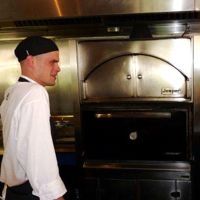
Quite how powerful these ovens are I discovered standing next to chef Mark Hansell-Dixon, pictured above with the Josper in the open kitchen of The Akeman, a bright, modern restaurant in the market town of Tring, 35 miles north west of London.
On the tray by our side were a whole sea bream and a 28-day aged British sirloin steak, which were seasoned, anointed with olive oil and, in the case of the fish, covered with lemon juice. Opening the Josper's door released the first blast of heat, a sensation that was to be repeated frequently as each item was turned promptly as the crisp grill marks appeared but before any part of the flesh could dry out. The fish was then taken to be finished off in a conventional oven for five minutes while the steak was put on the top rack of the Josper, where the temperature hovers between 60 to 80 °C, and where it will rest until ready to be served.
Hansell-Dixon explained that it had taken him, an experienced chef, about a week to adapt to the Josper's fierce heat and he showed me the burn marks on his arms to prove that accidents can still happen. He also used the phrase 'cremated' to describe what the Josper can do if the chef is not paying attention.
But he was wildly enthusiastic about the Josper's advantages and not just for the most obvious items. Grilling fresh sardines was a particular favourite and two items, slow cooked pork belly and oven roasted tomatoes, had found their way on to his menu simply from experimenting with leaving both on the top rack of the Josper for up to twelve hours.
Opening the lower door, Hansell-Dixon showed me the V-shaped tray that holds the charcoal that is cleaned out every morning by a junior member of his team. 'This one', he added, tapping it with a pair of tongs, 'burns about 10 kg of charcoal a day. Over a year this comes to about £5,000.'
Peter Borg-Neal, the Akeman's owner, believes the Josper is such an essential ingredient in his business of smart/casual restaurants outside London that he has installed a further two at The Old Post Office in Wallingford, Oxfordshire, and The Red Lion in Hemel Hempstead, Hertfordshire.
'It allows me to achieve two very different goals. Firstly, to use a cooking technique normally associated with the more expensive West End restaurants and secondly to use it to cook such a wide range of food. We even cook the chicken breasts on it for the chicken Caesar salad and they're the best I've ever tasted', he explained.
The Akeman, www.oakmaninns.co.uk
Josper, www.josper.es
The thrill of the grill
• 4 分で読めます
This article was also published in the Financial Times.


購読プラン
スタンダード会員
$135
/年間
ワイン愛好家向け
- 297,198件のワインレビュー および 16,153本の記事 読み放題
- The Oxford Companion to Wine および 世界のワイン図鑑 (The World Atlas of Wine)
- askJancisへのアクセス(AIワインアシスタント)


プロフェッショナル
$299
/年間
ワイン業界関係者(個人)向け
- 297,198件のワインレビュー および 16,153本の記事 読み放題
- The Oxford Companion to Wine および 世界のワイン図鑑 (The World Atlas of Wine)
- askJancisへのアクセス(AIワインアシスタント)
- 最新のワイン・レビュー と記事に先行アクセス(一般公開の48時間前より)
- 最大25件のワインレビューおよびスコアを商業利用可能(マーケティング用)
ビジネスプラン
$399
/年間
法人購読
「プロフェッショナル」プランの内容に加えて
- 最大250件のワインレビューおよびスコアを商業利用可能(マーケティング用)
- レビュー依頼用のワインを提出可能
- 従業員向けにメンバーシップを提供し、一元的に管理可能
- APIアクセス(※別途料金)
More ニックのレストラン巡り

ニックのレストラン巡り
アイルランド南部の田園地帯にある国際的な名所。 2011年、私はアイルランドのコークから車で40分のバリーマロウ・ハウス...

ニックのレストラン巡り
イースト・ロンドンのレストラン・シーンに加わったエキサイティングな新店。写真上はサリー・アベ。 サリー・アベ (Sally Abé)...

ニックのレストラン巡り
タンジールのル・サヴール・ド・ポワソンは、(やや困難な)道のりを経てでも行く価値がある。 今日の世界にある数多くのレストランの中で...
ニックのレストラン巡り
最初のレストランがどれほど成功していても、2店舗目を開くのは簡単ではない。ニックがウエスト・エンドからロンドンのドックランズへと足を向ける...
More from JancisRobinson.com

テイスティング記事
このアクセスしやすいヴィンテージに関するウォルターのレポートの後編。今回は、カスティリオーネ・ファッレット、モンフォルテ・ダルバ...

テイスティング記事
困難なヴィンテージに関する最終報告。驚くほどフレッシュでアクセスしやすいワインに仕上がっている。本日は、複数の村のワインと、ケラスコ...

現地詳報
メキシコのワイン産業は気候変動への対処法について教訓を与えてくれる、とメキシコを拠点とするジャーナリスト兼ソムリエのカルロス・ボルボア...

Vinomakase
リチャードの新連載「Vinomakase」では、専門家たちがワインと日本料理をどのようにマッチングさせているかを探る。第1回は...


Bite-sized
セント・オールバンズの大聖堂地区にある15世紀のパブで、最新の料理を堪能できる。 フロント・バーは今も安心できるほどパブらしさを保っている...

今週のワイン
フランス中部の赤ワインに見る、渇きを癒すフレッシュさ。 £15.50、$26.95から 。...

書籍レビュー
クラシック・ワイン・ライブラリーへの3つの新刊と、ポルトガル・ワインに関する自費出版ガイド。 以下のレビューのうち3冊は、アカデミー・デュ...