
The phrase 'chefs' toys' is an expression in the restaurant trade that has come to distinguish the invariably expensive tools professionals cook with from those that can be found in even the most committed amateur's kitchen.
Over the last few years the gap between the two has narrowed as manufacturers have cleverly induced us to believe that we can cook so much better if we have so much more. A display of Japanese knives, breadmakers, ice-cream makers and induction hobs are now de rigueur in many new homes, although a price tag of more than £3,000 ensures that the Swiss made Pacojet remains mainly in professional hands. This small, counter unit purees food in a frozen state and magically concentrates the flavour of the raw ingredients.
This toy is emblematic of a cooking style that manifests itself in mousses, foams and splodges of colour across the plate, a style that is currently moving out of fashion. Taking its place, and top of many chefs' current shopping lists, is the far more expensive Josper.
A Josper is a hybrid. It is first and foremost a grill but the secret of what it adds to whatever is cooked on it – whether steaks, chicken, fish, vegetables or anything enterprising chefs can turn their hands to – is that it has a front door which, when closed, ensures that none of the natural moisture or flavour escapes. More often than not, a Josper is described as an oven, although grilling is its primary role. Burning top-quality charcoal, the Josper is, in layman's terms, the hottest indoor barbecue available.
I encountered my first Josper five years ago in Moscow at Goodman's, the steak restaurant. The meat was exceptional. One was subsequently installed in their London outpost.
Raphael Duntoye, the charming chef at La Petite Maison in Mayfair, was a very early enthusiast but confessed to me that he had made two elementary mistakes. Firstly, the dishes cooked on it have proved so popular with his customers that he knows now that he should have bought two, not one. And secondly, he joked, he should have asked the UK importers for a commission. Every chef who has come to his kitchen to watch it in operation has ended up buying one, despite a price tag of up to £18,000.
This is not surprising, for a top-of-the-range Josper can accommodate about 30 pieces of fish or meat simultaneously. The bars of the very hot grill, at a normal setting of 300 °C (but this can go much higher), mark the meat or fish attractively and cook it swiftly; the closed door enhances the flavours; and the steam that emanates from the Josper whenever the door is opened adds a touch of drama for the customers if it is situated in an open kitchen.
While all of these attractions appeal to us now, and particularly at this time of year when simply grilled food is so attractive, it is somewhat surprising to discover that the Josper is 40 years old. It was created in 1970 by Josep Armangue and Pere Juli, who subsequently gave their names to the company, a year after they had opened their 1,000-seater restaurant Mas Pi in Pinedar de Mar close to the Mediterranean in north-east Spain, and became convinced of the need for a new solution to cook over charcoal in professional kitchens. The two adjustable draughts, at the bottom to draw air in and at the top to let the smoke and combustion gases out, operate in a similar fashion to the mechanism behind the Aga cooker, once the staple of the English country kitchen.
Josper's UK importer reports that business is currently very brisk with about 100 ovens installed and orders from several high-profile restaurants on the books. These include the second branch of Hawksmoor that specialises in serving British meat, due to open in Covent Garden in October, and another for Heston Blumenthal's kitchen in the Mandarin Oriental, Knightsbridge, at the end of the year.
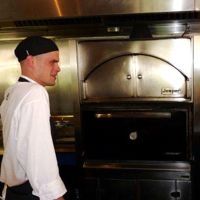
Quite how powerful these ovens are I discovered standing next to chef Mark Hansell-Dixon, pictured above with the Josper in the open kitchen of The Akeman, a bright, modern restaurant in the market town of Tring, 35 miles north west of London.
On the tray by our side were a whole sea bream and a 28-day aged British sirloin steak, which were seasoned, anointed with olive oil and, in the case of the fish, covered with lemon juice. Opening the Josper's door released the first blast of heat, a sensation that was to be repeated frequently as each item was turned promptly as the crisp grill marks appeared but before any part of the flesh could dry out. The fish was then taken to be finished off in a conventional oven for five minutes while the steak was put on the top rack of the Josper, where the temperature hovers between 60 to 80 °C, and where it will rest until ready to be served.
Hansell-Dixon explained that it had taken him, an experienced chef, about a week to adapt to the Josper's fierce heat and he showed me the burn marks on his arms to prove that accidents can still happen. He also used the phrase 'cremated' to describe what the Josper can do if the chef is not paying attention.
But he was wildly enthusiastic about the Josper's advantages and not just for the most obvious items. Grilling fresh sardines was a particular favourite and two items, slow cooked pork belly and oven roasted tomatoes, had found their way on to his menu simply from experimenting with leaving both on the top rack of the Josper for up to twelve hours.
Opening the lower door, Hansell-Dixon showed me the V-shaped tray that holds the charcoal that is cleaned out every morning by a junior member of his team. 'This one', he added, tapping it with a pair of tongs, 'burns about 10 kg of charcoal a day. Over a year this comes to about £5,000.'
Peter Borg-Neal, the Akeman's owner, believes the Josper is such an essential ingredient in his business of smart/casual restaurants outside London that he has installed a further two at The Old Post Office in Wallingford, Oxfordshire, and The Red Lion in Hemel Hempstead, Hertfordshire.
'It allows me to achieve two very different goals. Firstly, to use a cooking technique normally associated with the more expensive West End restaurants and secondly to use it to cook such a wide range of food. We even cook the chicken breasts on it for the chicken Caesar salad and they're the best I've ever tasted', he explained.
The Akeman, www.oakmaninns.co.uk
Josper, www.josper.es
The thrill of the grill
• 4 min read
This article was also published in the Financial Times.


选择方案
会员
$135
/year
适合葡萄酒爱好者
- 存取 297,198 条葡萄酒点评 & 16,153 篇文章
- 存取《牛津葡萄酒指南》及《世界葡萄酒地图集》
- Access askJancis, our AI wine assistant


核心会员
$249
/year
适合收藏家
Everything in “Member”, plus:
- Early access to the latest wine reviews, 48 hours in advance
- Early access to the latest articles, 48 hours in advance
专业版
$299
/year
供个人葡萄酒专业人士使用
- 存取 297,198 条葡萄酒点评 & 16,153 篇文章
- 存取《牛津葡萄酒指南》及《世界葡萄酒地图集》
- Access askJancis, our AI wine assistant
- 提前 48 小时获取最新葡萄酒点评与文章
- 可将最多 25 条葡萄酒点评与评分 用于市场宣传(商业用途)
商务版
$399
/year
供葡萄酒行业企业使用
Everything in “Professional”, plus:
- 可将最多 250 条葡萄酒点评与评分 用于市场宣传(商业用途)
- Access to submit wines for review
- Offer memberships to your employees and manage them from a single place
- API access available for an additional fee
More Nick on restaurants

Nick on restaurants
An international institution in the southern Irish countryside. In 2011 I travelled to Ballymaloe House, a 40-minute drive from Cork...

Nick on restaurants
伦敦东区餐厅界令人兴奋的新成员。上图,萨莉·阿贝 (Sally Abé)。 萨莉·阿贝 (Sally Abé) 的新餐厅蒂尔 (Teal)...

Nick on restaurants
丹吉尔的鱼之味餐厅 (Le Saveur de Poisson) 绝对值得(稍有挑战性的)一游。 在当今世界的各种餐厅中...

Nick on restaurants
开设第二家餐厅并不容易,无论第一家有多成功。尼克 (Nick) 从伦敦西区冒险进入伦敦码头区。上图为联合主厨杰克·克罗夫特 (Jack...
More from JancisRobinson.com

Tasting articles
沃尔特 (Walter) 关于这个显著易饮年份报告的总结部分。今天,评论来自南部和东部村庄卡斯蒂廖内法莱托 (Castiglione...

Tasting articles
关于这个棘手年份的最终报告,如今展现出非凡的清新和易饮性。今天,我们将评鉴来自多个村庄以及北部和西部村庄凯拉斯科 (Cherasco)、罗迪...

Inside information
墨西哥的葡萄酒产业为应对气候挑战提供了经验教训,常驻墨西哥的记者兼侍酒师卡洛斯·博尔博亚 (Carlos Borboa) 如是说...

Vinomakase
理查德 (Richard) 的新专栏 Vinomakase 探讨专家如何将葡萄酒与日本料理搭配...

Free for all
这家领先的新浪潮南非葡萄酒生产商正在展望未来。本文的一个版本由金融时报 发表。另请参阅这篇 帕拉迪乌斯垂直品鉴,他杰出的白葡萄酒混酿。...

Bite-sized
位于圣奥尔本斯 (St Albans) 大教堂区的一家 15 世纪酒吧,提供最新潮的美食盛宴。 前厅酒吧仍然令人安心地保持着酒吧风格...

Wines of the week
来自法国中部的一款红葡萄酒,带来解渴的清新感。售价 £15.50, $26.95 起。 对于一个在过去七百年中饱受诟病的品种来说,佳美...

Book reviews
经典葡萄酒图书馆系列的三本新书,以及一本自行出版的葡萄牙葡萄酒指南。 以下四篇评论中,有三篇是关于葡萄酒学院 (Académie du...