
Last summer was so kind to the English wine business, producing record amounts of grapes that were riper than ever, that it has changed the minds of some high-profile producers of sparkling wine who never before considered still wine a viable proposition in England and Wales.
Thanks to our chilly-to-temperate climate, there is never any shortage of acidity in grapes grown in the British Isles. High acidity is an attribute in grapes destined for sparkling wines; it keeps them refreshingly zesty and the bubbles distract from any tartness. But too often the acid in English still wines has been so high that the wines have been unacceptably sour. Winemaking regulations acknowledge the vagaries of the climate by allowing English wine to be made from grapes capable of producing wines with only 6% alcohol naturally (the rest being made up of sugar added before fermentation – so-called chaptalisation).
The summer of 2018, however, was so warm and benign that English grapes had no trouble reaching potential alcohol levels of 10 or even 12% naturally. Nights much warmer than usual prolonged the all-important photosynthesis. And the luminaries of English wine have been taking notice.
Winemaker Emma Rice, for example, at Hattingley Valley in Hampshire, an extensive wine property owned by the chair of the generic organisation WineGB Simon Robinson, confesses to having bought 30 used barrels from Burgundy, and having thinned the crop of some 2019 Chardonnay, with a view to producing Hattingley’s first still wine – if this year turns out to be suitably propitious. (The harvest is not expected until next month.)
At neighbouring Hambledon, the oldest vineyard of the modern era, ambitious owner Ian Kellett admits, ‘I may be in the process of being compelled to change my view of English still wine.’ Although he is adamant that if, as he is considering, he experiments with some oaked Chardonnay, it will be under a name other than Hambledon, which is to be reserved for the sparkling wine for which he has designed the estate so expressly.
These are both particularly well-funded enterprises. For some English wine producers, still wine has been a financial necessity while they wait to launch their sparkling wine. As the leading English viticultural consultant Stephen Skelton points out, it takes a good five or six years before sparkling wine yields any revenue at all, so long does the wine have to be aged, whereas a still wine can be produced three or sometimes even two years after the first vines go into the ground. He reckons you need a good £100,000 an acre to go into the sparkling wine business, which, as he puts it rather brutally, ‘keeps the under-capitalised riff raff out’.
Mind you, he pointed out to me as we surveyed this year’s generic WineGB tasting in one of London’s agricultural halls, the bountiful 2018 harvest has put financial pressure on just about all English wine producers in that they have had to finance far more cellar capacity, bottles and so on than ever before.
It may be the sparkling wines that have put English wine on the international map, with Pinot- and Chardonnay-based answers to champagne by far the most important representatives of this burgeoning phenomenon. (Eight per cent of total production was exported last year, with US and Norway the keenest importers of it.) But 31% of all English wine produced last year was still. On the generic tables at the WineGB event producers chose to showcase 74 sparkling wines, but 55 still wines too. At the tasting I decided to concentrate on these, mindful that many were from the favourable 2018 vintage.
It had been many years since I had tasted English still wines en masse. My memories were of painfully obviously sweetened, often sulphurous, versions of grapes bred in Germany to ripen at all costs – even in the coolest of climates. But if I was left with an overriding impression of the English still wines I tasted earlier this month it was of perfectly creditable wines, with the best of them not unlike a particularly youthful Chablis.
Perhaps not surprisingly, Pinot Noir and Chardonnay featured strongly in this collection of wines since each is planted on more than 1,000 of the 3,500 ha (1,415 ha) of the British Isles currently under vine. (The vine is moving north; Skelton told me that one of his clients is planting a vineyard outside Glasgow.)
The most popular variety for still white wine, however, is Bacchus, a German crossing rich in Riesling genes (though Riesling itself is almost impossible to ripen in the UK – so far). It’s being touted as an English answer to Sauvignon Blanc and some examples did share the pungency of a New Zealand Sauvignon while others were more reminiscent of hedgerows or elderflowers. Growers love it for its reliability in the vineyard.
Some of the rosés were attractive, generally those based on Pinot Noir, while English red wine is clearly still a work in progress. Or perhaps work while waiting for the earth to boil to a frazzle. Some growers depend on the red-fleshed Rondo for colour but it rarely has much real flavour. An avowedly light red seems the best bet. Biddenden has some fully mature Gamay vines that can yield a sort of Kentish Beaujolais, and Gusbourne has made a breakthrough red Pinot Noir, as well as very creditable Chardonnay.
Gusbourne is one of the few top-notch producers of English sparkling wine to have taken still wine seriously. Deputy chairman Mike Paul maintains, ‘We like making still wines and people seem to like drinking them and now we have a successful cellar-door operation a broader range makes more sense.’ He is the first to admit that the markets for English still and sparkling wine are quite different. Whereas the fizz could be seen as a good-value alternative to champagne, most still wines – admittedly made on a relatively small scale – look decidedly expensive when compared with imported wines.
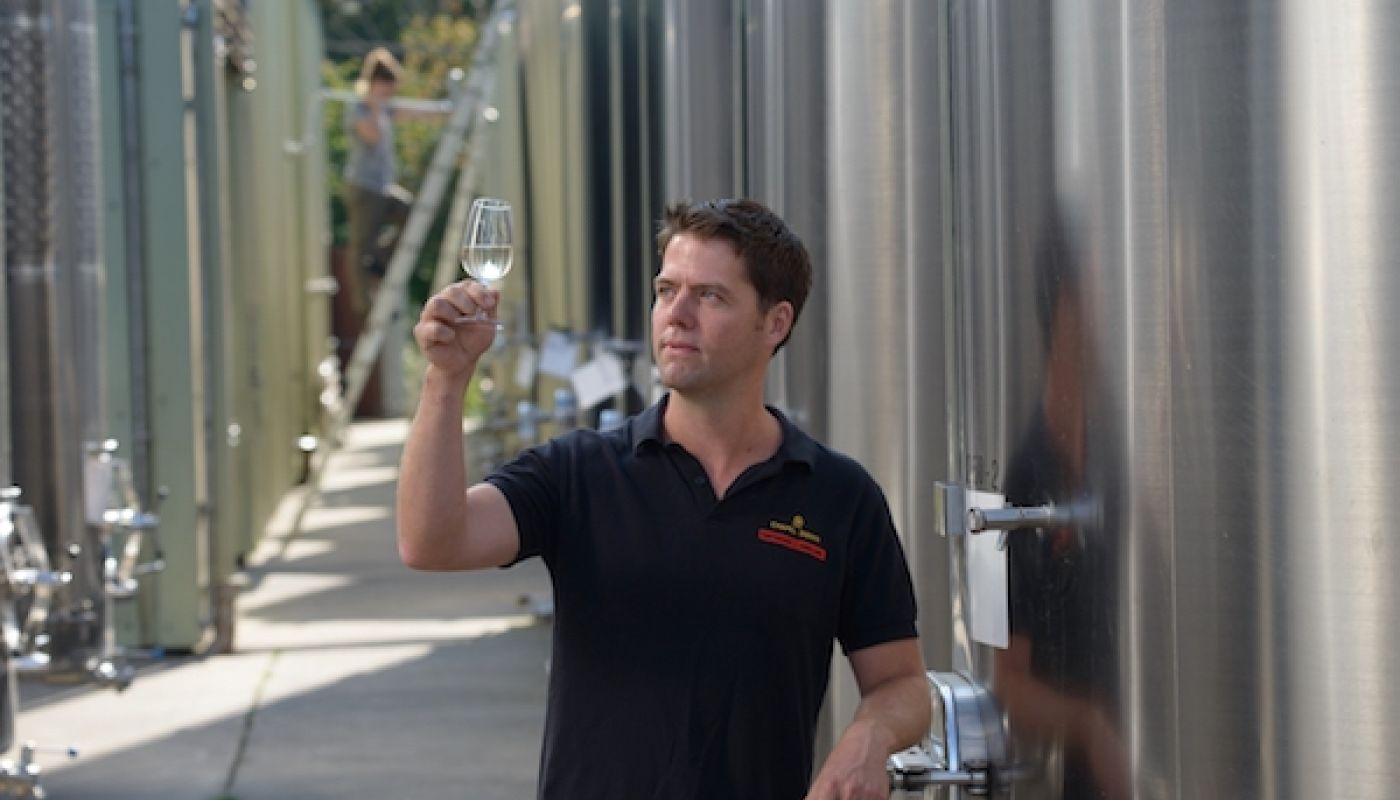
As Susie Barrie MW and Peter Richards MW pointed out in their opinion piece yesterday, the person who has probably made more English still wine than anyone is Chapel Down's Josh Donaghay-Spire, seen above right checking out the 2018 juice. See below for some relatively well-priced offerings from Chapel Down.
But the great majority of English still wine is sold as a sort of farm-gate souvenir, the way one doesn’t mind paying over the odds for, say, a lavender bag or bottle of olive oil, if it was produced in situ. As English wine tourism develops, as Wine GB sincerely hopes it will, the hope is that this will sustain sales of English still wine, whatever the price (all of which, at the cellar door, goes to the producer of course).
The quality is certainly vastly improved. There were a couple of still wines on the WineGB table that reminded me, not pleasantly, of the faulty wines that were common in the 1970s and are hardly seen today. But overall, the wines were very competently made, albeit characterised by relatively high acidity – a fashionable attribute nowadays admittedly, and one that makes English wines slower to age than most.
Favourite English still wines
With the county they are based in and recommended retail prices.
White
Hush Heath, Balfour, Liberty’s Bacchus 2018 Kent £20
Hush Heath, Balfour, Springfield Chardonnay 2018 Kent £25
Bolney, Lychgate Bacchus 2018 Sussex £15
Chapel Down, Flint Dry 2018 Kent £13
Chapel Down Chardonnay 2015 Kent £15
Gusbourne, Guinevere Chardonnay 2016 Kent £20
Lime Bay, Shoreline 2017 Devon £15
Simpson’s, Derringstone Pinot Meunier 2018 Kent £19.50
Woodchester Valley, Orpheus Bacchus 2018 Gloucestershire £15
Rosé
Camel Valley Pinot Noir 2018 Cornwall £15
Oxney, Organic Pinot Noir 2018 Sussex £16.50
Red
Gusbourne Pinot Noir 2016 Kent £24
Most of these wines are easiest to find at the wineries. See my tasting notes.













