
Will 2019 be the breakthrough vintage for German wine? Could it persuade Riesling-phobes to abandon their prejudices?
Kindly indulge me while I remind you why Germany’s signature grape Riesling (pronounced Reece-ling) is the greatest white-wine grape in the world. And is so twenty-first century in so many respects. The wines it produces particularly precisely express where they were grown (like Pinot Noir). They last and continue to evolve interestingly forever (at least as long as Cabernet Sauvignon). They are generally particularly refreshing and relatively low in alcohol. And they go superbly – generally better than white burgundy and other Chardonnays – with food. Nowadays most Riesling is dry, not sweet. And German dry Riesling is one of the wine world’s undervalued treasures.
Still not convinced? Do give the 2019s a whirl. They are exceptionally good – especially but not only in the Mosel and Nahe. Major beneficiaries of climate change, German vintners no longer have to disguise underripe grapes with added sugar. Vines that used to struggle to ripen their grapes now bask in sunshine so unremitting that sunburnt grapes have even become a serious problem in some German vineyards. As Oliver Haag who makes Fritz Haag wines says about global warming, ‘I would be happier if we could push the Stop button [re climate change]’.
During the same online presentation of the 2019 vintage organised by Justerini & Brooks, along with Howard Ripley and The Wine Barn, one of the UK importers keenest on German wine, his brother Thomas Haag, who owns and runs Schloss Lieser, admitted that sunburnt grapes are now routine. And no wonder. Temperatures of 40 °C were recorded on two or three days in July 2019. In the old days, Mosel wine producers used to boast of their slate soils and the fact that they stored daytime heat and re-radiated it at night, hastening grape ripening. In typical twenty-first-century summers that is no longer an advantage. But, magically, the best 2019s do not taste heat-affected.
Maximin von Schubert, who is in the process of taking over the Maximin Grünhaus estate on the Mosel tributary the Ruwer from his father Carl, was asked how 2019 compared with 2018, whose opulent wines, some slightly low in refreshing acidity, clearly signal that they are the product of a hot summer. According to von Schubert, in 2019 there were only 50 summer days that would qualify as warm, whereas there were 90 in 2018.
He lost up to half his potential crop to a late spring frost on 5 May, so 2019 is a particularly small vintage for him – although he still made at least 11 different 2019 Rieslings from his family’s 34 ha (84 acres) of vineyards, some of which have now been planted with fashionable Pinot Noir. I recently tasted his Pinot Noir from the quantitatively generous 2018 vintage and it had a positively Napa-esque alcohol level of 15.5%. If you’d told a twentieth-century German-wine fan that the Ruwer would be producing a red wine this potent, they would not have believed you. ‘You feel the warmth in the 2018s’, he admits, ‘but the 2019s are lighter and classier’.
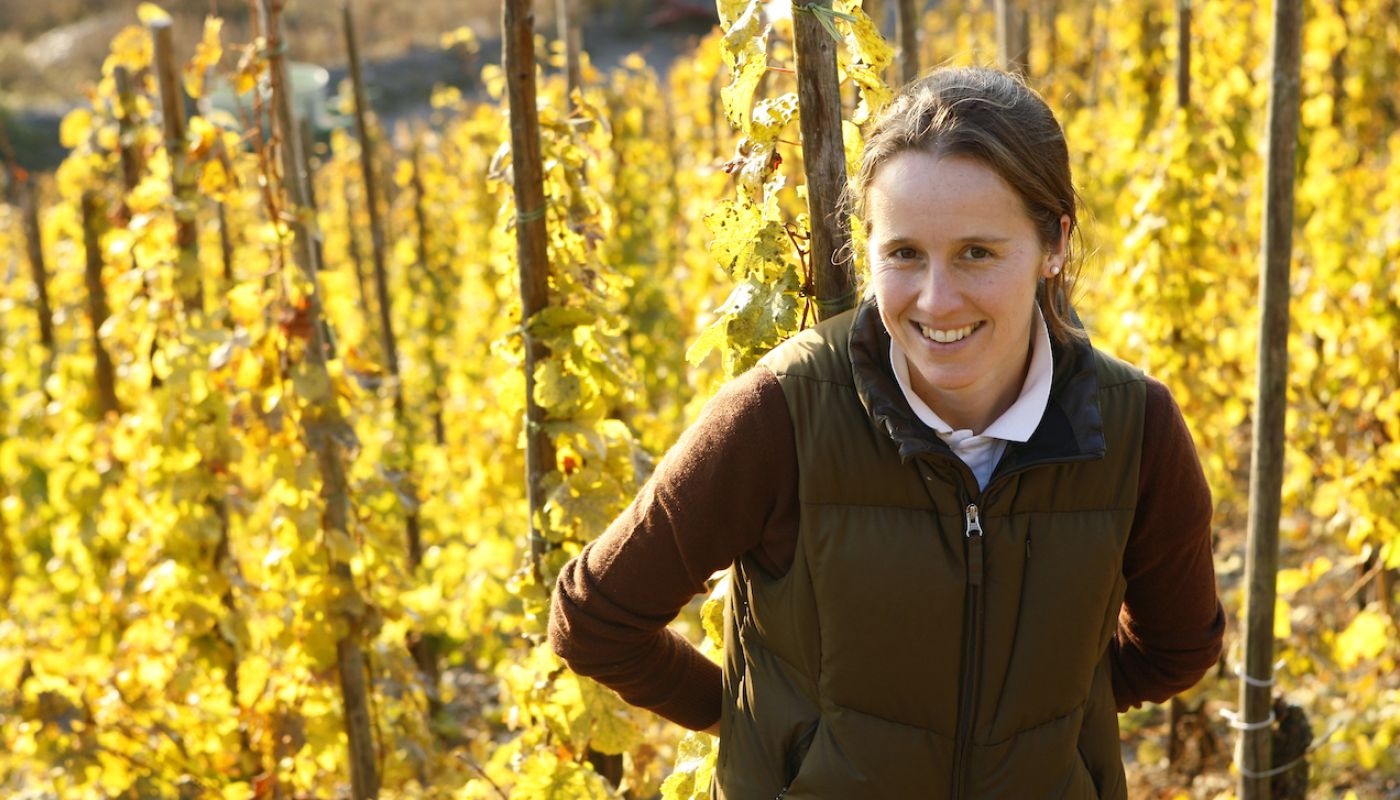
While trying hard not to criticise their 2018s, most German vintners are clearly thrilled with their 2019s, which have higher acidity and are distinctly more refreshing. According to Dr Katharina Prüm (pictured above in the vines by Andreas Durst), who has been taking over the famous family J J Prüm estate in Wehlen from her father Manfred, ‘2019 is really a great vintage. We have no complaints in any respect.’ (It is worth noting that this is an estate that does not seek to make dry wines, which is why they do not feature in my list below.)
She might not have said exactly the same in the middle of harvest. Oliver Haag outlined why the 2019 harvest was so much more stressful than in 2018 when dry autumn weather meant a particularly relaxed harvest. ‘The September rain in 2019 may have added depth and minerality to the wines and the cool nights helped to retain acidity but it was tricky to manage.’
His brother Thomas agreed that picking dates had to be chosen very carefully, dodging the rain, but for him too 2019 is a great vintage, helped by the refreshing September rain, but he reckons the lower yields, thicker skins and resulting extra concentration are also factors that elevate it above 2018.
High acidity is a quality much-treasured by German-wine purists, and some vintages have been so tart when young as to be almost undrinkable (2010 comes to mind) but then they tend to bloom eventually and last for decades. The characteristic of the 2019s is that, despite their appetising acid levels, so many of them are already a delight to drink. The wines of J J Prüm were traditionally released late and connoisseurs knew to give them years in bottle before broaching them, but the 2019s are already gorgeous. It’s no surprise then that the first thing [Katharina] Prüm said about the vintage was that it was one ‘to be enjoyed at many stages – even from us’.
For Dorothee Zilliken, also taking over from her father, in the Saar tributary in this case, ‘the 2019s are filigree and elegant but still intense. Open and accessible now, they will last up to 40 years, especially for the Auslesen and Spätlesen.’ There was a time – pre climate change – when the most revered German wines were these fruity styles that owed their sweetness to natural ripening and/or the famous concentrating fungus known as noble rot, rather than to being sweetened up with grape juice as cheaper wines used to be in the old days.
But today many of the country’s finest Rieslings are bone dry (labelled trocken) or are the medium-dry, featherlight style known as Kabinett. And anyway, noble rot was not particularly prevalent in 2019, although Christoph Schaefer of Willi Schaefer, across the river from J J Prüm in Graach, took the risk of leaving some of his grapes on the vine until the sunny weather of mid October and was rewarded with an array of Auslesen, some from raisined rather than nobly rotten grapes, and an even riper, sweeter Beerenauslese. Schaefer, J J Prüm and Schloss Lieser all have holdings in the famous Wehlener Sonnenuhr vineyard whose eponymous sundial is pictured below.

But he reported that in these warmer, drier growing seasons noble rot, which needs moisture to develop, is becoming rarer. It could even be that German wine has reached its apogee with the 2019 vintage and that future growing seasons may simply be too hot and dry.
Features of the 2020 vintage, currently underway, were of course logistical difficulties thanks to the pandemic – and sunburn.
Some beautiful dry German 2019 Rieslings
Most of these wines are available in Germany and some in other countries already. In the UK the 2019s are being offered en primeur by specialists Howard Ripley and Justerini & Brooks.
GG stands for Grosses Gewächs, a dry wine from a single, superior vineyard.
Battenfeld-Spanier, Mölsheimer trocken
Dönnhoff, Oberhäuser Leistenberg Kabinett
$24–$36 various US retailers
Dönnhoff, Niederhäuser Klamm Kabinett
$28 K&L, CA
Emrich-Schönleber, Monzinger Frühlingsplätzchen GG
Emrich-Schönleber, Monzinger Halenberg GG
£305 per case of 6 ib Justerini & Brooks
Falkenstein, Krettnacher Euchariusberg Alte Reben Kabinett
$29.99 Binny’s Beverage Depot, IL
Falkenstein, Krettnacher Euchariusberg Kabinett
$27–$29 various US retailers
Fritz Haag, Brauneberger Juffer Sonnenuhr im Falkenberg GG
Julian Haart, Piesporter Goldtröpfchen Kabinett
Peter Lauer, Lambertskirch Fass 14 Kabinett
Peter Lauer, Ayler Fass 4 feinherb
Peter Lauer, Ayler Kupp Stirn Fass 15 feinherb
Peter Lauer, Ayler Kupp Fass 8
Georg Mosbacher, Wachenheimer Gerümpel trocken
Rebholz, Birkweiler Kastanienbusch GG
£310 per case of 6 ib Justerini & Brooks
Rebholz, Siebeldinger Ganz Horn im Sonnenschein GG
£275 per case of 6 ib Justerini & Brooks
Schäfer-Frölich, Monzinger Frülingsplätzchen GG
Schloss Lieser, Brauneberger Juffer Sonnenuhr GG
£140 per case of 6 ib Justerini & Brooks
Schloss Lieser, Wehlener Sonnenuhr GG
£140 per case of 6 ib Justerini & Brooks
Willi Schaefer, Graacher Domprobst Kabinett
$38–$42 in the US
von Schubert, Maximin Grünhäuser, Herrenberg Kabinett
HK$220 The Fine Wine Experience, Hong Kong
von Schubert, Maximin Grünhäuser, Abtsberg Nr 33 Kabinett
Wittmann, Westhofener Aulerde GG
Zilliken, Saarburger Rausch Kabinett
£90 per case of 6 ib Justerini & Brooks
International stockists via Wine-Searcher.com.













