One minute we had been standing together looking over a stone wall at a flock of Ryeland sheep (who had sensibly taken refuge under some trees probably only too aware of what the chefs had in mind for them) and the next minute the chefs were not there. Whilst I had stopped to take a call from a photographer lost on the borders of England and Wales they had moved swiftly on and I was alone. But the birdsong, the sunshine and the beauty of the Herefordshire countryside on the banks of the River Wye were temporarily more than adequate replacements.
I caught up with the chefs and Richard Vaughan, whose family has farmed this land for five centuries, a few minutes later with the chefs uncharacteristically quiet as they listened to Vaughan explain the breeding, rearing and feeding of the Middle White pig. The rich flavour of this meat excites chefs, customers and Vaughan alike but the account of how, after 30 years of meeting supermarkets' price points for beef, Vaughan found this particular niche has much more profound repercussions for high-cost British farming.
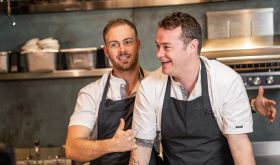
Rowley Leigh, executive chef for Image restaurants including Kensington Place and Avenue, explained his passion for Middle White as we left Paddington. 'It's the best-ever pork and it is principally because of its fat to meat ratio. As a result, every part of it tastes good however you cook it and the fat from what's left over produces marvellous roast potatoes.' His enthusiasm for Middle White is shared by inter alia Henry Harris of Racine, Bruce Poole of Chez Bruce, Fergus Henderson of St John, Sam Clark of Moro, Stephen Bull of the Lough Pool Inn and Padrig Jones of Cardiff's Le Gallois, all of whom were on this 'pig open day'.
And yet Vaughan, Britain's biggest breeder of Middle Whites, only came upon them by accident. He took over the family farm as the younger brother (two older brothers made their money somewhat incongruously in much noisier London discotheques) and ran it as a marginally profitable mixed farm before a Damascene conversion. 'We ran a model farm, all the supermarket buyers were extremely happy and for years we never questioned how we farmed. Then one day I phoned up the abattoir because I really wanted to taste some of the beef I was rearing but when I asked them to put some on one side for me they just laughed. Everybody's beef was being mixed up together and the effort, care and attention to detail we were applying was just being lost to produce what was effectively the lowest common denominator. It was time for a change.'
Vaughan hived off the arable land to a neighbour and decided to concentrate on animals with distinctive flavour and the potential for added value, Middle Whites, Ryeland sheep and Longhorn cattle. And to say goodbye to the middleman – from 1996 onwards Vaughan has sold directly to the end user, either the professional or domestic chef, ensuring that he pockets whatever profits British farming today can generate.
In many respects it seems rather suprising that it took Vaughan, now 55, so long to reach this conclusion because striding around his pristine farm followed by 20 chefs he looks, in his open necked pink shirt, dark chinos and loafers, more the successful entrepeneur than one would imagine a farmer, more like an inspiring business school lecturer than someone preoccupied with litters, feed pellets and the inevitable mucking out. As we left one part of the farm where the pigs were in the final stage of being fattened up Vaughan did in fact turn to the chefs and, rather like a store manager, ask, 'Does anyone have any more questions about this department before we move on?'
But it is also this scientific, hard-nosed approach to the rearing of these animals which attracts the chefs – Vaughan's approach not only ensures quality but also consistency, as Sam Clark explained. 'Each delivery is as good as the last and the yield, the amount of servings we can get from what we buy, is always consistent. And that is terribly important for our margins.' Vaughan now has 800 private customers and 60/70 professional chefs on his customer database but growth is restricted by the productivity of the sows. 'When we bought in Middle White piglets from other farmers we brought in disease so that had to stop,' he added.
Vaughan's approach to rearing is highly pragmatic. A heat lamp lures the piglets away from their mother (which also stops them being rolled on and smothered!) and after 10 days they are put on an expensive mini-pellet (which cost £350 a ton he explained on several occasions) followed by unlimited feed until they reach 35 kilos. Then, crucially, the pigs are switched to a strict finishing diet which restricts their intake to two kilos a day to maintain the crucial meat/fat ratio. They are slaughtered at 55 kilos to yield a 40-kilo carcass at an abattoir eight miles away, hung for extra flavour back at the farm and then prepared to the customer's specification by a butcher in South Wales.
The proof of the pudding is, as they say, in the eating, and the quality of Vaughan's Middle Whites was initially put to the test in a wonderfully gelatinous terrine of pigs ears which had been made by Edwin Lewis, sous chef at St John in Smithfield, from a recipe picked up whilst on holiday in Portugal. Thin slices of the terrine were wrapped around cornichons and wolfed down with a glass of sparkling Cremant de Bourgogne from Irma Finagal-Rock, wine merchants in Monmouth.
As the clouds rolled in, we repaired inside to what was once a Cider Press where a sturdy table bravely supported a score of dishes prepared over two days by Stephen Terry, Francesco Mattioli and Stefano Lodi Rizzini of the nearby Walnut Tree Inn, Abergavenny. Legs and shoulders of pork had been cooked overnight; the meat from the trotters, cooked for four hours, gently formed into a warm, breadcrumbed terrine whilst a beef silverside became a stunning carpaccio, spicy Mantuan sausages and a hefty bolognese. But best of all, unanmiously, was a Middle White offal stew made from the hearts and kidneys enriched with the skirt from the beef.
Not surprisingly given an audience of his peers, Terry spoke somewhat nervously. He began by saying how, in contrast to the usual hectic restaurant timetable, it had been such a joy to prepare the food over such a long period and how in serving fellow professionals he knew that they would appreciate why he had chosen to serve the food at a cooler temperature to enhance the flavours than would be the case in a restaurant. And then turning to Vaughan he modestly added, 'But with such good meat you don't have to be a great chef to make it taste wonderful.'
Pedigree Meats
Huntsham Farm, Goodrich, Ross-on-Wye, Herefordshire HR9
tel 01600 890296, web www.huntsham.com
Restaurant of the Week
The Well House, a pub two minutes' from a long walk on Hampstead Heath and just round the corner from Gainsborough Gardens and Keats Grove, used to boast the most depressing sign any watering hole could muster. 'Hot Food Served All Day' was its motto, testimony to a battery of microwaves rather than a brigade of chefs in the kitchen.
All that has been swept away and now, chrysalis-like, The Wells (sic) has emerged as a smart, clean and most useful gastro-pub in its place.
The Wells has hit the ground running not only because of its experienced management and a talented Irish chef, Derrick Gale, but also because its owners have immediately recognised one of the inherent problems in trying to serve good food in pubs – most were built with very, very small kitchens – and designed its menus accordingly.
At lunch there are about ten dishes on the à la carte menu ranging from a particularly well made potted duck liver and foie gras parfait to more comforting Caesar salad, plates of smoked salmon and deep-fried plaice with sauce gribiche to more intricate but just as well executed cep risotto and a bowl of smoked haddock, cockles, creamed broad beans and poached egg.
At an outside table in the sunshine two of our party waxed lyrical about the two-course £12.50 lunch of grilled salmon, crushed potatoes and sauce vierge followed by a splendid lemon tart.
Dinner comprises a short à la carte menu of four starters and four main courses but with enough choice for everyone – with, as so often still today, the exception of vegetarians. The wine list is extensive and fairly priced, the service charming and professional.
More conversions like this one, please.
The Wells
30 Well Walk, London NW3 1BX (tel 0207 794 3785)
Open lunch and dinner 7 days