
Since 1975, 23 Conduit Street, an apparently unlikely address in the very heart of London’s Mayfair, has been a bastion of all things Japanese.
That was the year in which Sakura restaurant opened here. Sakura used to be a reliable place for sushi, Shabu-shabu hot pot and the sake that proved popular with the Japanese community in London and those who worked nearby.
Then after 40 years, a good run for any restaurant, Sakura closed its doors and in its place emerged the oddly named Tokimeité. This is a restaurant I have kept my eye on for quite a while, not really understanding quite how it kept going. Then we finally booked and I discovered two of the reasons for its continued existence.
The first is that the food served here is of the highest quality. It may not be perhaps quite the same as in Tokyo or Kyoto but the freshness of the fish, the clean flavours of the tempura batter and the chef’s dexterity with his knives were certainly the equivalent of anything I have ever experienced in Japan.
But then I learnt a secondary reason: that this restaurant, via its ownership, serves a much more serious and long-term purpose than merely to excite anyone who eats here. And it is its ownership which goes some way to explaining why the restaurant’s website’s home page, replete with luscious photos of the food, contains links to one item not normally associated with any restaurant website I have encountered before: its tax strategy.
This is, I learnt half way through our meal and while watching the chef hard at work behind the sushi counter, due to this restaurant’s ultimate ownership. The restaurant belongs to Zen-Noh, the National Federation of Agricultural Co-operatives, which represents 36,000 farming associations and their 10.26 million members in Japan with annual sales of over $40 billion worldwide.
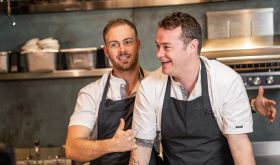
The decision to branch out into the restaurant business – they also have Shiki in Beverley Hills, a couple in Hong Kong and one in Ho Chi Minh City – is to use these restaurants as a vehicle for linking the pleasures of what their members grow, rear and fish in Japan with the appetites of current and future enthusiasts around the world. In London, executive chef Daisuke Hayashi (above right) is currently using Joshu wagyu from Gunma, peaches from Yamanashi, and sweet potatoes from Kagoshima prefecture.
Tokimeité, the Japanese word for a sensation of high anticipation, and seemingly the poshest of all their restaurants, cleverly fits this bill. While the ground floor seems reasonably busy, the upper floors house offices and, more crucially, private dining rooms, with the Japanese embassy, conveniently located nearby, as a prime customer.
The interior is dark and rather neutral, as though this has all been designed by a committee. The sushi counter with about 20 seats extends down one side with larger tables opposite. A good quantity of what must be very heavy Japanese porcelain hangs on shelves behind where Hayashi works.

In front of him, however, there could not have been a more cosmopolitan gathering. Right in front of where he was working were two Japanese businessmen who had taken off their jackets and were obviously enjoying the spectacle. Next to them sat a tall man, Danish-born, who had spent 12 years in the US before moving to live and work in Singapore, while across the counter from him sat a much younger Asian who had been educated in the UK, a man with an obviously healthy appetite. When Matthew Gough, the restaurant’s assiduous general manager, remarked how nice it was to see him back again, his response was a friendly, ‘Well it has only been a couple of days.’
While all this was going on to my right, there was plenty to watch to my left and straight ahead. Directly on our left, standing proudly under a clear glass cloche, was a large black truffle, which was soon put to good use. Ahead, stood Hayashi, together with an array of very sharp knives, chopping boards, cloths with which to wipe them down, and a printer.
The truffle was to play a significant role in our first starter, a tartare of wagyu beef, an ingredient that plays an important part in Zen-Noh’s arsenal of Japanese products. The truffle was shaved into a stainless-steel mould with the tartare before being mixed with a sauce of aubergine and ponzu, a Japanese citrus-based sauce.
There then followed two tempura dishes (a sure-fire method of testing any Japanese restaurant in my opinion): one of Scottish langoustines, the other of Japanese vegetables. Both, cooked by Hayashi’s European assistant, were golden, crisp and served with a dipping sauce so tangy and alluring that we refused to give it up.
After this came two very different courses. A plate of freshwater eel, grilled on their teriyaki grill to accentuate its innate sweetness, and two pieces each of their sashimi selection: fatty tuna belly from Spain, red prawn from Portugal and Japanese yellowtail.
My bill for this plus a glass of Trimbach’s 2008 Riesling Cuvée Frédéric Emile and a glass of Kubota Senja sake from Niigata prefecture came to £174.60.
Tokimeité’s food is excellent. But our meal here reminded me that restaurants can serve a higher purpose than merely providing food and entertainment. They can help to build bridges between continents.
Tokimeité 23 Conduit Street, London W1S 2XS; tel +44 (0)20 3826 4411