What do you think of when you come across a wine labelled Muscat, Moscato, Moscatel or Muskadeller?
Probably a sweet wine, or a sweet and fortified vin doux naturel such as Muscat de Beaumes-de-Venise from the Rhône, or Muscat of Samos, which is made in many styles but is typically sweet, perhaps a light and frothy Moscato d’Asti from north-west Italy or Clairette de Die from southern France, or simply a soft, aromatic dry wine that smells grapey and floral?
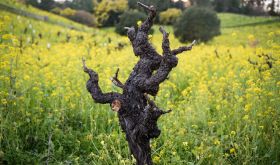
Not this one. Aôri’s Muscat of Spina is all about the mountain vineyard and the ungrafted centenarian vines. It’s bone dry, complex, slightly herbal, very fresh and persistent, with a notably salty flavour – and just a whiff of Muscat’s more typical grapey floral notes.
Muscat of Spina, also known as Moschato Spinas (Μοσχάτο Σπίνας), named after the village of Spina in Chania, north-west Crete, is a local name for the small-berried Muscat Blanc à Petits Grains, one of the oldest-known grape varieties in the world and generally thought to be the finest of the varieties with Muscat in their name. It’s widely planted around the Mediterranean but it’s not known whether its origins are in Italy or Greece though there’s greater consensus that it’s from Greece.
Former sommelier Aimilios Andrei, whom I met when visiting Crete in 2023, never intended to make a Muscat – he didn’t much like the variety – but he had always wanted to make a mountain wine: Aôri means ‘mountains’ in the local dialect around Chania, where his mother is from (his father is Romanian).
Having worked with Apostolos Thymiopoulos and Dalamara in Naoussa and with Commando G in Spain’s Gredos Mountains to get experience of vineyards at high elevations, he was looking for old, ideally north-facing (therefore cooler) Kotsifali vineyards in Chania to make a fresh red wine, one that would equally undermine the preconceptions of this local variety, which is often low in tannins and high in alcohol.
However, the Muscat of Spina vineyards he found on the coast near Termenia on the western side of the Lefka Ori mountains were so spectacular that he decided to give it a try. His friend and partner in stereotype-busting is winemaker Dimitri Skouras (son of George, founder of Domaine Skouras in Nemea). In a recent email, Andrei told me, ‘When I found the vineyards and the project was in my mind, he was the first one I called.’
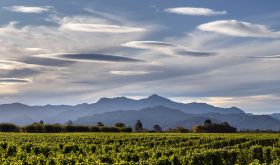
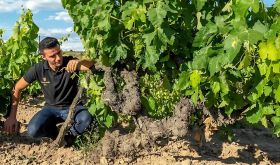
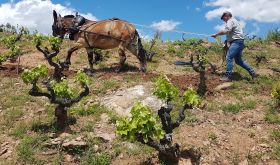
The majority of the vines, owned by local growers, are over one hundred years old though one parcel is much younger, around 15 years old. All are ungrafted bush vines on mainly schist and slate soils, with quartz and iron in the schist, at an elevation of around 800 m (2,625 ft). Andrei effectively rents the vines and farms them organically even if they are not certified. For this type of vineyard and location, they are densely planted at around 14,000 vines per hectare, which creates a lot of shade for the fruit, helping to retain acidity while the flavour accumulates in the grapes.
The wine is fermented without the addition of cultured yeasts in stainless-steel tanks after just 5–6 hours in the press to avoid any bitterness from the skins but to get as much flavour as possible from the whole berries. The wine then spends around five months on the lees, building the texture that is so important to this wine. This ageing is partly in tank and partly in Clayvers, small round ceramic vessels which allow more oxygen ingress than a steel tank but far less than a barrel. He increased the proportion of the wine aged in Clayver to 40% in 2024 and you can really taste the difference, although the vintage conditions (see below) also play a part. Andrei explained that this type of vessel ‘adds a texture that we really like, plus we see that it really boosts the salinity of the wine’.
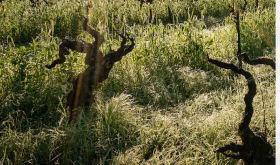
The alcohol is not particularly low (13% in the cooler 2023 vintage and 14% in 2024) but it is perfectly balanced by the freshness, which is unusual for this grape variety, highlighting the cooling elevation of the vineyards. Even in this location, the variety leaves behind a light aromatic, almost floral, signature yet the impression you get when tasting the wine is the wild landscape and vegetation not garden flowers.
I recently tasted the 2024 and the 2023; the former has already been released in Greece, the US and the UK but there may well be a few bottles of the latter still out and about.
As Andrei told me when I asked him about the difference between the two wines – the slightly lighter-bodied, tighter and stony/mineral 2023 compared with the more herbal and firmly textured 2024 – ‘The two vintages are quite different: 2023 was cool and rainy during the growing season whereas 2024 was warm and dry.’ The 2023 has also benefited from an extra year in bottle, adding further layers of flavour. This is not a DYA (drink youngest available) wine even if the 2024 is already irresistible.
Despite these vintage differences, both wines are a wonderful expression of these extraordinary and labour-intensive vineyards, from which they produce c 10,000 bottles a year.
Aôri’s long-imagined Kotsifali is now also available in two versions: Aôri Ungrafted Mountain Vine Kotsifali, a blend of more than one vineyard, and the single-vineyard Sandalos, which is more expensive but worth the premium. These wines, too, are highly distinctive for Cretan Kotsifali, with finely structured tannins, alcohol of 12.5–13.5% and delicious freshness – you could perhaps describe them as the Aôri equivalent of Gredos Mountains Garnacha, even if the landscape is completely different.
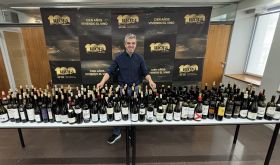
Aôri wines are imported into the UK by Indigo Wines and available from The Sourcing Table (their retail arm), as well as from Highbury Vintners and Iron and Rose. The US Importer is Diamond Wine Importers, whose Johnny Livanos tells me, ‘We just launched this wine last year, and it’s been off to a solid start. We have distribution available in the entire country’. For details of stockists near you, email Info@diamondwineimporters.com. The Muscat is also available in Greece and Australia.