The Australian wine industry is in recriminatory mood. After years of double-digit growth, exports, along with Australian wine’s reputation, have been plummeting. Some professional observers such as Professor Larry Lockshin of South Australia University say that the solution is to rip out 25 to 30% of all grapevines currently planted. Others such as grand oldish man of Oz wine Brian Croser (ex Petaluma) say that the problem is that Australia’s 2,000 small-scale winemakers (many of them every bit as artisanal as Europe’s best, incidentally) have been ignored while the handful of large companies that dominate Australian wine production have been allowed to tarnish its reputation with cheap blends that are now mere cannon fodder for supermarket discounters (see Croser's answer to Oz travails).
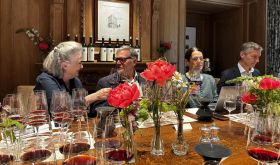
In general I agree with Croser’s view, but two big tastings recently have left me with newfound admiration for one of Australia’s biggest brands, the one that hovered so effectively in the background to the recent Australian Open tennis tournament in Melbourne, Jacob’s Creek. The first of these epiphanies took place in a private room at the new Hix restaurant in Soho, where I had been invited to lunch by Phil Laffer (pictured), veteran chief winemaker at Pernod Ricard’s Australian subsidiary and therefore responsible for what goes into Jacob’s Creek. ‘Lunch’ turned out to be an array of 20 bottles, flights of various vintages of Jacob’s Creek regular Chardonnay, Chardonnay Reserve, Riesling, Reserve Riesling, Riesling from their famous Steingarten vineyard and their regular Shiraz/Cabernet blend.
The fine quality of the Steingarten was no revelation, but what most impressed me was how well the older vintages of the most basic bottlings, currently retailing at £5.99 in the UK, had lasted. The regular Chardonnay 2007 blend, made from grapes harvested almost exactly three years ago, was, unlike most 2007s at similar price points, in fine fettle, and the current, 2009, bottling tasted as though it had not yet hit its stride. Usually, mass-market brands are made to be drunk the minute they reach retail shelves. And as for the Shiraz/Cabernets, the 1994 was still a delightful drink, all of the relics from the 1990s having an unusually thick deposit lining the bottle, showing that these wines had not been filtered or chilled to stabilise them but had been left to evolve naturally.
Just one day later, at the annual UK generic tasting of Australian wines held this year in the new Saatchi Gallery in London, I had a chance to put Jacob’s Creek Chardonnays in context. The organisers, those at the helm of the good ship Australian wine as it navigates the choppy export waters, decided to lay on a blind tasting of 50 Chardonnays, mostly but not all from Australia. This brave exercise was absolutely fascinating, not least because they had mixed up wines at all sorts of different prices, from some of Australia’s most basic brands to fine white burgundy via some of the most reputable Chardonnays from California, New Zealand and South Africa. The only clues we had to these Chardonnays was that they were ordered by weight from ‘Crisp & Refreshing’ to ‘Rich & Rewarding’.
As detailed in Chardonnays – Oz v the rest, I ended up giving the same relatively enthusiastic score, 16.5 out of 20, to Jacob’s Creek regular Chardonnay 2008 as to Bruno Colin’s Premier Cru Morgeot 2006 Chassagne-Montrachet, and gave an even higher score to the Jacob’s Creek Reserve Chardonnay 2008. (A number is admittedly a wholly inadequate way of expressing wine quality but it is at least usefully brief and quantifiable.) Although the latest Wolf Blass Yellow Label charmed me, some of the other big Australian branded Chardonnays did not acquit themselves so well. Lindemans Bin 65 was once the poster child for Australia’s export effort. Then the brand was taken over by Foster’s and has been thoroughly trounced on the US market by the cunningly marketed Yellow Tail (which was not in our Saatchi Gallery tasting). Tasted blind, the flabby Bin 65 2009 seemed to have copied Yellow Tail’s relatively high sweetness level, as did the oddly aromatic Oxford Landing Chardonnay 2009.
The distinguishing mark of the Jacob’s Creek Chardonnays is that Phil Laffer has steered their stylistic evolution in parallel with the dramatic change in the style of the average Australian Chardonnay much higher up the ranks, towards something much leaner and more refreshing. More Chablis than the old heavily oaked monsters.
‘If anyone talks about Jacob’s Creek being fruit-driven, I shudder', Laffer told me. ‘We’ve moved to more varietal and less constructed wine.’ They don’t use oak chips for white wines (‘the fruit won’t stand it’) but still insert wooden staves into some of the tanks that supply their million cases of Jacob’s Creek Chardonnay made each year, and put 60 to 70% of the blend through malolactic fermentation, ‘just enough to make sure that the oak can’t be tasted’.
The main changes Laffer has made in recent years have been to treat the Chardonnay grapes as though they were fragile Riesling, picking them at night, protecting them assiduously from oxygen, minimising the time between vineyard and winery. Laffer reckons even his regular Chardonnay should last five to six years ‘which certainly wasn’t the case five years ago’.
Now that there is such a surplus of Australian grapes in even the cooler regions, Laffer has been able to cut the proportion of fruit from the hot, irrigated inland regions to 60% and pointed out with some frustration, ‘the disappointing thing [in view of plummeting exports] is that traditional Australian brands are the best quality they’ve ever been – partly because of this cascading quality. In fact we’ve been very close to changing the style altogether because better wine is now available, but we’re worried that consumers would be too jolted by the lack of consistency.’ When he told me later that even the fashionable Adelaide Hills region now has a surplus of Chardonnay, I got the impression that he would really like to see every grape in Jacob’s Creek grown somewhere as cool as this, and it’s only the need to produce something not totally unrecognisable from the sort of Oz Chardonnay swilled by Bridget Jones that stops him.
That and financial considerations. Laffer clearly has the seniority and determination to fight any accountant’s suggestion that corners should be cut and costs reduced. Let us hope that his successor Bernard Hickin will continue this noble tradition. But what makes Laffer particularly concerned is the volume of substandard bulk wine that is currently being exported from Australia, thanks to a loophole in the ‘wet tax’ legislation imposed on the wine industry. As he told me gloomily, of the last 70 export licence applications for Australian wine, not one was from a winemaker. They were all from bulk wine traders, sopping up the cheapest ingredients in the Australian wine lake and shipping them out in bulk to continue the process of devaluing the reputation of Australian wine.
Favourite Chardonnays
The following were my favourite wines from a recent blind tasting of 40 Australian with 10 non-Australian Chardonnays.
Penfolds, Yattarna Chardonnay 2006 South Australia
Cullen, Kevin John Chardonnay 2007 Margaret River
Stonier Reserve Chardonnay 2008 Mornington Peninsula
Jacob’s Creek Reserve Chardonnay 2008 South Eastern Australia
Full tasting notes and scores can be found at Chardonnays – Oz v the rest.