
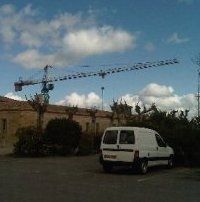
See our guide to coverage of Bordeaux 2009, including reviews of about 450 wines. The picture shows just one of the many cranes currently hovering over major renovations at top Bordeaux properties, Ch Montrose in this case. Haut-Brion has one; Cheval Blanc has two.
In all my years of immersion in tasting bordeaux en primeur, I have never written the word 'Napa' so often in my tasting notes. Come to think of it, I had never written the word Napa at all before when trying to describe the latest vintage shown off to wine media and trade in Bordeaux every spring. Nor have I ever had so much fun tasting young bordeaux as I did the week before last. Perhaps these two phenomena are related.
Every year bordeaux pundits, who in the age of Twitter now include increasing numbers of merchants and bloggers, try to find the shorthand to describe the latest vintage. 'Is it a left bank or right bank vintage?' I was asked by three complete strangers as I boarded the flight home from Merignac on Good Friday. But honestly, there are even fewer rules or generalities than usual with the 2009s. Patrick Maroteaux of Château Branaire Ducru, the immediate past president of the Union des Grands Crus, voiced the appealing theory that there were so few external pressures on the 2009 harvest – no pressing threat of rain, no plummeting acid levels – that proprietors and winemakers were unusually free to express themselves with this vintage, to produce the sort of wine they wanted to make rather than the one Nature forced them to.
Some other owners reported that this was, like 2005, a 'deckchair vintage', meaning that, unlike in 2007 and 2008, they could take it easy during the summer, but Frédéric Engerer of Château Latour, never short of a view, maintains that there were some difficult decisions to be taken as harvest approached. 'It was a pretty stressful year because of the lack of rain', he pointed out. 'The summer was hotter in 2003 but the heat lasted longer in '09. Although there was rain in June and July, the showers then were followed by wind and heat so the grapes and soil didn't stay damp. The berries were small throughout the season so we ended up with really thick skins and then we wondered how long we should wait before picking. There were many routes you could take around 25 September.'
The problem was that in the drier, more exposed sites, the vines had shut down the ripening process completely before the rains so that the phenolics, the tannins and all-important flavour precursors, were not ripening at all, even though sugar levels were rising – a familiar problem in Napa Valley. It was clear that the much more fragile Merlots needed picking in early September – but it was far from obvious when to pick the Cabernets, and how to play off less than fully ripe phenolics against the threat of raisining and overripe flavours – particularly since the acidity levels remained reassuringly refreshing.
It was inevitable that the 2009 vintage would be compared with 2005, the last 'great' vintage, but although a few of the 2009s notched up exceptionally high tannin readings, they don't seem to have quite the sheer mass and tannic denseness of the 2005s, partly because so many of them have so much luscious flesh that is capable of covering up the exceptionally concentrated tannins. They reminded me more of the lush hedonism offered by the 1990s, even though of course the 2009s were made in a quite different era, with much stricter selections and attention to detail, and the heat was more excessive in 1990.
In fact, so ambitious are the top producers of Bordeaux now, fired by the prestige in this very publicly competitive market and the sheer amount of money to be made by selling one of the most admired wines at the very top level, that the first growths are even more concerned with quality than ever – not just of their second wines but increasingly of a third wine.
Latour has offered a third wine, a simple 'Pauillac de Château Latour', for many years now and its quality is better than ever. The team at Château Margaux have made a third wine in 2009 one step below their Pavillon Rouge de Château Margaux. They were coyly equivocal about whether it will actually be commercialised but since it constitutes 23% of the total crop, I think we can assume that they too will be going into this particular diffusion line. Carruades de Lafite used to be a sort of also-ran, but this year it was clear that an enormous amount of effort had gone into maximising the quality of this second wine, to which 55% of the total crop had been relegated – remarkable considering that every bottle with the word Lafite on the label can be sold several times over in China nowadays.
The Bordelais, incidentally, are relying on Asian demand to justify the prices they are expected to announce next month.
There were some truly great 2009s at the very top of the tree in the Médoc and, certainly not to be forgotten, Graves. There were odd wines much lower down the ranks that are delicious and likely to be real bargains, for the magic inflationary dust of a famous vintage tends to be sprinkled exclusively on prices at the very top level. There are a few wines that seemed disastrously overripe and, as usual, many that were uncomfortably over-extracted. But these are small gripes. Overall this vintage can offer more sheer pleasure than any I can remember and may well provide delicious drinking throughout its life while we wait for the 2005s to emerge from their tannic corsets.
LEFT BANK 2009
Top scorers
These are presented in alphabetical order, and are those I, most unusually, scored 19 points out of 20.
Haut-Brion
Lafite
Latour
Margaux
In likely descending price order.
Tour Carnet
Chasse-Spleen
Desmirail
Pibran
Tronquoy Lalande
Tour de By
Capbern Gasqueton
Coufran
Potensac
Charmail
Fourcas Hosten
de Carignan, Cuvée Prima
Haut-Vigneau
Clément Pichon
Fonréaud
Greysac













