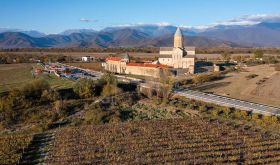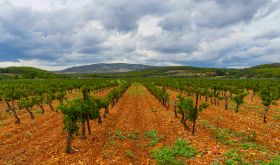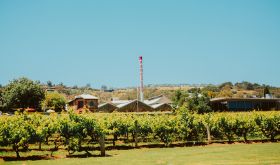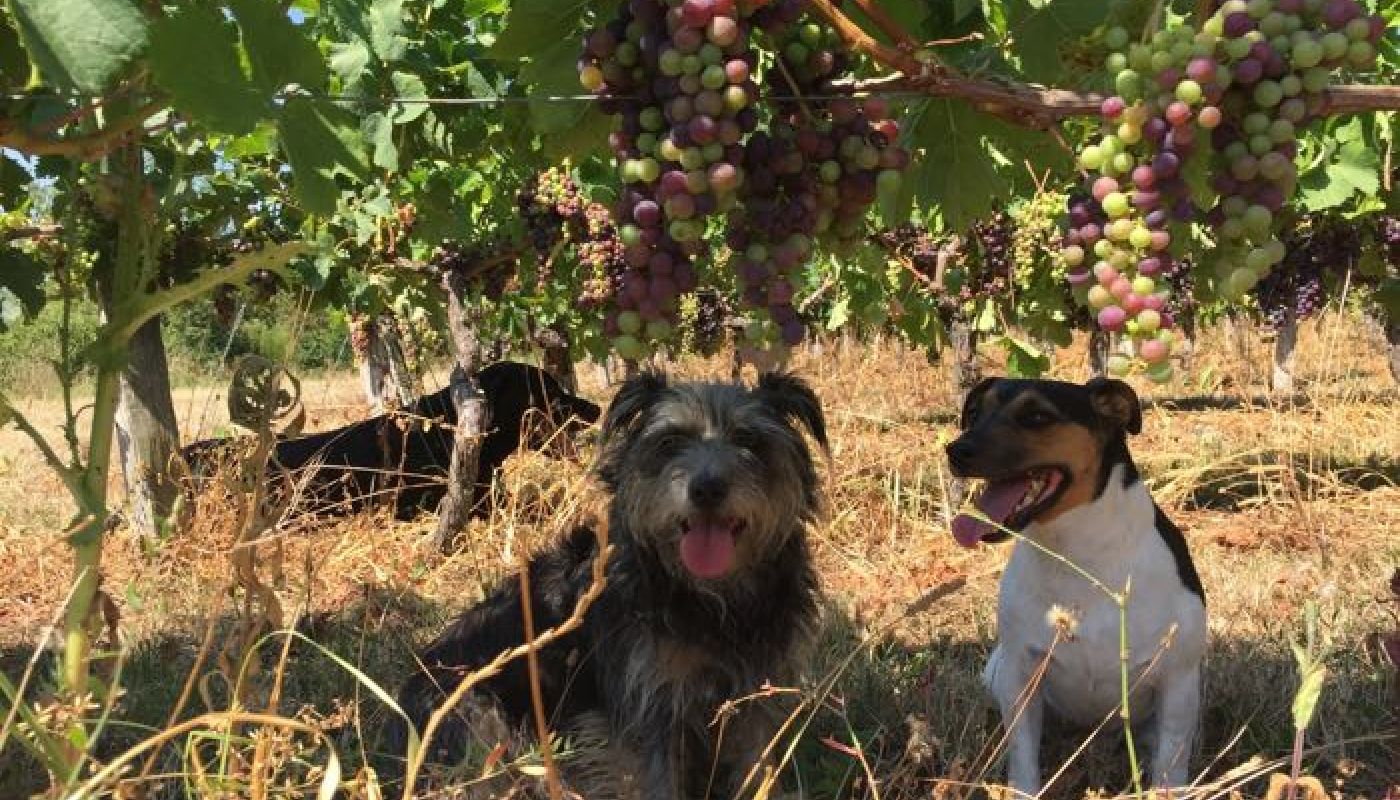
It’s been exceptionally dry during the holidays, with plenty of sunshine around Bordeaux. Most tourists have been on the beach, relaxing by the pool, strolling around markets or spending time in the city of Bordeaux itself. Those with an interest in wine might have visited the new Cité du Vin, which opened in June, or taken a trip out to St-Émilion. Most dogs, as here at Ch Bauduc, have been looking for shade.
Those who have ventured out into the vineyards – beyond the refreshingly cool barrel cellars – might have seen how dry the ground looks. The parched grass verges contrast starkly with the lush green rows of vines, which are, for the most part, in remarkably rude health. As you'd imagine, young vines with shallow roots on dry soils suffer when there's no rain but, overall, the vines are coping well, especially given the heat over the French holiday this last weekend with temperatures consistently reaching 33 °C (91 ºF) or more.
A glance down at the bunches and you’ll see the grapes are changing colour right now (as in this Cabernet vineyard at Rauzan-Ségla). Veraison is in full flow, as you’d expect in August, with the process in some vineyards almost complete and others not too far behind.

Look closer still – if you're at a more ambitious estate – and you can see the bunches of grapes that were snipped off at the end of July or earlier this month. The so-called green harvest (pictured below at La Fleur-Pétrus), when excess bunches are dumped on the ground to encourage those that remain on the vine to ripen more fully, can be quite shocking even to this experienced vine-spotter. More green harvesting may yet follow, as veraison can reveal the bunches that are lagging behind.
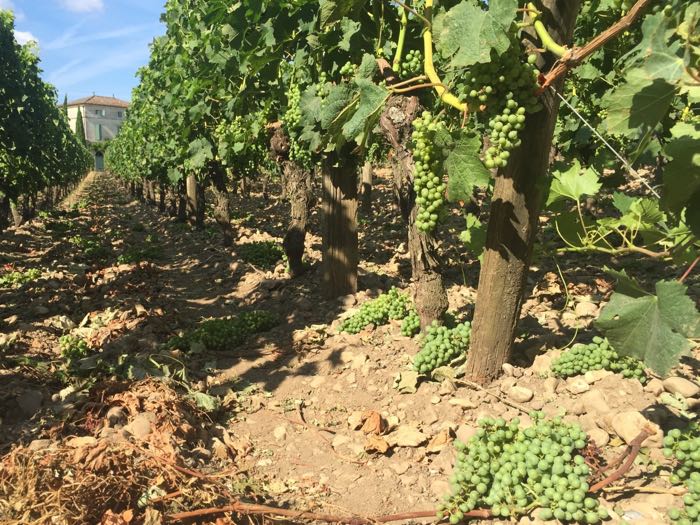
Brown leaves on the ground (see below) also show the efforts that have been made to expose the grapes to the ripening sun. It might be just on one side of the rows so far, with the second effeuillage to take place at the start of September for the final push – and to avoid potentially punishing sunburn up to now on grapes that are exposed to the afternoon sun.

That's one of the remarkable things about this year. While some less fortunate regions in France will have significantly reduced crops as a result of damaging frost in late April and, in some cases, hail damage, many vineyards in Bordeaux are heading for what appears to be a very decent crop. There’s a long, long way to go – a month for the white harvest and up to two months for the red – but the Merlot (pictured top right at my own Ch Bauduc) looks plentiful in many vineyards. Given that Merlot makes up two-thirds of the red in Bordeaux, and that this vast region has close to 90% red, that's an awful lot of wine.
The consistency of the flowering on the Merlot, during the first part of June, came as a pleasant surprise to many growers. This one included. Merlot is susceptible to poor fruit set if the conditions aren't right – notably coulure and millerandage when the berries don't form properly – and the weather was decidedly mixed this June. We had good days and we had rainy days. The weather during the last two years at the same stage during flowering, however, was dry and sunny, and this had favourably influenced the number of potential bunches this spring. The vines seemed to have more in reserve, as if the force was with them. Unusually, the fruit set on the Cabernet Sauvignon is more mixed, and the Cabernet grapes – say, in the northern Médoc – seem to be smaller than normal. That's just my impression, mind, and that may not be bad news, qualitatively.
The number of potential bunches and the surprisingly successful flowering of Merlot is one feature of the season so far. Another is just how little rain we've had in the last eight weeks compared with the months before that. Ample rain in the spring helpfully built up the reserves in the subsoils but added to the threat of downy mildew above ground. Some vineyards where producers fell behind on their treatments fell foul of this – black rot was also a risk – and this could certainly have a bearing on the eventual crop size.
I've updated my table of monthly rainfall from six subregions over recent years to include 2016 to date. Admittedly, we can be a bit obsessed by the amount of rain because it has so much impact in the vineyard. For one thing – and most visitors don't realise this – irrigation is not allowed for appellation contrôlée vineyards. (Click on the table to see a slightly bigger version.)

January and February 2016 were very wet (228 mm/9 in and 138 mm/5.4 in versus a 30-year Bordeaux average of 87 mm/3.4 in and 72 mm/2.8 in respectively) after a dry December. You can see from the table that, while April was in line with the average, March, May and June were relatively wet. And then we've had precious little rain – funnily enough since 23 June, a date which is memorable, for many of us, for other reasons.
In fact, we had 40 mm (1.6 in) of rain per week on average in January and February 2016. We then had 20 mm per week on average in March, April, May and June up until 23 June. Since 23 June, we've had less than 2 mm a week. It's been a particularly dry summer so far – and by some margin the driest July and August I can recall this century. (Even July and August 2003 – the roasty-toasty, early harvest – saw more rain.)
Temperature wise, we had a chillier spring than the 30-year average: 1.3 ºC (2.35 ºF) colder in March, 1 ºC in April, May was 0.5 ºC colder than the norm and June 1 ºC chillier (and 2 ºC cooler than 2014 or 2015). July was normal at around 21 ºC (70 ºF) average. It is way too early to predict quality – we could do with a little refreshment, I feel, but any prolonged September rains could put a big dampener on things. It is worth noting though that the great years of 2005 and 2010 were dry in July and August. So, too, however, was 2012, and that year we also had a wet spring, as per 2016. 2012 was a good rather than a great vintage, but it was a later harvest that was compromised by the threat of rot at the end. Because of the rain during the flowering in 2016, I do think there is a greater risk of botrytis at the end of the harvest if conditions go against us.
If you're planning on visiting Bordeaux during the harvest, 2016 won't be an early one, despite the lovely, dry summer. Some early-ripening vineyards, such as in Pessac-Léognan, will start their whites early in September but expect the dry whites to mostly come in during mid September and the reds, for the most part, in the first half of October.
If you want to see how things are progressing in the vineyards around Bordeaux, I’ll be posting plenty of images on Twitter and Instagram @GavinQuinney using #bdx16.