See my tasting notes on 50 Empordà wines.
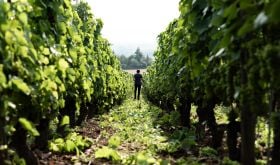
Ancient vines, stunning landscape (some of which is, alas, still smouldering after this week's forest fires), balmy climate, the best restaurant in the world – I suppose it is hardly surprising that the far north eastern corner of Spain has been getting its wine act together. El Bulli may have closed its doors but there is still a host of great places to eat in the region (see Nick on restaurants today) that have reason to be increasingly proud of their local wines.
The recent evolution of the official denomination that used to be known cumbersomely as Ampurdan-Costa Brava but is now restyled in Catalan as the rather breezier Empordà reflects what has been happening throughout so much of the wine world. Old local varieties make rustic wines of local interest only. The locals then decide the future lies with importing the same varieties that everyone else has, then start to see the virtues of indigenous plants transformed into distinctive wine with newfound skill and respect for local character.
Empordà has perhaps been slightly slower to evolve than more cosmopolitan wine regions, which has the great advantage that not too many old vines of traditional varieties have been ripped out to make way for inappropriate 'international' ones. For many years the wild hillsides inland of the blue waters of the Costa Brava were planted mainly with the variety known in French as Grenache, in Castilian as Garnacha and in Catalan as Garnatxa, together with ancient stumps of the variety known variously as Carignan, Cariñena, Carinyena and Samsó (this last name was dismissed as 'made up in Priorat' by my principal Empordà informant, referring to another, much more fashionable Catalan wine region).
For most of the 20th century, Empordà struggled to recover from the predations of the phylloxera louse. Abandoned vine terraces can still be seen following the contours of the hillsides lining the tortuous roads inland of Cadaqués and Roses even today. Such wine as was made was either strong local pink rosado or strong, sweet wines based on Garnatxa in various shades, just like wines such as Banyuls and Rivesaltes made across the Pyrenees in France's Roussillon. After all, Empordà and Roussillon are both Catalan first and foremost and share terrain and climate too, down to stratas of schist and granite through the landscape, so it is hardly surprising that their wines are similar.
Roussillon has been a hotbed of table-wine revolution in recent years so it seems entirely logical that Empordà to its immediate south should wake up and realise its potential for fine table wine, too. And among the new generation of ambitious wine producers there are some who worked in Roussillon during the week and brought back techniques and attitudes to be applied to their homeland.
In Empordà recently I had the pleasure of tasting more than 50 wines from some of the more dynamic producers and found they varied hugely in their styles and winemaking competence, but that the raw ingredients could hardly have more personality. Some of the best-value examples are made by the Espelt family winery from ancient Garnatxa vines. These are particularly valuable because, while it is not too difficult to find very old Carinyena vines (and this is a variety that produces good wine only from very old vines), Garnatxa was much more likely to be ripped out because it is so much less productive than Carinyena.
Espelt red old-vine Garnatxa is based on vines that were planted in 1920 on granite and sand. Although it was aged for three months in large old oak, the 2009 can be found on sale in the US for a derisory $8.99. Someone really ought to import it into the UK. Please. Bibendum Wine already import the hugely impressive, full-bodied white version, which they call Mar d'Avall Garnatxa Blanca 2009 and sell at £10.80 as part of a range of Catalan wines they call Els Pyreneus.
My favourite red was much more expensive, but then Roig Parals, Camí De Cormes 2007 is made from a single vineyard of very old Carinyena with the oldest vines dating back to 1896. It's clearly stuffed with local character. It even smells slightly of that dried grass or herb you find in southern France that smells a bit like curry powder. It sells at the cellar door for about 20 euros a bottle, the same price as a reasonably smart red Bordeaux. Roig (pronounced 'Roitch') Parals was set up by a young couple who had a beach restaurant and then acquired some vineyards. Their other headline red is their Finca Pla del Moli blend of the Bordeaux grapes Cabernet Sauvigon and Merlot, which is perfectly capably made but tastes like a host of reds made in the extensive Catalan region of Penedès to the south.
For a while they shared a consultant with the most prominent new wine in the south of Empordà, Clos d'Agon, a project involving Peter Sisseck, the Danish winemaker behind Pingus, the wildly expensive Ribera del Duero. The red is a Bordeaux blend, with Syrah, and the white is based on varieties imported from the Rhône, so the wines – sold mainly, at sky-high prices, in Switzerland, the homeland of Clos d'Agon's owner – are rather less obviously local than some. But they are extremely skilfully made, as one would expect.
They are not, however, the most expensive wines of the region. Finca Garbet is the flagship wine of one of the best-known Catalan wine producers, based in and named after the turreted Castillo Perelada. Part of their single-vineyard range, it comes from spectacularly situated slate terraces overlooking the Mediterranean in the Cap de Creus natural park. The first few vintages were a blend of Syrah and Bordeaux varieties but from 2005 it has been 100% Syrah. The cellar door price is 100 euros a bottle, which strikes me as ludicrous. But there are always people prepared to pay for 'the most expensive' rather than the best.
Empordà's white wines may constitute less than a third of total production (the traditional sweet, strong wines are only 3%) but, as in Roussillon, they are certainly no less interesting than the reds. The local Picapoll grape (not the Piquepoul but probably the Clairette Blanche of southern France) can add nerve, the various Garntaxas add weight, and Carinyena Blanca can add interest. My only criticism of the wines of Empordà in fact is that virtually all the labels look the same – smart black type on white – though Espelt try to jazz it up a little, as will, presumably, the many representativ⁞es of a younger generation currently taking over.
MY TOP WINES
WHITES
Clos d'Agon 2009
Espelt, Quinze Roures 2009 (Bibendum's Mar d'Avall in the UK)
Martí Fabra Carreras, Masia Carreras 2010
Masia Serra, Ctonia 2010
Vinyes Dels Aspres, Blanc dels Aspres 2009
REDS
Clos d'Agon 2008
Espelt Old Vines Garnacha 2010
Martín Faixò, Perafita 2008
Roig Parals, Camí De Cormes 2007
Terra Remota, Camino 2009
Those in the region who would like to find a shop stocking a good range of local wines are recommended to visit:
Vins i Licors Grau
Torroella, 163
17200 Palafrugell
Girona
Tel +34 972 301 835 begin_of_the_skype_highlighting +34 972 301 835 end_of_the_skype_highlighting
www.vinsilicorsgrau.es
See my tasting notes on 50 Empordà wines and stockists at www.wine-searcher.com.