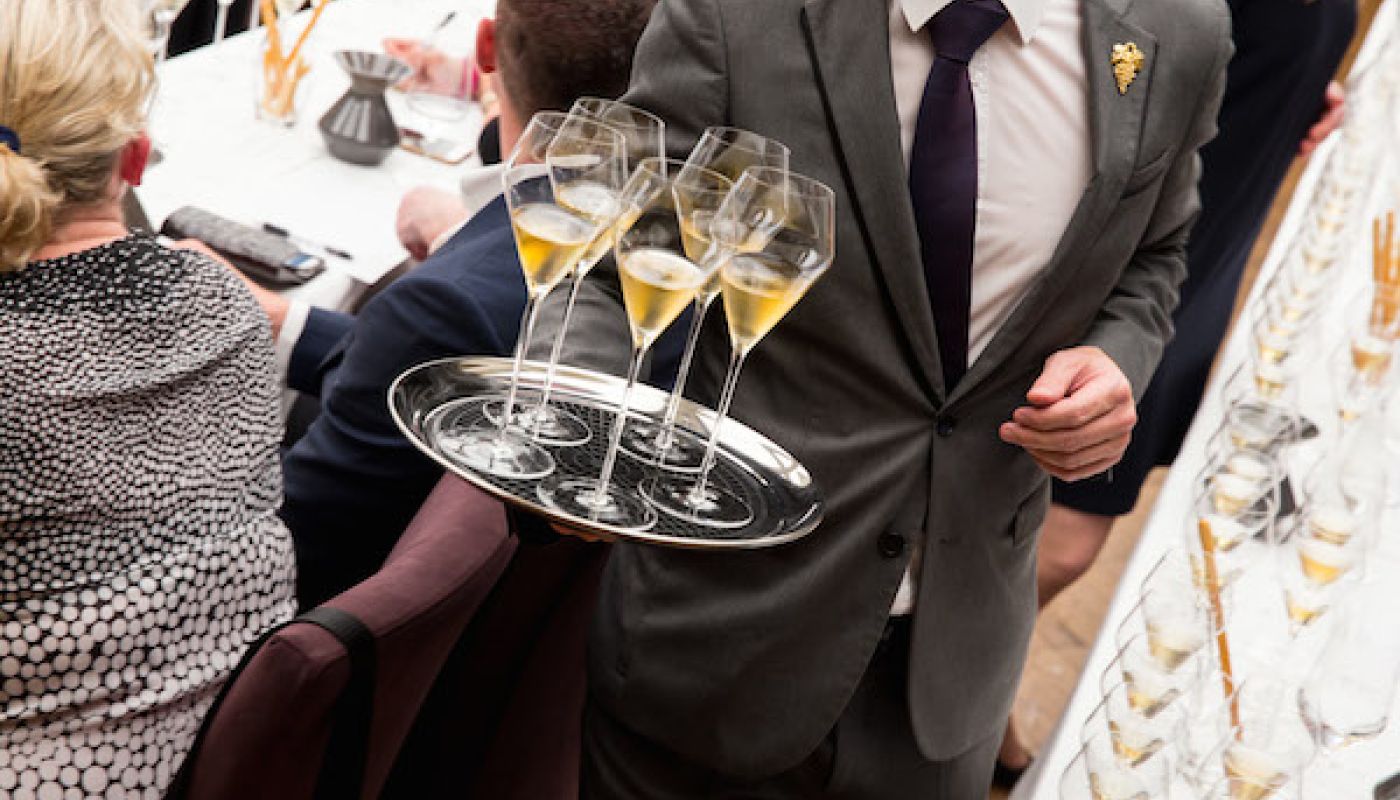
I arrived at the door of 67 Pall Mall, on Prince Charles’s London doorstep, to find a cloud of dust and three builders. One of them directed me down the front steps by the old coal holes into the basement, where there was a particularly smart tasting room, laid out classroom style, with bright overhead light designed to simulate daylight, and a bevy of highly qualified sommeliers getting ready to serve 750 glasses of champagne at the very first tasting event to be held in London’s new wine-minded club.
I had last seen this basement of the old Hambros bank with 67 Pall Mall’s founder, former hedge-fund manager Grant Ashton, when it was little more than a rundown warren of windowless offices and a strong room, but the bottom three floors of this Lutyens building are being transformed into a members’ club with smart hotel décor, a restaurant and a chance for people to sip wines at lower-than-restaurant prices, or to sip their own wines kept in the club’s cellars. The official opening is projected, somewhat warily, for the middle of next month.
Our tasting, following a choice of superior champagne aperitifs, had the bold theme of comparing magnums and bottles of six of the most luxurious champagnes blind to see whether we could work out which had been poured from a bottle and which from a larger container supposedly likely to age wine more slowly and for longer. This arcane exercise had been dreamt up by Nick Baker, proprietor of another fledgling enterprise, The Finest Bubble. Baker is a wine-trade veteran who claims to have identified a gap in the market for a company that offers same-day delivery of top-quality champagne. Below he addresses the crowd and explains his nifty iPhone voting system. (All photos of the event were taken by Matt Martin, although the room was decorated with photographs of the producers of the wines we were tasting – Frédéric Panaïotis of Dom Ruinart and Hubert de Billy of Pol Roger feature below – by Colin Hampden-White.)

He certainly could not be accused of a lack of engagement in the product. The day before this ambitious tasting for 56 paying guests, he invited me to a blind tasting at his home of all five unusually consecutive Dom Pérignons released from the 2002-2006 vintages. As soon as we finished he insisted on opening a bottle of the 1999 – for calibration purposes – and after I had left, he, disappointed by the relatively advanced state of the first bottle of his beloved 2002 Dom Pérignon, apparently opened a second bottle of it (he sells it for £146.95 per single bottle).
The first thing to say about the results of this delicious bottle v magnum tasting (which would have been a treat even if we had tasted them only from bottle sizes) is that they were inconclusive. Only one of the 47 tasters who registered to vote on their iPhones correctly identified which were the bottles and which the larger sizes. On the other hand, the majority of the crowd overall correctly identified which was the magnum in all cases except for the off-putting first pair, of Taittinger, Comtes de Champagne 2002s, of which one had clearly the more developed bouquet, leading most of us to guess it was the bottle size when in fact it was the magnum. A disconcerting start.
As specialist champagne taster Simon Stockton pointed out from the back row, there are just so many variables other than bottle size that are likely to affect the results. Fortunately, Nick Baker had eliminated one of the most important, storage conditions, for all but one pair, having bought most of the wines direct from their UK importer. The only pair in which provenance varied considerably was the Pol Roger, Winston Churchill 1998, one of the most robust, cigar-smoking champagnes of which the bottle was the only champagne to have been bought on the secondary market and which displayed a level of evolution that to me bordered on oxidation – although, to my surprise, it was preferred overall by the crowd to the magnificently tense magnum bought straight from importers Pol Roger UK.
But the other variables potentially affecting how each wine tasted include the quality of each individual cork, the amount of dosage – the mix of champagne and sugar with which most champagnes are topped up just before the final cork is inserted; for some of these wines such as Cristal, magnums are dosed, six months later than bottles, with less sugar than goes into regular bottles of the same wine. And then there is the date of disgorgement, when the sediment from the second, fizz-inducing fermentation in bottle is frozen and expelled, the dosage added and the final cork inserted. In theory, the more recent the disgorgement date, the tighter and less evolved the wine should be.
For some of these pairs, the disgorgement date (disclosed along with provenance once the bottles and larger sizes had been voted on and their identities revealed) was very similar for bottle and magnum, but for other pairs there were puzzling phenomena. The magnum of Dom Ruinart 1998, for instance, had been disgorged a full year after the bottle, in March 2011 rather than March 2010. But, counter-intuitively, the magnums were mellower, rounder, even sweeter (and one of them suffered from a poor quality cork which probably dragged down the group score).
I take my chapeau off to anyone who correctly identified the three (not the usual two) different sizes from which Krug 1998 was poured: bottle disgorged way back in October 2007, magnum disgorged in spring 2010, and jeroboam (twice as big as a magnum) disgorged last of all in autumn 2013. They were all very fine wines of which I liked the one that turned out to be the magnum best, taking it for the jeroboam on account of its tautness. (And we were assured that the wine had been matured in that very jeroboam, not decanted into it from a smaller bottle as is the case with some larger-format champagnes.)
As for which format the group of tasters preferred, in all cases except one, the oldest wine Cristal 1996, they preferred the bottle – thereby perhaps demonstrating that there is no point in buying magnums of champagne unless you are going to hang on to them for a very, very long time. We all acknowledged what a treat it was to taste such a mature vintage of Cristal when so much of this popular wine has traditionally been necked in an infant state (the wine not the drinker) in nightspots around the world. And in all cases except one, the majority of tasters thought the size they preferred was the bottle – although, as I have explained, most of them took the bottle of Comtes de Champagne 2002 for a magnum.
Nick Baker and his team were able to demonstrate how we all, particularly the female tasters, tended to become more generous with our scores as the evening wore on. Funny that.
FAVOURITE PRESTIGE CHAMPAGNES
Group scores out of 20 for the six wines under the microscope were in this order for the more common bottle format, but I think the tasting order (from young to old) may well have played a part. My personal scores for the bottle size of these wines are in brackets.
Prices below are The Finest Bubble’s for single bottles. For other stockists see wine-searcher.com.
Louis Roederer, Cristal 1996 17.4 (19) £499.95
Krug 1998 16.9 (18.5) £255
Pol Roger, Sir Winston Churchill 1998 16.7 (17.5) £285
Dom Ruinart Blanc de Blancs 1998 16.1 (18.5) £149
Taittinger, Comtes de Champagne Blanc de Blancs 2002 15.9 (19) £165
Bollinger RD 2002 15.4 (18) £169.95
See full tasting notes and much more detail in Champagne– bottles v magnums.