See also my tasting notes on the current Vigno wines.
As someone who writes wine reference books, I am truly scared by Chile and its unparalleled pace of change. I asked two people to bring me up to speed on the newest wine regions there – writer and broadcaster Peter Richards, the Master of Wine who knows most about Chilean wine, and UK head of Wines of Chile Michael Cox. Between them they managed to come with seven new areas where vines have recently been planted and of which I had never heard.
But it is not just the Chilean wine map that has been evolving frenetically. The range of grapes grown and good enough to tout has widened enormously from the old Cabernet/Merlot nexus.
Social structures are changing rapidly, too. Until quite recently, Chile's thriving wine export business was dominated by the large companies run by the country's landed ruling class, descendants of those who controlled vast estates and much of what made Chile work for centuries. The grandees owned the land and the companies, employing families of farm workers in the vineyards and an oft-changing roster of trained oenologists in the wineries. It was rare for these talented winemakers to own their own vines – although in less favoured wine regions, peasant farmers would deliver their grapes to local co-operatives. This has been changing, however. Winemakers have increasingly been able to invest in land, and a number of foreigners have moved in.
Then came the MOVI movement, a loose grouping of ambitious small-scale wine producers dotted around the country who realised in 2009 that by joining together and singing the praises of small companies versus big, they could create much more noise than by operating independently.
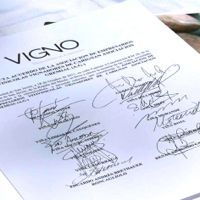
And now we have another much more geographically and varietally specific association, Vignadores de Carignan, producers who have very recently joined together to bottle a range of exciting wines, effectively, though not technically, all obeying the strict rules of a single appellation they have created and called Vigno. (The photo above shows the document signed on 18 October 2011 to mark the legal creation of the association.) According to one interpretation, Vigno is basically the result of two earthquakes and a Canadian wine-loving marketing enthusiast who came to Chile originally to ski.
Derek Mossman Knapp ran a brand agency in Santiago for 10 years before starting Garage Wines and realising that Chile had a completely unrealised and so far unmarketed asset in the vineyards of its least glamorous wine region, Maule, the southern limit of Chilean viticulture before Chilean vineyard expansion took off. For years this extensive region was dismissed as fit only to furnish the most basic table wine for the domestic market, not least because Pais, or Mission, the rather coarse vine variety introduced to the Americas by the Conquistadores, was the dominant grape.
In 1939 there was a terrible earthquake around Chillán in the south of Maule. Just like their counterparts in the Languedoc would do a decade or two later, the Chilean authorities suggested that the devastated vineyards might be improved by planting Carignan, the productive vine variety that makes deep crimson, relatively tart, structured wines. Varietal Carignan made carelessly from young or over-productive vines can be a fearsome thing, but many of these Maule vines are now 60 or 70 years old. These ancient, low-yielding plants (pictured here with Garage Co winemaker Pilar Miranda) are also dry-farmed. The fact that rainfall this far south is higher than in the north, and because most of the farms are peasant smallholdings which can ill afford much investment, there are few irrigation systems. The vines are also unwired bushvines – no expensive trellis systems here. These vines look quite different from the rows of carefully trained, often highly productive plants on fertile soils that supply most of the wine exported from Chile, but they are well able to coax real individuality out of Maule's inhospitable granite and rocky soils.
Then came the earthquake of 2010, also centred on Maule, which left many of these farmers even more impoverished. Knapp saw that an old-vine Carignan initiative would tick many boxes for modern wine consumers in search of authenticity, but that it could also help local farmers and the Chilean wine industry re-evaluate the produce of Maule. (Most of the grapes have until now been sold for a song to local co-ops whose produce is, with luck, bought for a song by the big companies.)
Knapp travelled widely throughout the region, meeting the generally notably senior vignerons here, left in charge of the family holdings after their children had long since fled to the city. His marketing antennae twitched delightedly when he encountered ancient earthenware fermentation vessels, tinajas, eerily similar to the amphorae and expensive 'concrete eggs' being adopted by fashion-conscious 'natural wine' producers in the rest of the world. He had moody photographs of hands as gnarled as the vines and wise old men in straw hats taken for a Vigno brochure. A Vigno logo was designed.
But the most important groundwork for establishing the Vigno initiative was enthusing a small band of winemakers from companies of varying sizes about the quality of the old Carignan grapes so that they could go back to their employers and insist that they participate. As New Zealander Brett Jackson, winemaker at Valdivieso, explained, 'it's just great fun to get into this bit of Chile that has been ignored for so long. We're capturing a bit of Chilean history that was getting lost'. 'Living patrimony', is the word, prompted Knapp, ever the marketing man, though one who has been keen to encourage Fairtrade principles in paying the smallholders for their grapes.
Those currently involved are the local Cauquenes co-op Las Lomas; big companies Valdivieso, Miguel Torres, De Martino, Undurraga; medium-sized ones Morandé and Odjfell; MOVI members Bravado Wines, Garage Wines Co, Gillmore and Meli, and winemaker Pablo Morandé's small family company Viña Roja. Renan Cancino, viticultural consultant with a number of wineries including the widely admired De Martino, has also made a Vigno from his family's own vines in Maule but it has not yet been released.
The rules that the Vignadores de Carignan have agreed on include a mandatory 24-month ageing period (arguably a bit long), dry-farmed bushvines, and at least 65% of Carignan, all vines to be at least 30 years old (although they allow new varieties to be grafted on to old roots).
These earthy reds vary of course, and those I tasted ranged from 2007 to 2010, including one that even included a touch of Chardonnay in the fermentation vat. None is less than 14% alcohol, but they are all vastly different from the Chilean norm: much more, well, natural.
You can read more background to this initiative, written by the 2010 Geoffrey Roberts Award winner Derek Mosmann Knapp, in Vignadores de Carignan and in Maule – slow recuperation.
See also Peter Richards' excellent take on this new initiative (and some lovely pictures) here.
CURRENT VIGNO OFFERINGS
See here for my tasting notes on these wines.
Garage Wines Co, Lot #29 2010
Undurraga 2010
Bravado Wines 2009
Meli 2009
Morandé 2009
Odjfell 2009
Miguel Torres 2008
Valdivieso, Éclat 2008
De Martino 2008
Gillmore 2008
Viña Roja 2008
Las Lomas 2007
Vigno winemakers, left to right: Felipe Zuñiga, Las Lomas; Fernando Almeda, Miguel Torres; Eduardo Reinero, Meli; Rafael Urrejola, Undurraga; Pilar Miranda, Garage Wine Co; Pablo Morande (junior), Viña Roja; Pablo Morande (senior), Viña Morande; Arnaud Hereu, Odjfell; Harold Pinter, Valdivieso; Eduardo Jordan, De Martino; Andrés Sanchez, Gillmore; Felipe Garcia, Bravado.