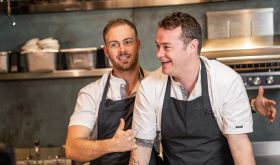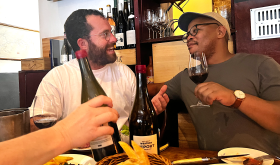
Eating in restaurants, at home or in friends' houses fulfils very distinct objectives and brings very different pleasures.
Restaurants can bring excitement, an opportunity to see and to be seen as well as the potential risk of unfriendly service and the inevitability of a bill. Eating in puts more pressure on the hosts, which starts with shopping and ends many hours later with the washing up, but presents the opportunity to offer genuine hospitality, particularly to those travelling and far from their home.
Yet despite the huge advance in domestic cooking equipment and the money many have invested in their high-tech kitchens there is still a gap between how food tastes in a restaurant and someone's home. This is not surprising – after all it is the difference between the professional, someone who stands and cooks eight to ten hours a day, five days a week at least, and someone who may pick up a less-than-perfectly sharpened knife no more than once or twice a week.
But I am certain that there are elementary lessons any amateur chef can learn from the professionals, so over the past few weeks I have shamelessly asked chefs Michel Roux, Rowley Leigh, Sally Clarke and Eric Treuillé and American restaurateur Drew Nieporent how we can bridge this gap.
This quest began after what proved to be a successful Sunday lunch roasting a whole rump of beef (Wild Beef, Dartmoor, Devon, tel 01647 433433). The meat tasted even better than normal because, I believe, as I went into the kitchen to make an early morning cup of tea I inadvertently did what all professional chefs do at that time of day and I put the oven on and left it on for a couple of hours on a low light.
Now most recipes specify that the oven should be hot before it is used but how many take this seriously? For professionals, on the other hand, this is a matter of course – particularly as it is often the pastry chefs or apprentices, who come in early when the kitchens are cool, who switch them on – and they stay on often until midnight. Roux agreed, adding that at his Waterside Inn in Bray they even go as far as checking the calibration of the ovens just before each service.
For Leigh the difference is obvious. 'Seasoning' was his one word response to my question about the difference between professional and amateur cooking. 'Amateur chefs do season some dishes but not all of them and they tend to overlook the timing of just when to add salt and pepper in particular, which is often as important at the end, when for example a piece of meat is resting, as it is at the beginning.'
This was a point Roux agreed with wholeheartedly, rushing back to where I was sitting after our discussion with a copper pan in his hand which contained two succulent veal chops. 'I am preparing these for a photo shoot,' he exclaimed with all the enthusiasm of a novice, 'but I want you to stick your fingers in and taste them. You see I have seasoned them even though they are for the camera. It's just second nature to a chef.'
Leigh's second tip, 'peeling', was delivered equally abruptly if less obviously. What he meant was that in professional kitchens a great deal more attention is given to the precision with which vegetables are peeled (and meat and fish trimmed and prepared for that matter) than at home and this has a particularly beneficial effect on how the eventual dish will taste. Although many chefs do begin their professional careers preparing vegetables, the key players in this taste transformation are the kitchen porters whose invaluable role is invariably overlooked but whose presence, if you could hire them for an evening, would be a huge boon in a domestic kitchen.
The word precision also highlights a huge gulf between the professional and the amateur chef. It has now become fashionable for chefs to appear flamboyant and theatrical as they cook, adding 'a little bit of this or that'. After all, such an approach makes for better television. But nothing could be further from reality. Quite simply the best chefs are the most precise not just in what they cook with but in how much of each specific ingredient they use – after all they have a business to run, profit margins to meet. But it would come as a shock to many an amateur chef, however keen, to see how many professionals rely on timers in various sections of the kitchen in addition to a more obvious clock on the kitchen wall.
While time and timing are crucial to the most successful professional preparation of any dish, Drew Nieporent reckons timing explains why restaurant food can taste so good. 'The crux of what I do every day as a restaurateur (and his company Myriad Restaurants manages 15 restaurants from the West Coast to London) is a trade-off between speed (how quickly can a customer be served) and accuracy (is the kitchen able to prepare that dish fast enough during a busy lunch). But the professional kitchen does have one advantage and that is that the table is ready and waiting, they have come in to eat, and they are not standing around, chatting. And this in turn means that the food can be served hot, as it should be to maximise its different flavours. Obviously, not too hot but I think a great deal of food that talented domestic cooks have spent a lot of time preparing is never shown off to its best advantage simply because people dally too long.'
If what distinguishes professional chefs is the luxury of preparation time, the speed with which they can deliver their food to an expectant table and the precision of their culinary equipment, then there is also one other vital factor, one perhaps they share with artists in general, and that is the confidence to push their skills to the limit, to extract the maximum flavour from all their ingredients.
I was first made aware of this principle overhearing Marjan Lesnik, formerly executive chef of Claridge's, instructing the British entry in the Prix Taittinger, an extremely stiff international culinary competition. The entrant had just been given a list of ingredients and he was being packed off to bed to work on the recipes he would have to cook the following morning for a judging panel of top French chefs. 'Don't be afraid,' Lesnik exhorted, 'take everything to its limit, that's where the flavours lie.'
This obviously does not mean burning or overcooking but it does mean browning, caramelising and reducing sauces more than may seem obvious or even safe. This is a subject on which Michel Roux has strong opinions. 'I believe that an amateur chef is more interested in the visual presentation of their dish rather than the explosion of flavours in the mouth. There has to be a depth of flavour to food, just as there is with wine, and intense flavours only come from intense cooking.'
These flavours come from practice and confidence, two key factors noted by Eric Treuillé the French chef in charge of the demonstration kitchen at London's unique Books for Cooks (www.booksforcooks.com). 'Professionals develop a more relaxed manner of handling not just their tools but also their produce and this is important, it stops them trying too hard.'
This, I believe, divides not only professionals and amateurs but also the very best from the rest amongst the professionals. In cooking today, as in architecture, less is more – a maxim which holds true whoever is at the stove. As Sally Clarke who manages to coax more flavour out of her ingredients than perhaps any other chef explained, 'Amateurs often seem to me to try too hard, to make menus too complicated and as a result to make more work than is necessary. Cooking should be a joy.'
Ten Tips From The Pros
- Plan the menu for ease of service, a cold/cool first course then a hot main course. Vice versa in the summer.
- Professionals agree that mis en place, the preparation of the ingredients and how you are going to serve them is 90 per cent of the work. This includes everything from getting bowls of garnish ready to warming the plates. There is no shame in writing a list!
- Give yourself plenty of time.
- Do check the equipment, that ovens are hot enough, knives are sharpened regularly.
- Pay attention to how you prepare and handle your ingredients, removing them from their plastic wrapping before you put them in the fridge.
- Be scrupulous with how you season.
- Don't pre-cook vegetables and leave to keep warm. Vegetables need to have your total concentration at the last minute. Kettles normally boil more quickly than pans even with lids on so use one for your hot water.
- Dishes take time to master, don't rush through anyone's repertoire too quickly. The professionals don't.
- So too do techniques. Better to be a master of a few than a jack of all trades.
- Relax – there is never likely to be a professional food critic lurking in a domestic kitchen.
The Professionals
Michel Roux, The Waterside Inn, Bray, Berkshire, tel 01628 620691
Sally Clarke, Clarke's, London W8, tel 020 7221 9225
Rowley Leigh, West Street, London WC2, tel 020 7010 8600
Eric Treuille, Books for Cooks, London W11, tel 020 7221 1992
Drew Nieporent, Montrachet, West Broadway, New York, tel 212 219 2777
Restaurant Of The Week
The Real Greek Souvlaki & Bar which opened in Clerkenwell on Wednesday 23 April is part of chef Theodore Kyriakou's passionate mission to convert the UK to real Greek food and the best of Greek wines.
It is a process that Kyriakou initiated three years ago when he opened The Real Greek in equally trendy Hoxton and continued when he expanded sideways to open Mezedopolio, a wine bar serving mezedes or 'Greek tapas', in a former mission hall next door.
But this new venture is perhaps even more totemic. Souvlaki – marinated kebabs made from lamb between Easter and late autumn and then from pork – are the staple Greek convenience food, served on a skewer with warm rye bread. It is a dish that has been consistently and successfully bastardised over here for years. Who, having once watched Harry Enfield's grubby Stavros character, would ever willingly order souvlaki?
This menu will convert even the most sceptical. There are olives from the Rovies cooperative; traditional souvlaki served in single (£3.50) or double (£7) portions and less conventional souvlaki with herb-infused chicken, smoked Evritania sausage and open pitta with grilled fish. There are ten side dishes to choose from, ranging from oven-cooked giant beans from Kastoria to authentic taramosalata and stuffed vine leaves, and half a dozen desserts including a tooth-rotting Metaxa and sultana icecream.
Authenticity, fun and fair prices – everything a restaurant should be delivering in 2003.
The Real Greek Souvlaki & Bar
140/2 St John Street, Clerkenwell, London, EC1V 4UA (tel 020 7253 7234)
Monday – Saturday 1000-2300