9 May This is a longer version of an article published by the Financial Times.
See Walter’s tasting notes on these remarkable wines.
If the history of fine French and German wine are luxuriant forests, that of fine Italian wine is a little bush. Winemaking may have been introduced to France by the Romans, but Italy, or rather the many and diverse regions that were finally corralled into the Italian republic, stagnated for many recent centuries. Wine was an essential everyday drink, still poured liberally as a more trustworthy alternative to water until relatively recently. But the concept of wine as an ageworthy, valuable luxury was hardly known. Even Barolo, Piemonte’s ‘king of wines and wine of kings’, was traditionally aged, often in dubious conditions, in large glass demijohns rather than in bottles.
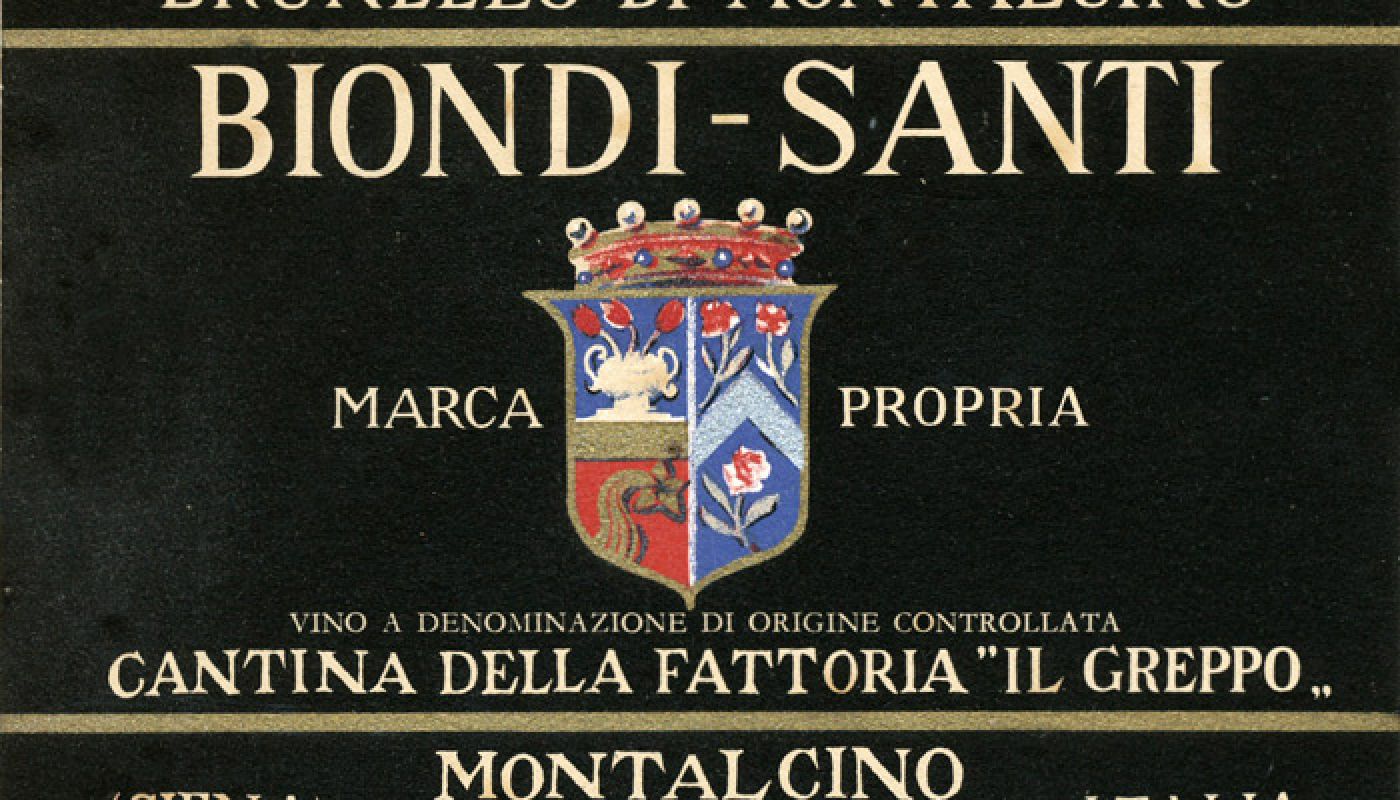
But in the late 19th century Ferruccio Biondi Santi began to make a red wine he called Brunello based on a clone of the local Sangiovese vine that had been identified by his grandfather in southern Tuscany. This prototype Brunello di Montalcino was expressly designed to be aged – quite unlike the sweet white Moscadello di Montalcino that was then the zone’s most characteristic wine.

In fact the Biondi Santis’ marker gene is clearly that of a hoarder. Ferruccio’s grandson Franco (pictured left with the barrels bought at the end of the 19th century by Ferruccio), who died in 2013 at the age of 91, would deliberately inflate the price of his best vintages to deter anyone from buying them. Ferruccio’s son, the splendidly named Tancredi, managed to drum up an international media storm in 1970 over his ceremonial recorking of Ferruccio’s legendary 1888 vintage – a wine that all agreed was still very much alive and kicking. Thus, between them, three generations of the Biondi Santi family proved that Italy could indeed make great wines worth ageing.
Tancredi was a particularly remarkable man for his time. As early as the 1920s and 1930s he travelled the world extolling the virtues of his father’s wines – and later was effectively Italy’s first consultant oenologist, advising growers in other regions, such as the famous Fiorano outside Rome, how to make better-quality wines. What is all the more remarkable is that until the late 1960s, when the Italian wine guru Luigi Veronelli held a tasting that catapulted the reputation of Biondi Santi wines to a new level, Biondi Santi’s was the only serious wine estate in the commune of Montalcino, one of the single most impoverished in all of Italy after the second world war (during which Tancredi carefully walled up their precious bottles).
Today there are well over 200 producers of Brunello di Montalcino, and remarkably few of them make wine in the image of Biondi Santi. The recent vogue has been for plump, ripe, dark wines with an obvious dollop of new oak and, often, an equally obvious dollop of the international grape varieties such as Merlot and Cabernet Sauvignon strictly outlawed by the original official regulations for the wine on which Tancredi advised. ‘Proper’ Brunello di Montalcino is 100% Sangiovese, the quintessential and not especially deep-coloured Tuscan grape, and is long aged in large old oak vats, owing any concentration it may have to impeccably farmed old vines and long maceration. A local spat about the varietal composition of modern Brunello di Montalcino blew up into a much-publicised farrago, with Franco Biondi Santi, ‘the gentleman of Brunello’ according to a monograph about him by Kerin O’Keefe, credited with steering the assembled growers into rejecting any officially sanctioned deviation from the path of all-Sangiovese righteousness in 2011.
Does all this have any relevance to today’s wine drinkers? Thanks to a major swoop on the remaining stocks of Biondi Santi wines by New York-based Sergio Esposito, wine lovers who would like to taste significant ingredients in Italian wine history, and have the deepest of pockets, now have a chance to do so.
Esposito was born into a large Neapolitan family, raised in upstate New York, and cut his professional wine teeth as a sommelier in Italian restaurants in Manhattan. Incensed by the extent to which Italy seemed to be losing out on the investment boom in fine wine, with partners he operates the Bottled Assets Fund, an investment fund largely devoted to top Italian wines. And while many a wine fund devoted to more conventional blue-chip wines has been wound up in the wake of the declining value of top bordeaux, Bottled Assets is apparently thriving. At a recent presentation of seven venerable Biondi Santi vintages in London he admitted, referring to the fund, ‘we got really lucky. We’ve been the only ones not to lose money. But I don’t want to talk about returns because then people will think I’m really smart.’
Arguably the smartest strike was to get his hands on a total of 7,000 bottles of Biondi Santi Brunello di Montalcino Riservas from the 1945, 1955, 1964, 1968, 1969, 1970, 1971 and 1975 vintages, all painstakingly checked, re-corked and certified by Franco Biondi Santi once and sometimes twice. The collection was bought around the time that Franco died in 2013 for a reported $5 million from the distribution company Biondi Santi SpA, which the year before had moved the wines from the estate to another location in Tuscany.
Esposito spends several months a year in Italy and obviously treasured being allowed to taste with Franco (who had a temporary rift with his more modernist son Jacopo) in the hallowed Biondi Santi cellars from the early 1990s. He says one of his early thoughts when acquiring this collection had been to return it to the estate’s cellars, but in fact the bottles have been moved to Octavian’s subterranean wine store in the west of England and already about half of them have been sold, largely to American buyers but also to Germany, Switzerland, Finland and Sweden.
He was presumably in London to try to drum up interest in them in the UK, where, according to him, ‘the general level of knowledge of Italian wines is like the US in the mid 1990s’. He claims, ‘I'm not in a rush to blow these out the door but rather get them in the right hands of people who can appreciate Franco and Tancredi's work and enjoy the last bottles of a truly exceptional estate's best work.’ He is particularly keen to get them on restaurant wine lists, to judge from the others invited to this tasting at which a most unfortunate misunderstanding about opening times resulting from an email dashed off by me robbed us all of the eight hours’ pre-tasting aeration recommended by Franco. Grrr.
Esposito said he is yet to taste the 1945, and is apparently down to a few hundred bottles of some vintages, but has up to 2,000 bottles of others. The first sniff revealed wines that certainly tasted from another era. Esposito claims to have opened 100 bottles so far without a dud – but then at £350 to £2,200 a bottle, a dud would be most unwelcome. Franco Biondi Santi , who took over in 1970, always said he wanted to make wines that were never old enough to drink. As Esposito puts it, ‘the most important thing that Franco did was not sell’.
Roberson in London are currently offering the following Biondi Santi Brunello di Montalcino Riservas, listed in my order of preference, with in-bond prices per bottle. They were all remarkable for their purity, and their prices.
1955 recorked 2000 and 1978 (£2,200)
1968 recorked 2000 (£475)
1964 recorked 1985 (£1,395)
1969 recorked 2005 (£350)
1971 recorked 2001 (£510)
1970 recorked 2007 (£350)
1975 recorked 2000 (£640)
For international sales, contact Vino Management [email protected]. In the US, private sales are managed by Italian Wine Merchants [email protected].
The photos above are taken from the Biondi Santi website.