
The continuing drought in large parts of northern Italy, from the alpine Val d’Aosta in the far north-west to Emilia-Romagna in the east, has triggered an emergency here in Italy. Already at the beginning of June, Coldiretti, the national association of small agricultural farmers including wine producers, estimated damage caused by the drought was in excess of €1 billion. The cause of the virtual absence of any rain combined with the mercury hitting 40 °C (104 °F) is anticyclone Scipione from north Africa and which has shown no sign of abating.
Especially hard-hit is the Pianura Padana, the plain that stretches from Turin in the far west to Trieste and the Adriatic in the east. Italy’s largest and longest river, the Po, runs through it and last week it registered the lowest water level ever, three metres (10 ft) below what is normal. This huge plain, known for intensive agriculture thanks to its flatness, hasn’t seen a drop of rain for more than 110 days, with losses of agricultural produce such as corn and wheat estimated at 30% so far.
The sector that was on its knees even before summer had begun is rice cultivation, widespread south of Verona and around the town of Novara in Piemonte. The rice paddies cannot be filled because the water reserves normally stored to compensate for low rainfall have completely vanished after three years of extremely dry winters: 2019, 2020 and 2021.
As for irrigation for other agricultural crops, up to 80% of the total volume of water requested by farmers is still not distributed due to water shortages, while the cost of the energy needed to operate pumps has reportedly quadrupled, compounding an already severe situation. The government is likely to dispense much-needed emergency state aid to the hardest-hit regions first, while insurance companies have taken drought off their lists of possible damage claims.
Italy needs to have an urgent discussion on vineyard irrigation, according to agronomist Davide Ferrarese, director of VignaVeritas and specialist in viticulture and phytopathology of the vine. Ferrarese is based in Gavi, where he consults to many small growers and also renowned producers such as Bruna Rocca in Barbaresco.
On my visit to Gavi last week, he explained that above 35 °C (95 °F) the vine’s metabolism stops working unless you irrigate. Ferrarese expressed his frustration that even after three years of very little rain, the possibility of irrigation and how and when to apply it has only recently been acknowledged. While temperatures over 35 °C used to be rare in Piemonte, late last week the mercury shot up to 37.5 °C (99.5 °F) in Gavi and producers are bracing themselves for what July will bring.
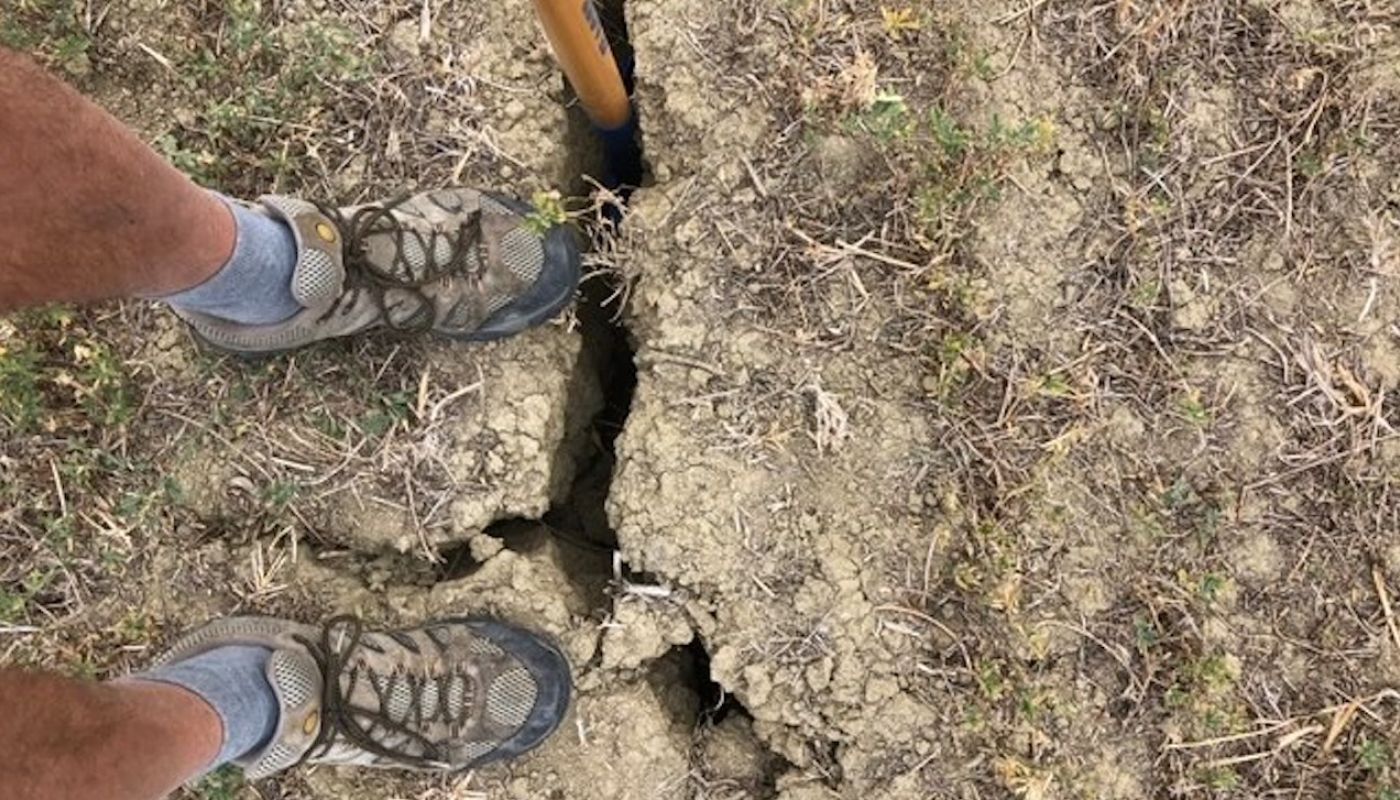
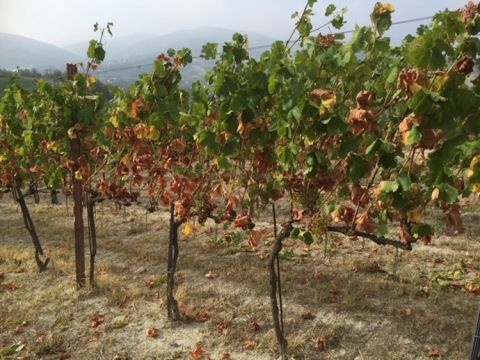
In the main image above, the legs are Ferrarese’s but the point is the dried-out calcareous clay soils tear open and release the soil’s humidity. The stick indicates how deep the crack is and how grave the problem. Below are drought-affected vines in Gavi in July 2021. (Both pictures were taken by Ferrarese.)
In most viticultural areas in Italy irrigation is forbidden and permission to irrigate may be applied for only in emergencies. This legal restriction was put in place to prevent overproduction and hence the topic remains controversial. However, Coldiretti have taken the lead in trying to secure water reserves while proposing regional projects to create large networks of small ponds, lakes and water basins into which rainwater can be collected throughout the year.
But irrigation alone will not be enough to mitigate the drought. Every wine producer I spoke to during my recent stay in Barbaresco and Gavi considers the drought is a direct result of global warming and climate change. Corrado Cavallo, retiring general director of La Scolca, one of Gavi’s biggest producers, pointed out that rootstock choice is of major interest too. Cavallo mentioned that rootstocks with naturally shallow root systems were once widely used in order to increase production because the roots absorbed rain easily. By and large they have become unsuitable because they tend to compete for available water with the many cover crops and inter-row sowing which are now standard practice in organic viticulture.
Rootstocks readily used in Piemonte and especially in Gavi have been SO4, Kober 5BB and 1103 Paulsen. Instead, Ferrarese suggests using 140 Ruggeri or 110 Richter, which grow deeper looking for water and nutrients.
At the same time rootstocks must also help to slow down the growing cycle in order to prevent spring frost damage, but they should also help to bring phenolic ripeness in sync with sugar accumulation – a problem with ever-hotter springs. But replacing rootstocks is a very long-term project and viable only when vineyards, or individual vines, are replanted.
Reportedly, owing to the unusually warm March this year, the growing cycle in Barolo, Barbaresco and Gavi is more than two weeks ahead of normal. A notable exception is Paitin in Neive, where the vines are two weeks behind. Eighth-generation Luca Pasquero-Elia explained that this is due to their unusually high proportion of old vines which self-regulate. Pasquero-Elia admitted that old vines tend to give irregular rather than the often-supposed low yields, going from abundant in one year to practically nothing the next, while this can be different again between one vine and the next.
Because of this irregular yield pattern, old vines are often uprooted, but at Paitin they don’t look for or expect regular yields. Regular yields are essential for most producers who might pull out any vine older than 25 years. Young vines are said to produce much more regularly in normal years, but what is normal in our current era of extreme weather conditions which seem to affect young vines much more than old vines?
Pasquero-Elia follows the developments on climate change closely and mentioned a theory that predicts the future will see one of two things: tropicalisation, with six months of abundant rains followed by six months of drought, or desertification.
Cascina Luisin’s Luigi Minuto in Barbaresco was equally pessimistic. With 70 vintages under his belt, he mentioned that many wells that used to be in vineyards have all dried up. Minuto confessed he has given up hope, saying it is too late to change the course of global warming.
While several techniques focusing on canopy management can help mitigate heat and sunburn by providing shade, and so leaf-plucking is now much less severe than in the past, the real challenge viticulture (and agriculture as a whole) is facing is to find a quick and sustainable solution to compensate for the lack of rain. Vines are robust enough to survive the heat but it is the lack of water which has a much more damaging impact on their tissues, function and survival.













