The email from Roger Jones, the wine loving, chef/proprietor of The Harrow at Little Bedwyn in Berkshire was brief and to the point – if I wanted to see the best British truffles he had ever seen, and lots of them, I should head out west immediately (see Truffleporn).
Three days later I was patting the dog of the couple on whose land deep in the Marlborough Downs these truffles have been found, although for obvious reasons I trust that readers will understand why I cannot be more specific about either their names or the precise location than that. After we had donned Wellington boots, in a break with truffle hunting tradition we said goodbye to the dog and set off for the woods carrying just a trug and two trowels.
This was my fourth truffle hunting expedition after forays in France, Spain and Italy and the only one on which no dog had accompanied us. It was also my most successful. We unearthed our first truffle after five minutes and within an hour there were between 30 and 40 nestling in the bottom of the trug, some weighing as much as 200 grams (one monster of 400 grams had been found the day before). Not even the presence of a journalist inhibited the process and by the end of the foray even I was beginning to feel the truffles nestling under the mossy earth through the soles of my boots.
The woodland I was taken to is on private land and comprises about 15 acres that were planted in the mid 1990s on what had been arable land for the previous 200 years. It was planted under the Farm Woodland Scheme with predominantly beech, hazel and birch trees (the soil is too alkaline to support oak) and in the bright autumnal sunshine it looked wonderful. It was explained to me that when the trees were planted the couple had no idea that truffles might emerge and in fact when they first did so three years ago the couple had no idea what they were and it was only Jones who identified them as the English truffle, (tuber uncinatum var. aestivum). Three years ago the woods yielded 20 kilos; last year this rose to 30 kilos; and this year 47 kilos had been picked before we even set out.
And I use the word ‘picked’ intentionally because it really was as easy as that. Rather than letting a dog loose and following in its wake, we set out for what I was told were the most likely spots, slightly ‘burnt’ areas (actually called brülé by French mycologists) that had formed within two to three metres of the beech trees, predominantly. In these clearer areas it was often possible to see the ridged edges of the truffles peeking through the earth. But to ensure that the maximum care was taken to extract them in their entirety my guide would drop down on to all fours and, with his gloved hands, feel the earth for the truffles. Once found, he would use the trowel to extricate them and hand them to his wife who would brush the loose earth away before placing them gently in the trug. And again what was most unusual about this expedition was that the truffles were invariably in clusters. Rather than just one truffle deep in the earth there could be anything up to a dozen next to one another which had to be gently teased out of the ground as it is often the smaller, roundest ones which are most sought after by chefs.
Not all, sadly, were in perfect condition. Badgers, muntjacs (a deer introduced from China and an increasingly annoying pest although, I was told, very good for the pot), truffle flies and slugs had often beaten us to the truffles but there was still such a plethora that my guide was not too concerned. His principal aim whenever he discovered a rotten truffle was to spread it as far as he could to encourage next year’s harvest.
Although these truffles have appeared as if by magic, they have provided this couple with a new lease of commercial life. There have been forays to several farmers’ markets where the truffles have been gratefully appreciated by adventurous amateur cooks who have in the past found them priced too highly (these sell for £100-£130 a kilo and such is their pungency that a little goes a long way). However, the majority of them have been marketed via local chefs (listed below) or via Nigel Haddon-Paton at Truffle UK Ltd. So far, about 50 chefs across the UK have bought and enjoyed them because, as it was explained to me, ‘as they are so much cheaper than the French or Italian ones the chefs feel they can use them more generously’.
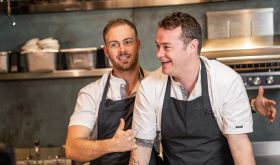
That was certainly the case back at The Harrow where Jones had prepared two very different truffle dishes. The first was an extremely delicate carpaccio of ceps (found in local but different woods the day before) and these truffles, a dish that had such an intensity of flavour that it reminded me of a first course in Jean-George Vongerichten’s highly–rated Perry Street restaurant in New York. Then something far more robust, a faggot (pig’s intestines prepared here without the liver but with diced apple and truffle and wrapped in its caul) served with more truffles, a dish that proved what many chefs believe, that truffles, however expensive, are always at their best when served alongside the least expensive ingredients such as this one, or sliced on to mashed potatoes, scrambled eggs or risotto.
As we ate it was time to ask the two all-important questions that had been nagging me since I first entered this magical wood. How did these truffles come to be and, just as importantly, how did they come to be in such density, something that I was told has surprised the French, Italian and Slovakian contacts they have made in the truffle world over the past three years?
There are, however, no straightforward answers. Although southern England did produce and export truffles, then called ‘trubs’, a couple of centuries ago, nothing like these truffles has been seen in this vicinity by the couple’s neighbour who has lived on this tranquil part of England since the early 20th century. So if they are recent they may be the result of the more caring, gentle management of the land that has been practised for the past generation, coupled with the recent changes in the climate which allowed us to collect the truffles in warm sunshine the day after very heavy rain, the ideal combination for truffle development.
But there may also be one other explanation that no expert could categorically either prove or dismiss. During the 1970s this couple imported Limousin cattle from a region in the south of France well known for its truffles. There were four in the first year and six in the second and during those two years this land was authorised as their quarantine area (subsequently this was moved closer to the cattle’s port of entry). Over these two years these cattle may have carried the spores of the truffles with them which were then spread on to what would subsequently become this woodland via their dung and manure.
According to expert advice this woodland will continue to produce truffles for the next 5-10 years. But as logically they should not be here at all and certainly not in such profusion, I hope this woodland will prove the experts wrong. The ones I bought certainly made my briefcase smell exotically different on the train back to Paddington.
The Harrow at Little Bedwyn, www.theharrowatlittlebedwyn.co.uk
Truffle UK Ltd, www.truffle.co.uk
Alex Aitken, Le Poussin, http://www.lepoussin.co.uk
Mike Robinson, The Pot Kiln, http://www.potkiln.co.uk
John Campbell at The Vineyard at Stockross, www.the-vineyard.co.uk