
For reviews of nearly 70 current English wines, see tasting notes
As May Day is celebrated and England is looking its most delightful, awash with mayblossom, it is also awash with its very own wine. All over the world – most notably in Australia, New Zealand, California and Chile – there is a grape glut, causing a fall in the prices paid by wine producers for grapes. Amazingly, to me anyway, this is also in prospect for English vineyards.
Admittedly the scale of the English winescape is relatively miniature. The Master of Wine who most actively specialises in English wine, Stephen Skelton, reckons that the total area of England and Wales devoted to commercial grape growing is now around 1,350 hectares/3,336 acres (even New Zealand has over 30,000 ha). But this represents such a marked increase, with a substantial proportion of these plantings so recent that the vines either only just came into production with the bountiful 2009 vintage or are not yet bearing fruit, that there are real fears of an over-supply of the grapes of Albion.
Last year, more than three million bottles of English wine were produced. Total plantings increased by 20% with a further 25% planted but not yet producing.
English viticulture, which was once the preserve of untutored amateurs, is now a much more commercial proposition. High-profile awards and trophies won by English sparkling wines in international competitions, and somewhat opportunistic media coverage suggesting that global warming is sending the Champenois en masse scouting for vineyards in southern England, have fuelled serious investment in land that will produce English fizz in champagne’s image.
Some of the more prominent newcomers to the English wine scene from within the wine business include veteran wine writer Steven Spurrier, Christian Seely, who heads AXA’s wine division, supermarket Waitrose and the dominant mail-order merchant Laithwaites.
But English vineyards have also attracted serious investment by hard-headed businessmen without any previous dalliance in the wine business. Richard Balfour-Lynn, whose interests include Liberty's, the Malmaison and Hotel du Vin hotel groups and MWB Business Exchange, has done well on the trophy circuit with his Balfour Brut pink English fizz. It must help that he has all those hotels and upmarket caterers Searcy’s to sell it through, for its recommended retail price is £35.
In 2006 Dutch businessman Eric Hereema bought Nyetimber, the producer that first won serious recognition for English wine back in the early 1990s after Stuart and Sandy Moss from Chicago decided to copy exactly the champagne recipe in the heart of Sussex. Hereema has been aggressively expanding the vineyard area and winemaker Cherie Spriggs is being treated to a new winery in which to continue a more rigorous ageing policy than is practised by many other producers of English sparkling wine – although at a recent tasting I pickily found the Nyetimber Blanc de Blancs 2001 too old and the just-released Classic Cuvée 2005, the only other vintage shown, too young.
Other widely admired producers of English sparkling wine are Ridgeview, another Sussex specialist in what English vineyards do best, and Camel Valley in Cornwall.
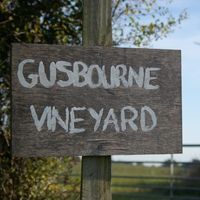
But to judge from the first two (2006) bottlings just tasted, there is a promising new name in English sparkling wine, Gusbourne Estate where, quite coincidentally, our own Richard Hemming worked in the vineyards and sent a series of reports. South African surgeon Andrew Weeber bought this property in Kent in 2003 and started planting vines the year after. I liked the blend based on all three champagne grapes (Chardonnay, Pinot Noir and Pinot Meunier), priced at around £22, even more than the all-Chardonnay Blanc de Blancs bottling at £25. These first wines were apparently made by Mike Roberts of Ridgeview, who is surely also to be congratulated.
The growing importance of sparkling wine in the English landscape is underlined by the transformation of the varietal mix planted. The total area planted with the three champagne grapes has increased more than sixfold in the last five years so that together they now account about 40% of all vines grown. This is in marked contrast to the early days of the English wine renaissance, in the second half of the 20th century, when English vineyards were dominated by early-ripening German crossings and the hybrid Seyval Blanc.
Today, vintages in the British Isles are still extremely variable in both quality and quantity – 2007 and 2008 were both short crops of grapes that proved difficult to ripen – but high acid levels are no disadvantage when making sparkling wine. Indeed, producers in the Champagne region in north-east France are increasingly worried by the plummeting acid levels in grapes grown there.
But, to judge from last week’s English Wine Producers tasting of a representative selection of nearly 70 wines from England’s 116 wineries, it is still inordinately difficult to produce good still wine in England’s green, pleasant but often chilly land. Few producers are brave enough to make really dry whites, clearly hoping that a slug of the sweet stuff will distract from endemically high acid levels, and too often the wines simply taste as dilute as off-season Skegness.
The typically ‘crisp’ (hem, hem), often aromatic style of English wine, incidentally, would seem ideally suited to screwcaps – yet most producers persist with corks, at least for their more expensive bottlings.
Some producers are making still red wines that owe their deep colour to the red-fleshed hybrid grapes grown to produce them. They rarely have really appetising fruit character, however, and there seems to be a tendency to try to disguise this with a bit of gratuitous oakiness. England’s coolish climate seems intuitively better suited to producing rosé, but I failed to find any really outstanding examples at last week’s tasting.
The single most striking wine other than the best fizzes was a delightful, varietally true, if pretty light-bodied Gamay from Biddenden Vineyards, from vines planted as long ago as the mid 1980s. But I suspect it owes its pure, fruity charm to the unusual ripeness achieved in English vineyards in 2009. The last time Biddenden bottled a varietal Gamay was after the long, hot summer of 2003.
English wines are rarely inexpensive. Small-scale production and often small crops are not helpful. Nor is the current glut of champagne and the number of special deals on what many wine drinkers still regard as ‘real’ fizz.
English Wine Week runs from 29 May to 6 June.
SUPERIOR ENGLISH WINES
FIZZ
Camel Valley Pinot Noir Brut 2007 and Pinot Noir Rosé Brut 2008
Chapel Down Sparkling English Rosé NV
Denbies, Cubitt Reserve 2006
Gusbourne Blanc de Blancs 2006 and Brut 2006
Hush Heath, Balfour Brut Rosé 2006
Ridgeview, Grosvenor 2006, Knightsbridge 2006 and Bloomsbury 2007
STILL WINES
Astley, Veritas (Unchaptalised) 2007
Biddenden Gamay 2009
Camel Valley Bacchus 2009
Chapel Down, Flint Dry 2009
For reviews of nearly 70 current English wines, see tasting notes













