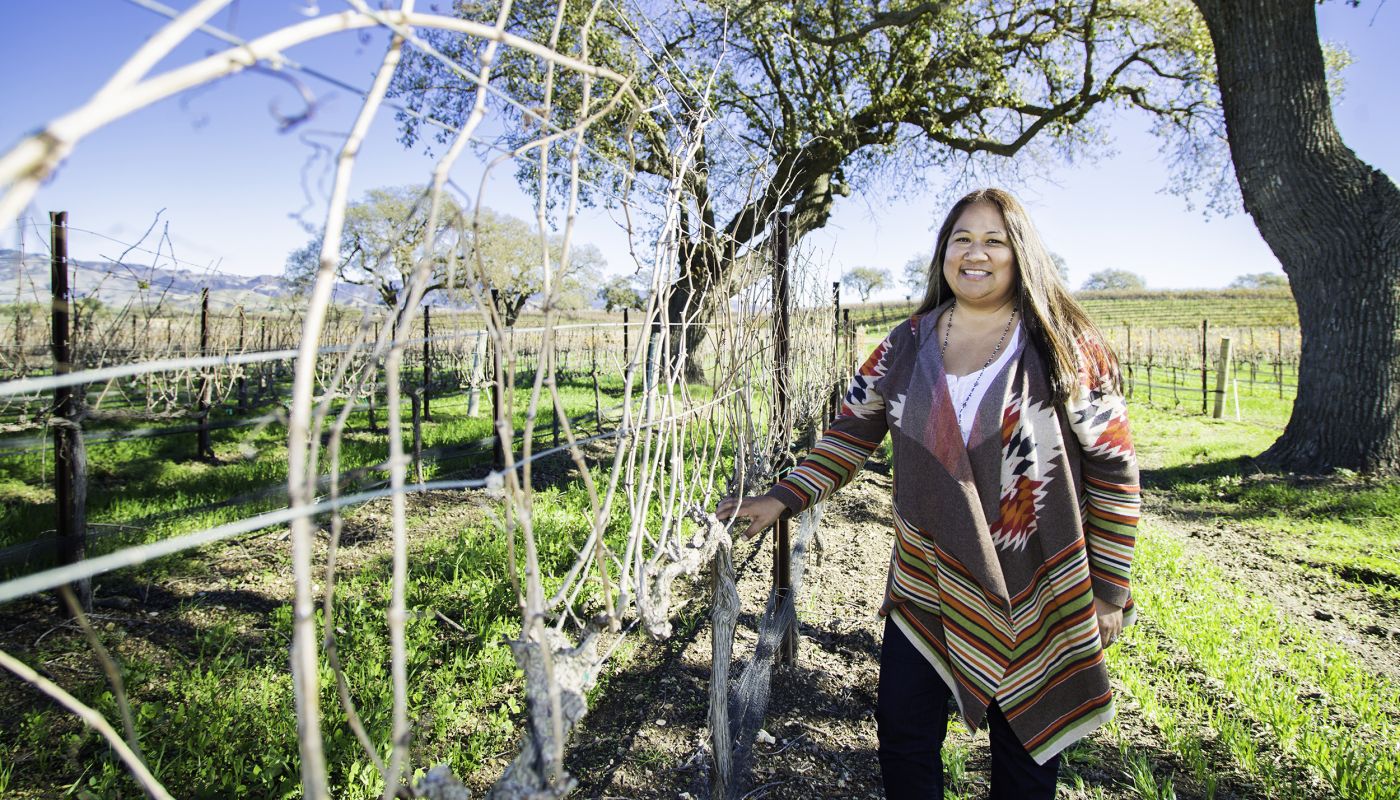
Kitá, the first tribally owned and made winery in the US, is closing its doors after ten years of successful operation. Though Kitá did not yet have international distribution, here in the United States it had become a meaningful brand for Black and Indigenous people and people of colour passionate about wine. The quality meant the wines were appreciated more broadly as well. The enterprise was founded by tribal member Tara Gomez through the Santa Ynez Band of the Chumash tribe. She was pictured above in a photo by Benny Haddad and was recognised by the California state legislature as the first Native American winemaker. Prior to founding Kitá, Gomez previously made wines in Spain, and elsewhere in California.
Kitá was unique in that it was fully tribally owned and operated by the Santa Ynez Band of Chumash, a band being a portion of a larger tribal group. The wines were made entirely from their own tribally owned vineyard, Camp Four near the town of Santa Ynez in Santa Barbara County. Other pre-eminent wineries in the county also make wine from the site. Though Camp Four was originally planted by the late Fess Parker, before his passing he initiated arrangements to sell the surrounding property and vineyard to the tribe to help restore historical Chumash land to the Santa Ynez Band and to provide more space for tribal housing.
Wine writers Dorothy Gaiter and John Brecher broke the news publicly this week on the site Grape Collective, including a statement from tribal chairman Kenneth Kahn, who said the tribe ‘has made the business decision to leave the wine industry at this time’. The tribe has still not made its own formal announcement or given any further explanation.
The timing is painful. Over the last ten years, Gomez has brought ever greater attention and success to the brand. Last year alone, Vine Pair named her winemaker of the year, and included Kitá in their top 50 wines of the year. SOMMtv devoted an entire episode of their flagship series Verticals to Gomez’s winemaking career, including a significant portion on Kitá. (Full disclosure: I served as narrator and co-producer on the episode to help tell the story of Gomez, Santa Barbara County and Kitá, and to serve as cultural advisor for the episode. I am Inupiaq and Unangan-Sugpiaq from Alaska. Though those are different tribal groups from the Chumash, I was previously a specialist in Indigenous studies and have known Gomez for several years.)
Distribution of Kitá wines increased around the United States over the last several years, and they were featured in multiple magazines, including Robb Report this month. For many brands, the first ten years stands as the test of survival. It can take that long to gain not only attention but greater stability. Gomez had guided the brand to what seemed like that marker of success.
Kitá, being tribally owned, grown and made, had cultural significance beyond the quality of its wines. It meant something special to those few of us who are Indigenous and work in wine in North America, or simply enjoy it. Though tribal communities are all distinctive, something generally shared by Indigenous groups is the understanding that it is our community and relation to our land that make us Indigenous. For Kitá to be grown on historically tribal land, managed by that tribe, and made by one of its members, made it a fully Indigenous brand in a way few other wineries are. Its existence also powerfully helped counteract the common racist stereotype in North America that falsely associates Native peoples with increased alcoholism.
In British Columbia, the Osoyoos Band of South Okanagan led the way with their winery Nk’Mip (pronounced inn-kah-meep). Today, tribal member Justin Hall also serves as winemaker. Nk’Mip was founded in 2002 in partnership with what was then the Canadian wine producer Vincor to learn how to navigate the idiosyncrasies of the wine business. (Vincor has since been sold multiple times and is now known as Arterra.) In this way, Nk’Mip relied on outside support for its operations. They employed tribal members in the tasting room and cellar to work with people from outside the tribe who were already experienced in the wine industry. This gave Hall the opportunity to learn alongside the founding winemaker and he eventually become winemaker himself. In Utah, the Cedar Band of Paiute now have their brand, Twisted Cedar Wines. It is fully owned by the Cedar Band with wines made in partnership with an outside winery. What was unique about Kitá in North America was that it was fully tribally founded, led and operated from the beginning.
Gomez continues to make wine in partnership with her wife Mireia Taribó. Together they have the brand Camins 2 Dreams, making wines from purchased fruit grown in the Sta Rita Hills. They focus mainly on Syrah and Grüner Veltliner, though they have added Graciano and are exploring other varieties. Camins 2 Dreams has also received significant media attention. In the last year the wines were featured in both Food & Wine and Bon Appétit magazines and were named in the top 50 wines of the year by Vine Pair.
The Santa Ynez Band continue to own Camp Four Vineyard and sell fruit to other wineries. They have made no indication that this will change.
Since the announcement of Kitá’s closure, quite a few other Black and Indigenous people and people of colour have contacted me. The loss of the winery is a real shock for the community. It’s a reminder of the import wine can have beyond merely being an intriguing beverage. Even with the closure of Kitá, the pathway Gomez has opened through her work in establishing the winery and bringing it national attention has helped change the perception of what is possible, not only for Indigenous peoples but also more broadly in the culture of wine.