Southern California physician Harin Padma-Nathan first tasted the famously rich Château Pétrus thanks to his mother-in-law and, after one of the drugs he was involved in developing became a worldwide success a decade or so ago, he decided to treat himself to 18 bottles of Pétrus 1982. He drank three of them, but last year when he noticed that each bottle was worth more than £4,000, he decided to sell them, along with some of the other smarter bottles in his wine locker – although none was as valuable as the Pétrus.
He was horrified to find that, when Christie's staff came to collect the bottles late last year, they refused to take the Pétrus, citing disparities between the labels on his bottles and those used by the château itself. He was also puzzled. For 20 years he had bought wine from the same Los Angeles store, beginning with relatively modest California wines and moving steadily up the price list, and had always been a thoroughly satisfied customer.
The retailer denies responsibility for the disputed bottles and Dr Padma-Nathan is now locked in legal dispute with him. Such tussles are not uncommon. What distinguishes Dr Padma-Nathan is that he doesn't view himself as a member of the connoisseurs' club and is unusually willing to talk about the possibility that he was sold a pup. 'I do not claim to be an expert in wines and I am not at all embarrassed about the fact I was deceived', he told me. 'But I do think this seedy aspect needs to see the light of day.
'I claim no expertise in wine. For me it's binary – either good or not. But those were the premier bottles in my collection and it's heart breaking. I am astounded by the amount of fraud in this field and the concomitant absence of any public exposure of such cases. Examples of this sort are so rampant but so few people are willing to talk about it because their egos are attached to it.'
He is right about the omertà surrounding the issue of fake bottles. I emailed many wine collectors of my acquaintance asking for their thoughts on the subject and not one replied. They include a prominent New England businessman who, like so many well-heeled Americans, fell in love with wine a decade or so ago and has been badly served by his wine supplier. His extensive wine cellar, stuffed with apparently magical combinations of vintage and producer, proved to contain a substantial proportion of questionable bottles when it was inspected by an expert in authentication, Maureen Downey of Chai Consulting. According to her, 'most of the large collections that I see that have had significant purchases of wines other than direct release [en primeur and/or direct from the producer], in the past 15 years have some fake wines in them.
'Fake wines have permeated the entire market at this point, and it is not just coming from a few dubious auctioneers. Brokers and retailers also buy at auction and from less-than-reputable sources and often do even less diligence than auction houses.
'I am fortunate that people who hire me, like Dr Harin Padma-Nathan, are not so concerned with people knowing that they were duped, that they will simply take the loss of having been sold fraudulent bottles. Most are too embarrassed, or they simply do not want their names out in public as buying these very expensive wines. The people who hire me are people who are not okay having been sold fakes – and who would rather know that what they are drinking is real than just hope or pretend that it is.
'We have seen a steady rise in the prevalence of fakes in the past 15 years, and I think it is due to a number of reasons. The rise of collecting and a culture of fine and rare wine have fuelled demand, and auctions becoming legal in New York and Hong Kong has further fuelled that demand in expanding the market of collectors. The collector community in the US has grown exponentially since auctions became legal in NYC – and clearly the same has occurred in Asia.
'Couple this with the ability to do business rather easily across the global markets, and the improvements in technology that allow for better fakes to be made, and you have a perfect storm of opportunity for fraudsters. Throw in a few vendors who are more than happy to look the other way – or even possibly be in collusion with the fraudsters – and you have an outlet to get those fakes into the market.'
The problem is certainly not confined to the United States. Wherever there is a new market of inexperienced wine enthusiasts with money to burn, there seems to be someone ready to sell them a 1945 Romanée-Conti or a 1959 Château Lafite, exceptional wines of which there are minuscule quantities of genuine examples.
As we have seen in the collection of articles and photographs on Chinese fakery on Purple Pages, the extent of fake wine at all quality levels in China is jaw-dropping (labels on offer in wine shops brazenly include 'Chateau Lafeet' and 'Bordeaux Port'), and even Hong Kong, home to some of the most sophisticated wine collectors in the world, has been seriously infected by some of the grandest fakes. The owner of Le Pin, for example, one of very few rivals to Château Pétrus, recalls being invited to a dinner in Hong Kong supposedly dedicated to his wine at which he and the most knowledgeable collector there were reduced to discreetly exchanging texts under the table about the (lack of) authenticity of each bottle.
In China the threat of loss of face, together in some cases with lack of knowledge, seems enough to silence any complaints about this lamentable state of affairs. Because, until recently anyway, it has been bordeaux that has been most prized by China's new wine buyers, the Bordelais have been taking steps generically to fight fraud, initially hiring a British lawyer with previous experience of bringing Chinese counterfeiters in another field to the attention of the authorities. More than 100 wine bottlers in China have already been brought to book and the campaign against fraudulent wine there is ongoing.
Of course it has to be said that on the scale of human misery, a rich man being sold a counterfeit bottle of a famous wine hardly ranks high. Although the fake rate has now reached such a level in the US that the FBI are investigating several cases, and some FBI staff have even developed a high level of wine knowledge, the strictly white-collar nature of this 'crime' may have acted as a brake on a general clean-up of the fine-wine business.
But one man, a lawyer and wine lover in southern California, has become so angry about the rising incidence of fake wine that he is determined to do something about it. Don Cornwell is the perfect champion of probity in selling wine. He has proved himself capable of paying sustained and meticulous attention to the small details that distinguish a genuine bottle from the rest and earlier this month was hailed a hero by a legion of fine-wine lovers for his forensic dissection of the photographs in one particular auction catalogue that was brought to his attention. See this thread in our forum and Alder Yarrow's article about Don and his work.
Thanks to the internet, he was able to share his concerns with thousands of connoisseurs both here and on winebeserkers.com just four days before the 8 February London sale organised by a new entity on the wine auction scene: an alliance between Spectrum of southern California, whose principal expertise was numismatics, and Vanquish, a relatively new fine-wine supplier in London. On the night at least 20 lots of what looked like some of the finest, rarest burgundies in existence, from the Domaine de la Romanée-Conti and Domaine Comte de Vogüé, were withdrawn from the auction, as well as the notoriously oversold 1961 Château Latour à Pomerol.
Cornwell is particularly fond of and knowledgeable about burgundy (he founded the Oxidized Burgundies Wiki-Site) and the discrepancies he asserted included glass too modern for the vintage, mis-spellings (particularly missing, and occasionally superfluous, accents), capsules and even the trim of the neck label incompatible with the usual practice at the domaine. He was especially alarmed by the high incidence of capsules, the foils over the corks, that looked as though they had already been cut.
So far the UK has probably been less infected by blatantly fake wines than, say, the US and Hong Kong – protected to a certain extent by the country's tight-knit group of wine traders and merchants well-versed in fine wine. According to London-based David Elswood of Christie's, who has considerable experience of both Europe and Asia, 'the whole fakes situation is so different in Asia, where vast quantities of counterfeit wines are being sold on an industrial scale, almost without comment (Laffitte, La Tour, etc). That said, those large-scale fake first growths are not the same types of bottles that we saw in the Spectrum/Vanquish event, which are clearly far more sophisticated in nature and of the type that were widespread mainly in the US market over the last decade. In general, I would say all the big, responsible and legitimate auction houses (and that's a very short list in my view) are much more aware of sophisticated fakes than a decade ago and are doing all they can to prevent such bottles coming to market.'
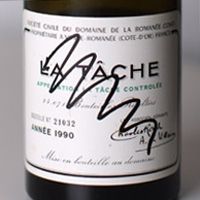
There is such a healthy trade in empty (refillable?) bottles from expensive wine that some producers deliberately spoil the labels on bottles that have been consumed, as shown above.
But Dr Padma-Nathan is in no doubt about how he plans to avoid any possibility of being duped in the future. 'I have decided I am not going to buy any great wine unless directly from the producer.'
WARNING SIGNS
Unless you know for sure that the wines have come direct from the producer, be wary of the following:
An offer of only the very top wines eg first growths, Henri Jayer, Romanée-Conti, Roumier and de Vogüé
Only top vintages such as 1990, 1982, 1961, 1959 and 1945
High fill levels in apparently very old bottles
Young corks with zero cork shrinkage in apparently old vintages
Labels of varying levels of age and cleanliness on the same bottle
Glass obviously younger than the vintage
General inconsistencies