It happens every time. I go to South Africa to write about wine and end up writing about tourism.
Not that South African wine is in any way disappointing. I am convinced that South African whites in particular are some of the world's great wine bargains, and more and more exciting reds are made every year. But the place is just so damned beautiful that only the most blinkered, tiresomely obsessive wine lover could go there and ignore the scenery.
This observation holds for most of the Cape Winelands but is especially true for the village of Franschhoek or 'French corner', the name the Huguenot settlers earned for it at the end of the 17th century. Today the settlement has 15,000 inhabitants and 34 restaurants of which three – La Petite Ferme, The Tasting Room and the deceptively casual Reuben's – are regarded as among South Africa's top ten. It also has pretty guesthouses, bed and breakfasts and, in the form of Le Quartier Francais, a small hotel set in a beautiful garden in which I felt more cosseted than in any other. As well as a vast suite in a small courtyard, I had a private loggia overlooking a pool in which my special minder materialised whenever I decided I wanted breakfast, or anything else.
Small wonder then that Franschhoek is famous for its 'swallows', flocks of temporary incomers who arrive when temperatures plummet in the northern hemisphere. Many of the pretty, flower-bedecked cottages that I saw there earlier this year looked empty, as though waiting for their owners to arrive, but the main street was always lively with a mixture of locals, including quite enough evidence of a thriving local youth culture, long range tourists with European accents and South African day trippers from Cape Town who have only to drive an hour or so east to reach this bucolic scene.
The word spectacular is, for once, earned by the craggy Groot Drakenstein and Franschhoek mountains that tower over the main street, enclosing the village on three sides, leaving it open only for access from the main road from Cape Town to Paarl and Stellenbosch. It's as though a tiny outpost of the Napa Valley were plopped down in an unusually sunny replica of the Scottish Highlands. But it is not, yet, too overrun by tourists nor too twee. There is still an endearingly messy supermarket on the main street and the gift shops are, just, matched by other commercial ventures – though they include the intriguing likes of Huguenot Property Management and La Laundry. French is everywhere on the signs, if not on the lips of many.
English was very much the language of the first Franschhoek Literary Festival, conceived by South African-born writer Christopher Hope and the reason I visited the village for the first time in years last May. It was hugely enjoyable to saunter from church hall to meeting house taking in fierce arguments about the future of southern Africa between the likes of Rian Malan and Max du Preez or listening to willowy novelist Siri Hustvedt talk about her loves. Only a place as small yet well-appointed as Franschhoek could accommodate such a literary influx so easily.
Where there are good restaurants there is wine of course, but wine occupies a rather strange role here in what is always promoted as an important wine centre (and a substantial proportion of the new arrivals I met seemed to be designing their properties around their own handkerchief-sized winery in an outbuilding). Just as in another attractive wine town, Walla Walla in eastern Washington state, in fact the great majority of grapes processed by Franschhoek's wineries have traditionally been bought in from other regions.
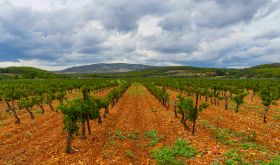
So far there are about 30 wineries in the beautiful Franschhoek Valley, at least half of them with French, or pseudo French, names. (Franschhoek noisily celebrates Bastille Day, which would presumably bemuse any Huguenot.) The most famous wine producer here is Marc Kent's Boekenhoutskloof which both turns its back on French nomenclature and sources the grapes for its most lauded wine, a Syrah unusually reminiscent of the northern Rhône, from a vineyard well to the north in Wellington. Kent is the champion of Franschhoek wine in several senses however and is doing his best to upgrade both image and reality.
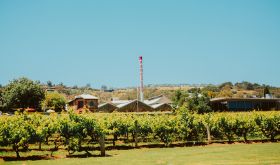
To this end he has remodelled his winery on the wooded southern fringes of the village so that visitors can picnic on its terrace with stunning views while tasting Boekenhoutskloof wines from a studiedly modern wine bar. Semillon seems so far to be a real strength of Franschhoek and the old Semillon vineyard between the Boekenhoutskloof winery and the river is treasured for its susceptibility to noble rot for sweet wine. The Cabernet Sauvignon vineyards around the winery are being upgraded while some upper slopes that have been cleared of alien vegetation as part of Cape wine's big sustainability campaign are being planted with Syrah vines. (In the winery, coincidentally, Kent and winemaker Rudiger Gretschel are experimenting with the same open-ended barrels as Thibault Despagne of the cult Entre-Deux-Mers red Girolate, profiled here a year ago, Thibault being a frequent visitor to Boekenhoutskloof.)
Another boost to Franschhoek-grown wine is the fact that Johann Rupert of luxury goods firm Richemont has been busy rebuilding his sumptuously-financed L'Ormarins wine enterprise on the slopes above Franschhoek and planting vineyards there. South Africans sparing no expense are a phenomenon indeed.
One of the very few reasonably-sized Franschhoek wineries that has long been self-sufficient in terms of grape supply – the likes of GlenWood, Landau du Val and Stony Brook being relatively small – is Chamonix, perched up on the hills to the north of the village. The terroir effect is clearly a good one since Chamonix's cherubic winemaker Gottfried Mocke, in his first-ever job, won Diners Club Winemaker of the Year in 2006 for his Chardonnay. Chamonix's German owner must have been thrilled by this achievement, I suggested to Gottfried. "Ach yes," he acknowledged. "He bought me another grape sorting table."
The whole set-up feels very German indeed and in the little Stübli in one corner of the cellar I was knocked out by the quality of the (oaked) Chamonix Sauvignon Reserve which seems well able to withstand, even warrant, five years in bottle. The Chardonnay and Pinot Noir are decidedly superior too.
While Chamonix has quietly put itself on the map, neuro-psychoanalyst Mark Solms, whose work broke new ground in our understanding of the relationship between dreams and the brain, has fast drawn attention to the Solms Delta winery on his family property on the road in to Franschhoek since he moved back there from London five years ago. Major factors have been the establishment of a trust whose profits are shared equally with the historically disadvantaged workers on the 300 year-old farm and his Museum van de Caab (Cape Museum). In an historic outbuilding near the Cape Dutch manor house he has assembled a fascinating collection of artefacts that chart the history of the land not just from Huguenot times but from the early Stone Age including records of slaves imported from Madagascar, Batavia and India. With ex-Boschendal winemaker Hilko Hegewisch Solms is also experimenting with winemaking techniques suggested by his reading of ancient texts – which makes for some seriously distinctive wines.
Favourites from Franschhoek
Boekenhoutskloof Dry Semillon 2002 and 2004
Chamonix Sauvignon Reserve 2002, 2005 and 2006
Landau du Val Semillon 2004 and 2006
Solms Delta, Hiervandaan red blend 2004
To find out more about Franschhoek as a tourist destination see www.franschhoek.org.za/ and to find out more about wine there see www.franschhoek.org.za/