Before I get to global news, a reminder that in honour of the 25th anniversary of JancisRobinson.com we are offering 25% off annual and gift memberships. So if you need a gift suggestion, or if you’ve been debating becoming a member, now is the time.
Friuli floods
On 17 November torrential rainfall in Friuli-Venezia Giulia triggered flooding and mudslides. The Torre river overflowed its banks, two people died, more than 300 were evacuated and many historic buildings were destroyed. Millions of dollars of damage have been done to winery production facilities, vineyards and cellars. The Borgo del Tiglio winery was hit by a mudslide, destroying a cellar containing more than 10,000 bottles, burying the cellar containing their 2025 vintage and damaging the historic Ronco della Chiesa vineyard. Venica e Venica, Valentino Butussi, Martissima and Casa Riz all suffered damage. The Collio Consortium has set up a donation account to support the affected winemakers. The Butussi winery has launched a campaign to sell their mud-covered bottles to assist with repair costs. I’ve linked to both the Collio Consortium’s donation account and the Butussi winery’s sale on our site.
Local family buys Ste Michelle Wine Estates
On 4 December, Washington’s Wyckoff family (one of the largest grape-growers in Washington state and owners of Coventry Vale Winery) purchased Ste Michelle Wine Estates (Washington’s largest wine producer) from the private equity company Sycamore Partners. The sale includes all Ste Michelle’s Washington brands – including big hitters Chateau Ste Michelle, Columbia Crest, 14 Hands, Spring Valley and Northstar – as well as Washington production facilities, vineyards and inventory. Ste Michelle’s Oregon brands were not part of the deal. The terms of the deal remain undisclosed. This is the first time since 1973 that Washington’s largest producer is both locally and family-owned.
More Burgundian GIs recognized in China
On 5 December, China’s National Intellectual Property Administration approved protection for 70 geographical indications (GIs) in Burgundy. The EU and China established a GI mutual recognition agreement in 2020. Since then, EU GI products falling under the agreement enjoy the same level of intellectual-property protection as a Chinese product. 80 out of Burgundy’s 84 AOCs have now been added to that agreement. This will reduce the risk of counterfeit wines as well as reducing market-entry costs for Burgundian wines.
Another UK duty hike
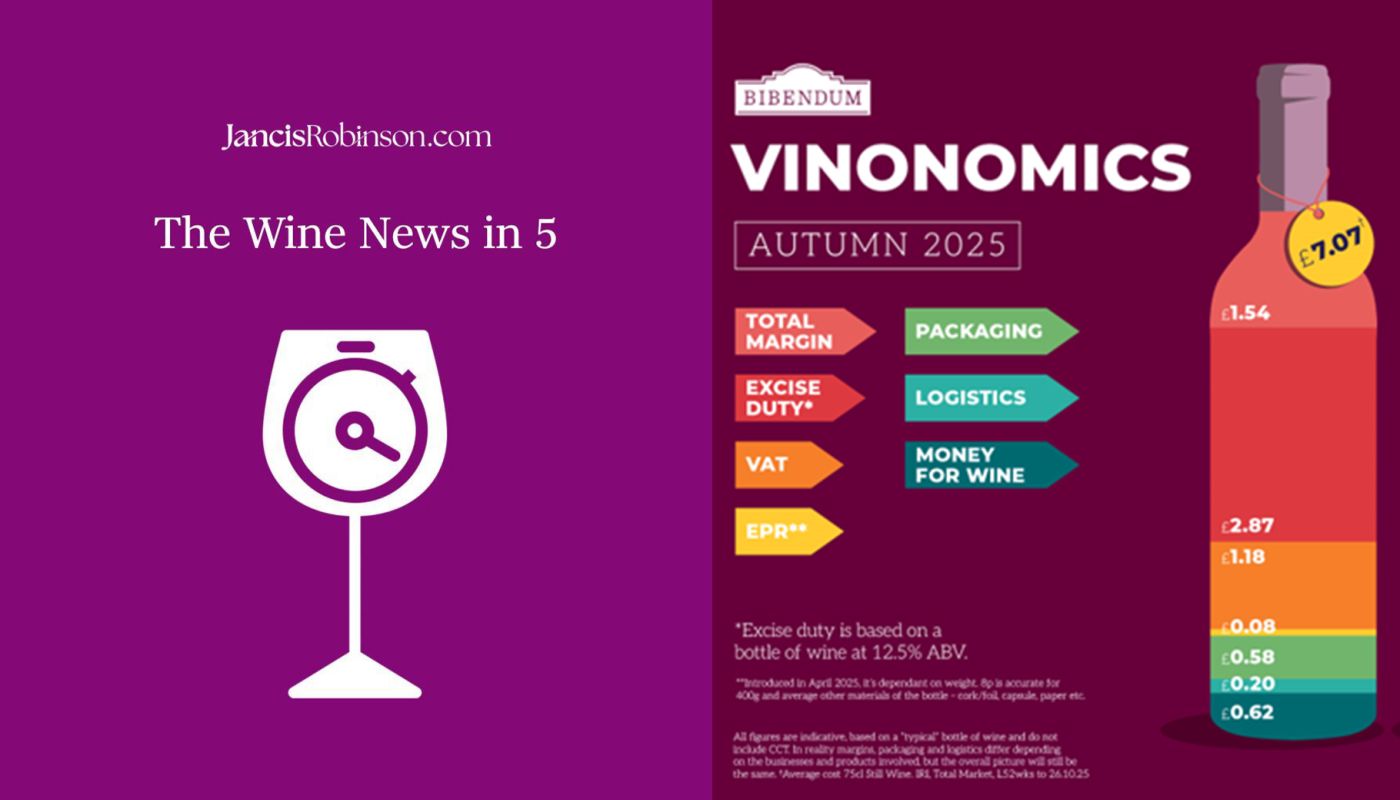
On 26 November, UK Chancellor of the Exchequer, Rachel Reeves, announced an excise tax hike effective 1 February 2026 of 3.66%, in line with inflation. Needless to say, the UK wine trade, which is already hurting from the previous tax hike, in February this year, as well as the introduction of the extended producer responsibility levy on packaging, is not best pleased. A new graphic from Bibendum Wine – a UK-based merchant – shows that on a bottle of wine of 12.5% abv costing £7.07, the excise duty and VAT will make up 57% of the wine’s cost. Jamie Avenell, group buying director for Bibendum, was quoted in a press release saying, ‘Whilst not unexpected, at a time when consumers are already under pressure in their spending, this increase adds further strain on everyone in the supply chain, all the way through to producers – many of whom have nothing left to squeeze. It risks reducing consumer choice and diminishing the experience of the wine category as more wines are pushed out of affordability.’
LVMH in the news
Moët Hennessy – Louis Vuitton has had a lot going on in the last week.
On 28 November they announced, via press release, that their brand French Bloom had acquired 25 ha (62 acres) of vineyard in Limoux, France – making it the only exclusively non-alcoholic wine brand in the world with its own vineyard.
On 8 December Vitisphere reported that 85–90% of Moët Hennessy’s staff went on strike on 5 December. The reason for the strike, according to a CGT Champagne union leaflet, was that ‘for the first time since its creation in 1967, no Moët Hennessy house [this includes Moët & Chandon, Mercier, Veuve Clicquot, Ruinart, Krug and Dom Pérignon] will distribute a profit-sharing bonus … the same will be true for the next three years.’
As far as the wine industry goes, Moët Hennessy isn’t doing terribly. They showed €58.1 billion in revenue during the first three-quarters of 2025 – with wine and champagne up 3%. In October, when third-quarter results were announced, share prices surged 12%, increasing the wealth of LVMH-owner, Bernard Arnault by €16.3 billion in a single day. It stands to reason that disgruntled employees who, based on 58 years of profit-sharing had expected a bonus, decided to strike. Further strikes were planned for yesterday, 11 December.
Fraud investigation in Portugal’s Vinho Verde
On 4 December, Vinetur, a Spain-based publication, published the news of the arrest of eight suspects, including four employees of the Comissão de Viticultura da Região dos Vinhos Verdes (CVRVV), in conjunction with a large-scale investigation into the corruption of the certification process for Vinho Verde wines. Investigations began in August into a scheme involving collusion between CVRVV staff and certain winery owners. Allegedly, the CVRVV deliberately failed to monitor the origin and movement of grapes during the 2025 harvest and potentially compromised the integrity of wines labelled with the Vinho Verde DO.
Reading between the lines, my guess is that the concern is most likely that cheaper wine was being trucked in from an area outside of the DO.
Barossa growers defend their protected lands
Back in July, I reported on plans to build a 150-room IHG luxury hotel on protected land in Barossa. IHG had skirted the Barossa Council – who are in charge of preservation measures – and gone directly to South Australia’s Minister of Planning, Nick Champion.
Well, this development is still in the pipeline. Matthew McCulloch, news listener and managing director of Langmeil winery, emailed me on 30 November to say that IHG had submitted its 1,767-page environmental impact statement on 17 November. The public has been given only until next Thursday, 17 December, to respond. Members of Preserve and Protect Barossa have submitted a 51-page response. I’ll link to the whole thing in the transcript of this newscast but I’m going to read you the last paragraph of the executive summary.
‘In short, Barossans are not saying “no” to growth; they are saying “yes in the right place”. The CPA, CPD, SLP overlay, and relevant Code provisions are seen locally as positive, community-backed tools that maintain the balance between tourism, farming, and landscape. The SBWTAP proposal reads those same tools as obstacles, asks the Minister for Planning to set them aside for one resort on one rural hillside, and, in doing so, risks the very character, safety, and long-term opportunities that make the Barossa special, while setting a precedent that could weaken planning safeguards across South Australia.’
The group is very much hoping you’ll send a formal submission endorsing this document; I know I will be.
That’s all for this episode of the wine news. If you enjoy this newscast and would like to see it continue, please become a member of JancisRobinson.com. And if you have breaking news in your area, please email news@jancisrobinson.com.
This is a transcript of our weekly five-minute news broadcast, which you can watch below. You can also listen to it on The Wine News in 5 Podcast. If you enjoy this content and would like to see more like it, please become a member of our site and subscribe to our weekly newsletter.