
For most wine drinkers Krug champagne is either unthinkably expensive (well over £100 a bottle) or an insider’s treat, a cult wine enjoyed by fellow Krugistes on special occasions.
I associate it with two memorable breakfasts. The first was in the late 1970s when I stopped off en route from a cross-Channel ferry at the late and much-loved cricket commentator John Arlott’s house in Hampshire for a breakfast of kippers and Krug Private Cuvée, as the house’s non-vintage blend was then known, an unconventional food pairing. The second took place at the beginning of this year when I was invited to be the first outsider to taste their exceptional new vintage, Krug 2002, at Krug HQ in Reims. Forty-nine-year-old Olivier, the family member currently the peripatetic ambassador of this boutique champagne house, is a social media fiend. I suspect that it was my number of Twitter followers rather than my palate that influenced his invitation.
I had been to Krug several times before. The first visit had been not long after the kipper episode and I had not been clever enough to spot that large areas of the cellars were shrouded in darkness. This was because the family were about to launch a replacement for Private Cuvée. Grande Cuvée comes in its own extremely elegant but eye-catching bottle shape, and had to be aged in the cellars for many a long year before release; it’s a miracle they managed to keep it under wraps for so long. On a later date, Olivier’s grandfather Paul shared a bottle of Krug 1959 with Nick and me, and subsequent visits had been during the era when the house was run by Paul’s sons, imperturbable Henri, Olivier’s father in charge of winemaking, and flamboyant Uncle Rémi whizzing round the world trying to convert everyone to his personal belief that Krug champagne was at the centre of it.
Last January’s visit was the first for many years, however, and there was a very different look and feel about the reception rooms, even if the cramped yard and Victorian production facilities with their trademark old barrels for fermentation seemed virtually unchanged. We met in a sitting room that had more than a nod to a hip hotel about it, shelves lined with wine books old and new (note Wine Grapes bottom right in the picture below).

Pride of place was occupied by the leather-bound notebook of the founder, Joseph Krug, with his recipe for making particularly distinguished champagne. He had such confidence that he decided to set up his own champagne house, and had his wife deliver his letter of resignation to his old boss, Adolphe Jacquesson of the eponymous champagne house – her brother-in-law.
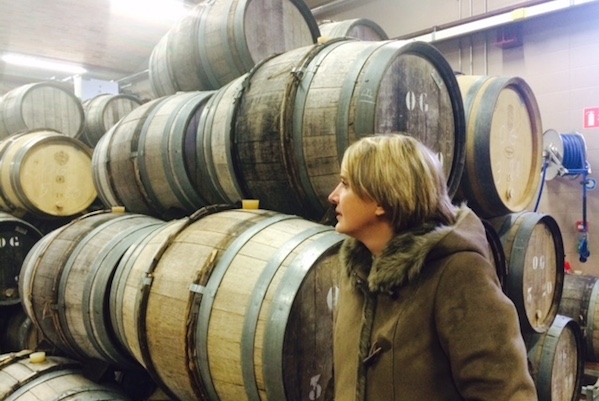
On the coffee table that January day at 10 am was a heap of butter-scented croissants, a bank of Krug’s distinctive tall, broad-waisted tulip-shaped glasses, and a bottle of Grande Cuvée. No one seemed to think it was strange to be breakfasting off one of the most celebrated champagnes on the planet. It felt more like a family breakfast, the family members being Olivier, Maggie Henriquez, who has been president and CEO since 2009, the senior chef de caves Eric Lebel, 53, whose reign in the cellar dates from 1998, and his heiress-designate Julie Cavil, 41 (pictured below surveying barrels fondly). It was the relaxed yet focused relationship between the team that struck me as rather remarkable. I have never seen as many smiles in a workplace before, and this was before the champagne.
What presumably glues them is that they are all just as obsessed by the superiority of Krug as Rémi and Henri ever were, but now, I suspect thanks to Maggie’s relationship with the luxury goods conglomerate LVMH that acquired the house from Remy Cointreau in 1999, they have the means to achieve all they want to do in relative comfort. Maggie is a willowy Venezuelan who demonstrated to the LVMH hierarchy that she could run one of their many wine businesses in Argentina.
She is so obsessed by maximising Krug’s potential that she has managed to persuade the company to invest in even more stocks of reserve wine (they already famously draw on more blending ingredients, up to 200 for Grande Cuvée, than any other champagne house) and to increase the period during which the wine rests before release after its final disgorgement and recorking to almost a year. There was a time not that long ago when Krug, a champagne that demands long ageing, seemed to be being released rather too early, but the Maggie effect now seems to have definitively kicked in. Over dinner the night before, discussing passionately the official harvest dates announced each year by the governing body of champagne, which she thinks are often too late in this era of climate change, she explained, ‘you can get a derogation to pick earlier – all you have to do is tell them, not ask'.

Eric Lebel (above), the blending maestro who retires to his office each year to come up with several unbelievably complex permutations of ingredients for the new blend of Grande Cuvée, was the first to pick up a glass of champagne after polishing off a croissant. ‘What’s the code?’ he asked his team automatically. Since 2011, under Maggie and Olivier’s influence, Krug started to put a code on the back label of all their champagnes so that consumers can tell, via the Krug website or a QR code, exactly what went into that particular blend and when it was disgorged. Olivier got out his beloved smartphone and was able to tell us that this particular Grande Cuvée blend was the one based on the 2007 vintage that had aged for seven years in the cellar with a total of 183 ingredients from 12 vintages dating back to the exceptional 1990.
The key to Krug is the series of tastings each year before the final blend is decided upon. At 11 am each morning between the harvest and the end of March the small tasting committee – Eric, Julie, Eric’s right-hand man Laurent Halbin, two young winemakers Jérôme and Alice, sometimes Rémi and usually Olivier and/or Maggie – sit and taste 15 samples. No more for fear of palate fatigue, but they try to taste each of 400 samples two or three times. ‘We always taste blind and feel free to say anything we like about a wine. There must be absolutely no hierarchy', insisted Eric Lebel, adding with a reference to the conventionally least favoured grape of the Champagne region, ‘We could make a blend with 15-20% Meunier if we thought that was best.’ Krug are renowned for including Meunier in their blend when most houses limit themselves to Pinot Noir and Chardonnay in their top wines. ‘We never even mention the grape variety when we’re tasting', added Julie Cavil, ‘we just try to judge how expressive the wine is and whether it will blend well.’ (Those intrigued by the details of the Krug production process can read all about it in a book to be published in May 2016 by Alan Tardi, Champagne, Uncorked.)
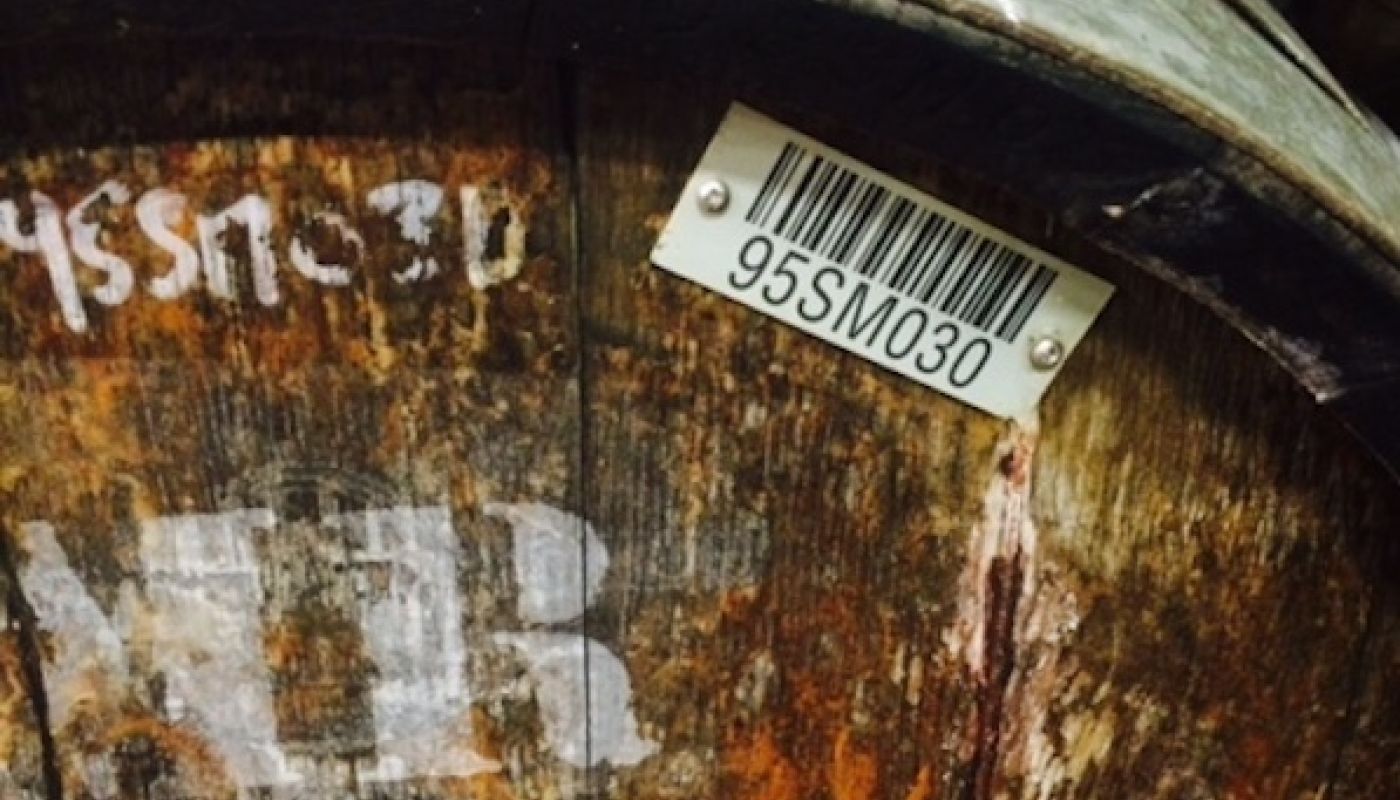
For all Krug’s treasured history and unbroken line of quality-obsessed technique, the house is exceptionally IT-oriented. The tasters record their impressions on iPads before discussing individual wines, and they have recently devised a programme that allows them to cross reference characteristics noted in the wines, as well as providing a digital record over decades of every lot of grapes, how and in which barrels they were individually fermented (a most unusual detail in Champagne), tasting notes over time and what happened to each particular lot each year. As shown in our main picture top right, every one of the ancient barrels has its own bar code. Krug recently announced a plan, a claimed first in the wine business, to respond to individual tweets from Krug drinkers about each bottle of champagne – although I wonder about the accuracy of the second adjective in their promise that they ‘will be replied to in over 800 dedicated and exclusive responses’.
The playful, confident Julie Cavil joined the team in 2006 and Eric Lebel clearly approves. ‘She tastes like me. The young ones judge wines by the aroma and their descriptions, but we’re looking forward all the time, trying to work out how each wine will blend and mature. It’s very important to transmit what I know. Henri Krug gave me a start but it’s not enough.’
Continuity of the very particular Krug ethos is Lebel’s daily preoccupation. ‘We don’t want people to work here short term just to put it on their CV', he said. ‘You need common aims and you need a memory.’ The plan is for Lebel to step back from the blending decisions long before retirement so that Julie will know intimately and personaly the ingredients in each blend created during her reign.
Julie looks as happy in her job as Olivier and Maggie. ‘We’re just so lucky to have all this time. I’m sure if I were to have to decide on the blend at the beginning of December it would be quite different.’
SOME FAVOURITE KRUGS
Many a Grande Cuvée
Rosé
2002
2000
1998
1989
1982
1979
1973
1959
You can find stockist information on wine-searcher.com.













