Restaurateurs in Hong Kong and Shanghai had been quick to tell me the dishes that we must not miss during our stay in Beijing, most notably anything involving duck, the cook-it-yourself Mongolian hot pot and, for a quick lunch, any of the many noodle shops. But quite how different Beijing’s restaurants are from anywhere else I have ever visited only became obvious as we ate our way round this fascinating city.
The most significant physical difference is their sheer size. I have eaten in large Paris brasseries and some of the bigger joints that have opened in London, Moscow and New York over the past decade but these are relatively small by comparison. This is one reason that there can be several charming receptionists standing by the door to greet customers whom they escort to their tables in relays without leaving it unattended. This can also mean a long and sometimes tortuous walk to your table.
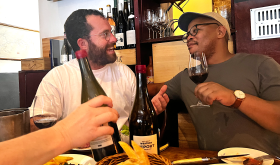
This is also the result, one Beijing restaurateur explained to me, of the contradictory demands put upon the interior design by the roles the Chinese want their restaurants to fulfil. There must be a plethora of private rooms so that the host can entertain behind closed doors and lavish hospitality on his guests (typically business guests) in private. But at the same time, and this is a more recent development, that there must also be the opportunity to be seen to be spending magnificently. That passers-by can notice the numerous expensive and rare bottles of red wine on the table is also good for ‘face’ and the reason that empties are never cleared away until the party has left.
A tour of Tian Di Yi Jia, an exquisitely restored, grandiose restaurant right by the Forbidden Palace, revealed how cleverly this can be done .The main restaurant in the centre, semi-private rooms round the outside and a host of rooms tucked away behind closed doors in the corners and upstairs.
Philippe Starck, France’s well-known whimsically baroque designer, has taken a much more modern approach to the vast, fourth floor interior of the Lan Club. While London restaurateurs would be more than happy to find 5,000 sq ft on one floor this covers 50,000 sq ft – with up to 36 private rooms. Floor to ceiling curtains on circular rails stake out each of the differently designed eating spaces which can, when necessary, be drawn back to leave one space that is certainly several times bigger than Sketch in London, its only rival in terms of whacky design.
An important factor connected to the financial viability of any Beijing restaurant is the huge role that its central government plays in entertaining in general, whether potential commercial partners, visitors from overseas or from the various other regions of China. Location and discretion are obviously key factors in securing this business – one local restaurateur agreed but wasn’t prepared to discuss this matter much further – but even though I am sure a hard bargain is driven this is a volume of business that certainly does not apply in the West.
And while this tradition of hospitality is unlikely to change – I found that all the Beijingers I met were adamant that while I was in their city I was their guest – one old Beijing hand did comment that, “The custom of downing numerous toasts with very strong rice wine during the course of a dinner does seem to be fading I’m delighted to say. You had to take part but unless you were a hardened practitioner it did tend to ruin the rest of the week.”
The evolution of restaurants in Beijing can, I believe, be most readily compared to that of Moscow where there is a similar volume of conspicuous consumption, the desire to attract the very best in terms of associations with overseas designers and chefs as well as displays of expensive wines. But as one British chef currently working in Beijing put it, “It’s a situation where all the hardware is in place but there is still a long way to go on the software, particularly the training of the waiting staff.” As I heard that waiting staff are already in short supply even before the Olympic Games get under way this is a situation likely to get worse before it gets better.
But what distinguishes Beijing from any other capital city, and contributed to one unforgettable meal, is the fact that each of its 34 provinces must maintain a representative office there as well as a restaurant in which to serve their regional food. The Sichuan provincial government takes this more seriously than any other and brings in the best chefs from Chengdu to cook at the Sichuan Governmental Canteen (I was reliably informed that the Sichuan governor eats here whenever he visits Beijing).
This restaurant is not easy to find even for the fluent Mandarin speaker who took us but who had to stop and ask directions from the group of men playing Chinese chess on the corner of the alley in which its back door is to be found. Nor is it that easy to get a table as the prices are extremely low which can lead to a wait of an hour or more in the evening. Its interior fits its name perfectly and comprises a series of tables distinguished only by a plastic stand, somewhat incongruously sponsored by Budweiser beer, designating your table number. We sat at number 44 and were served by waitress no 24.
Fortunately, the plastic menu is more user-friendly as it includes not only the names of the dishes in English but also numerous colour photos of the dishes to point to while the waitress takes down the details on an order pad in triplicate. One copy is left on the table, one goes to the kitchen and the third is for the bookkeeper.
Sichuan food is hot, principally because a great deal of its countryside is low- lying and damp which the heat of the food induced by chillis and pepper is to combat. Here it is very hot thanks to the use of ‘facing the heaven’ chillis, so called because they grow towards the sky which numb the lips and a small, slightly open black pepper which zings around the cheeks of your mouth rather like a firecracker.
We ordered five dishes plus dessert and were somewhat surprised when the latter arrived first but, as the waitress matter of factly explained, “Well, we had made them and the rest of the meal wasn’t ready.” We put these to one side and waited no more than five minutes before a hot version of kung pao chicken arrived (widely known as the ‘foreigners favourite Chinese food’), along with stir fried beans with chilli and dried shrimp, snow pea greens, a bowl of one of their 20 different soups to combat any possible ailment, and an extraordinary dish, that seemed to be on everybody’s table of chicken with peppers and chillis. Or, to be more precise, a dish of chillis with peppers and chicken as it was certainly the overall covering of red chillis that was most obvious with the small, dark nuggets of chicken hidden underneath. This dish is very, very hot even if you follow the advice I was considerately given about Sichuan food which is to eat it very, very slowly.
Our bill for all this for four came to 203 yuan, no more than £15, and for anyone who wants to continue this chilli or pepper habit back home the restaurant has a small shop to one side.
Opinion in Beijing as to the best roast duck seems to divide those we spoke to rather like loyalty to a football club and while the less expensive branches of Da Dong find favour with many we settled on the cleverly named Made in China in the Grand Hyatt.
This modern interior will strike a chord with many who have eaten at Zuma in London as it was designed by the same Japanese company, Super Potato, and features many similar open displays of the kitchen’s ingredients. In the middle, however, are two large brick ovens in which the ducks are cooked for 55/60 minutes over branches of fragrant date wood.
When I was introduced to Nick Du, the restaurant’s Head Chef, I asked him what was his biggest challenge running such a busy restaurant. While his initial response was common to all chefs, that the kitchens are too small, his second was very particular. Taking my arm he escorted me down to the wok section and explained, “When I started as a chef we cooked on coal and we could get the temperature up to 260 degrees C. But this has been outlawed now to minimise pollution and the gas woks are not nearly as powerful.”
The whole ceremony of eating Beijing duck I found here much more elegant than anything I had experienced before with a chef carving the skin into the finest slices (to be dipped in sugar by tradition). The correct sequence is to eat first the skin on its own followed by any combination of the skin and the succulent meat. Happily, too, fingers are allowed.
Our final meal at Tian Di Yi Jia was distinguished by a Mongolian hot-pot, with its combination of the thin slices of lamb and a dipping sauce of sesame and fermented bean curd , and the introduction to several local vegetable dishes. But most memorable of all was the view from the terrace of one of the private rooms upstairs where it is possible to have drinks before or after the meal looking across at the eaves of the Forbidden Palace. Haunting indeed.
The Sichuan Governmental Canteen, 东城区建国门内大街贡院头条5号 No 5 Gongyuan Alley, off of Jianguomen Nei Street Tel: 8610 -6512 2277
The Sichuan Governmental Canteen, 东城区建国门内大街贡院头条5号 No 5 Gongyuan Alley, off of Jianguomen Nei Street Tel: 8610 -6512 2277
RECOMMENDED BEIJING RESTAURANTS BY TYPE
ROAST DUCK RESTAURANTS
Da Dong Roast Duck (#1)
Building 3, Tuanjiehu Beikou,
Dongsanhuan Rd, southeast corner of Changhong Bridge,
Chaoyang District
(8610) 6582-2892, 6582-4003 (low-fat duck available; popular with locals)
Da Dong Roast Duck (#2)
#22 Dongsishitiao,
Dongcheng District
5169-0328,5169-0329
Bianyifang Roast Duck Restaurant
2 Chongwenmenwai St, Hademen Hotel,
Chongwen District
(8610) 6712-0505 (traditional Menlu cooking method; deep fried chili-salt sardines)
Jingcai Roasted Duck
223 Wangfujing Ave, Dongcheng District
(8610) 6523-0483 (wine bar, non-smoking area)
Li Kang
Gonti Nanlu, Chaoyang District
(8610) 6552-3818
Building 5, Songyu Dongli, Chaoyang District
(8610) 8737-2687 (home delivery)
Liqun Roast Duck Restaurant
11 Beixiangfeng Huton, Zhengyi Road, Qianmendong Street
(traditional huton environment)
Liu’s Cuisine
Meishuguandongjie, Dongcheng District
(8610) 6400-5912 (courtyard house restaurant)
Made in China
1 East Changan Ave, Beijing Oriental Plaza,
Grand Hyatt Beijing
(8610) 8518-1234 (salt & pepper duck bones)
FIRE POT RESTAURANTS
Chama Gudao
3/F, Soho New Town Block D, #88 Jiangguo Lu
8610-8580-4286
Manfulou
#38 Di'an Mennei Jie
6403-0992, 6405-3088
BEIJING CUISINE
Chama Gudao
3/F, Soho New Town Block D, #88 Jiangguo Lu
8610-8580-4286
Red Capital Club
#68 Dongsi Jiutiao
Dong Cheng District, Beijing
8401-6152, 8401-8886 (reservation); (courtyard house with wine cellar)
Xiangmanlou
19 Xinyuan Xili Zhong St, Chaoyang District
Grand Hyatt Beijing
(8610) 6460-6711
Tian Di Yi Jia
140 Nan Chi Zi Street,
86-10 85115556.
WESTERN
The Courtyard
95 Donghuamen Avenue
Beijing, 100006, China
6526-8883 (t); 6526-8880 (f)
Salt
Jiang Ti Xi Lu, West of Rosedale Hotel,
Lido Area, Chaoyang District, Beijing
6437-8457, 6437-4893
The Lan Club